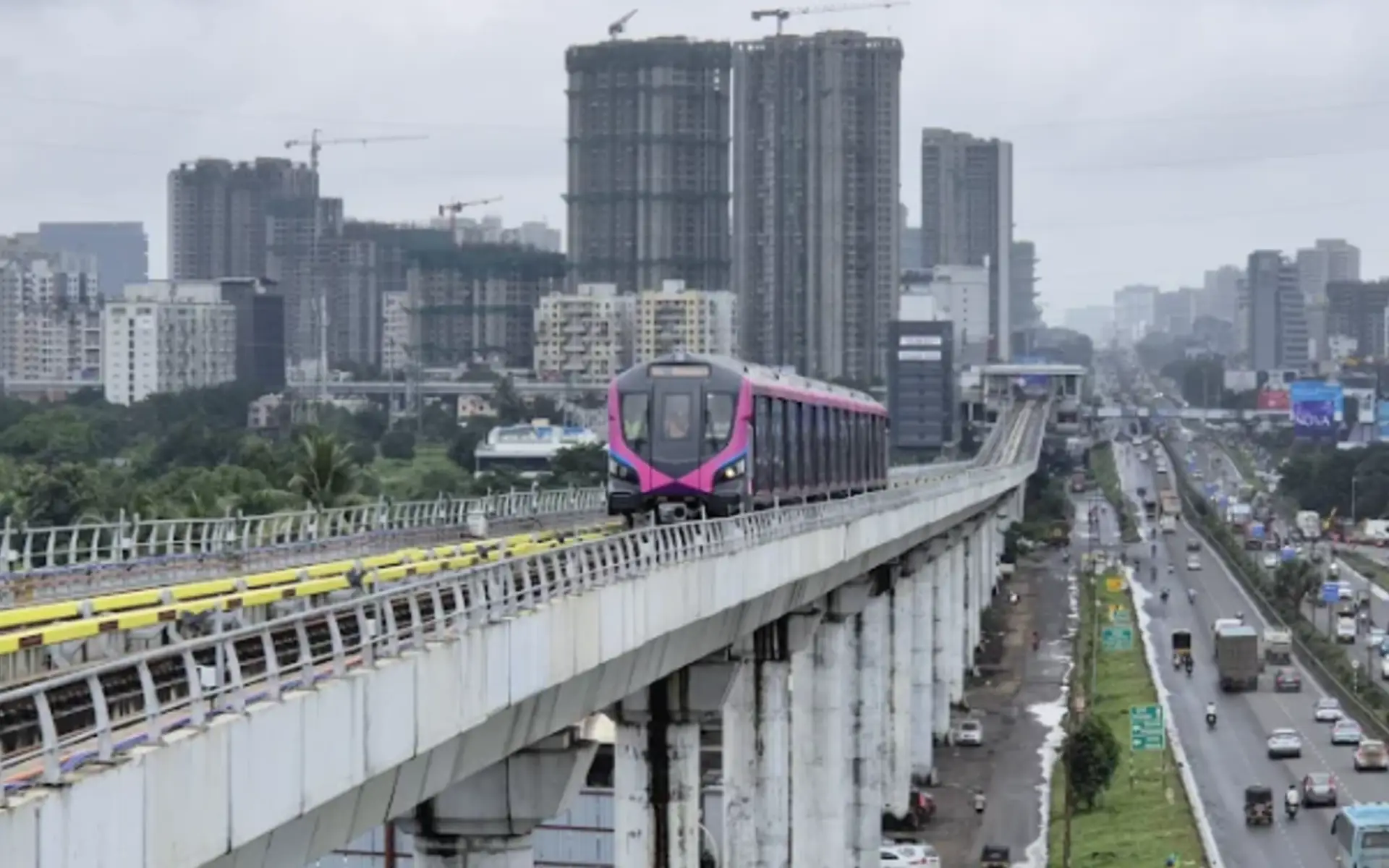
Pune’s long-anticipated Metro Line 3 has crossed a significant operational threshold after completing a critical technical trial, bringing the city closer to launching mass transit services along one of its most congested urban corridors. The development marks a decisive step towards easing daily travel pressures between the Hinjewadi employment zone and the city’s central areas, with full passenger operations now targeted for late March 2026.
The recent trial was conducted on a completed stretch between the depot at Maan and the University Chowk area, where engineers evaluated train performance under operational conditions. Officials associated with the project confirmed that the test focused on safety-critical systems, including traction power, braking response, coach stability and alignment across curves and elevated sections. Data from the run indicated that performance remained within mandated safety parameters, paving the way for subsequent statutory approvals. Metro Line 3 spans over 23 kilometres and is being delivered as a fully elevated corridor through a public–private partnership involving the regional development authority and private infrastructure partners. Urban mobility experts note that this corridor has the potential to reshape commuting patterns in Pune, particularly for the technology workforce that currently relies heavily on private vehicles and overcrowded buses.
The Hinjewadi–Shivajinagar belt has long been identified as a stress point in the city’s transport network. Peak-hour travel times along parallel arterial roads frequently exceed acceptable urban mobility benchmarks, contributing to productivity losses, higher emissions and commuter fatigue. By offering a predictable, high-capacity alternative, the metro line is expected to reduce surface traffic volumes while supporting the city’s broader climate and air-quality objectives. Construction work on viaducts and track systems is largely complete, with current efforts concentrated on station finishing, access integration and passenger amenities. Of the 23 planned stations, several still require completion of concourses, elevators and last-mile interfaces. Project authorities are evaluating phased commissioning strategies that could allow limited services to begin while remaining stations are readied.
Rolling stock availability is no longer a constraint. More than ten train sets have already been delivered, with the full fleet expected to arrive well ahead of the operational deadline. Technical readiness, however, remains contingent on final safety certifications and system integration checks, which are standard for high-capacity urban rail projects. Although the corridor was initially expected to open earlier, revised timelines now point to a March 31, 2026 launch. Urban planners say such recalibration is common in complex metro systems and can ultimately improve reliability if used to address last-mile connectivity and station usability.
Once operational, Metro Line 3 is expected to anchor transit-oriented development along its alignment, influencing office location choices, residential demand and mixed-use growth. For Pune, the project represents more than a transport upgrade—it signals a structural shift towards a more sustainable, people-first urban mobility framework.
Pune Metro Line 3 Moves Closer To Passenger Launch