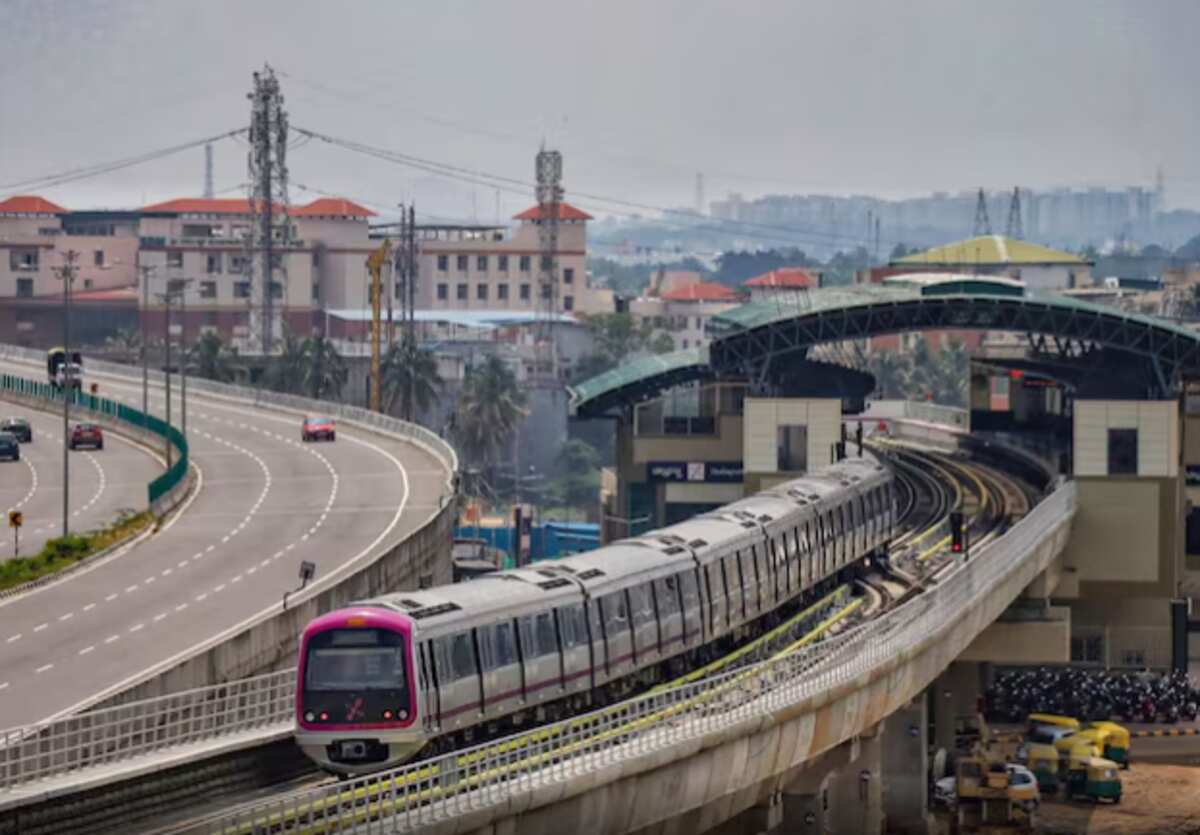
The Maharashtra government has granted revised administrative clearance for two new rapid transit lines in Pune, unlocking a ₹9,857 crore investment that will extend the city’s rail network across some of its most congested growth belts. The decision follows earlier approval from the Union government and paves the way for formal agreements and financial closure, signalling a decisive phase in Pune’s Metro expansion strategy. The sanctioned works cover a combined 31.6 km stretch linking Kharadi to Khadakwasla via Swargate and a second corridor connecting Nal Stop to Warje. Together, the routes are expected to add 28 elevated stations, strengthening east–west mobility while integrating established residential zones with emerging commercial clusters.
Under the funding structure, the Union and state governments will each contribute ₹1,212 crore in equity support. The remaining capital requirement including an estimated ₹4,694 crore loan component will be mobilised through multilateral or institutional borrowings. A formal memorandum between the state, the Centre and Maharashtra Metro Rail Corporation Limited is expected to follow, enabling the project execution agency to begin detailed financial planning and tendering. For a city where arterial roads such as Sinhagad Road, Nagar Road and Solapur Road routinely witness peak-hour gridlock, the additional Metro corridors are positioned as structural mobility interventions rather than incremental upgrades. Urban planners say the Pune Metro expansion could reduce vehicular dependence across dense mixed-use corridors, cut travel time variability, and stabilise land-use patterns along transit spines.
Preliminary engineering activities are underway, including refinement of station footprints, ramp placements and alignment calibrations. According to cost break-ups shared in official documents, civil alignment and formation works account for the largest share, followed by station infrastructure and systems such as traction, power supply and signalling components critical to operational reliability and energy efficiency. Beyond mobility, the project holds economic implications. Real estate consultants note that transit-linked appreciation in Kharadi, Hadapsar and Warje has historically followed infrastructure visibility. However, experts caution that integrated planning including pedestrian access, last-mile connectivity and affordable housing provisions will determine whether benefits are equitably distributed.
The Pune Metro expansion also intersects with climate objectives. By shifting commuters from private vehicles to electric rail-based transport, the corridors can contribute to lower urban emissions, particularly if supported by feeder bus electrification and non-motorised transport networks. Transport economists argue that aligning station precincts with compact, mixed-income development will maximise ridership and financial sustainability. With tendering expected in the coming months, the focus now shifts to timely execution. Commuter groups and civic observers have called for strict adherence to construction timelines and transparent progress monitoring to avoid cost overruns. If delivered within projected schedules, the new corridors could significantly rebalance Pune’s mobility map not only easing traffic pressure but also shaping how the city grows over the next decade.