


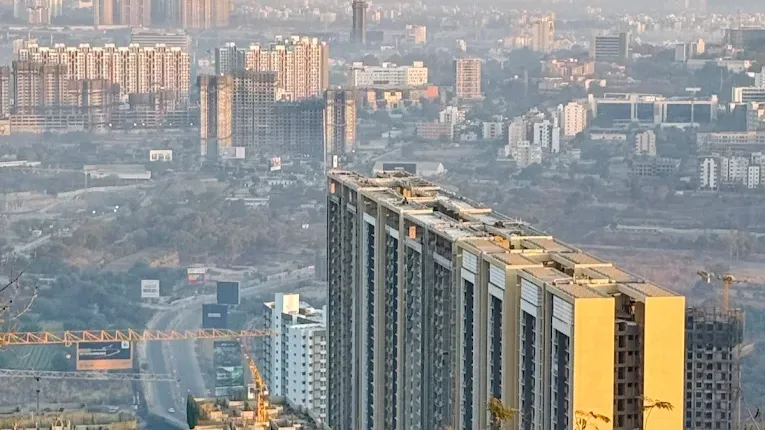
Pune’s western growth corridor continues to attract long-term residential investment, with a leading national developer securing a large land parcel in Mahalunge for a high-density group housing project. The acquisition signals sustained confidence in Pune’s peripheral micro-markets, where infrastructure expansion and employment-driven housing demand are reshaping the city’s urban footprint.
The 8.5-acre parcel, acquired through an outright purchase, is planned to support approximately 2.1 million square feet of residential development. Industry estimates suggest the project could generate around Rs 2,000 crore in revenue over its lifecycle, positioning it among the more significant housing additions planned along the Hinjewadi-Balewadi belt. Urban planners point out that Mahalunge has emerged as a strategic transition zone between Pune’s established western neighbourhoods and the rapidly expanding technology and financial services hubs around Hinjewadi. Improved road connectivity, including the proposed Pune Inner Ring Road, is expected to reduce travel times and redistribute residential demand away from saturated city cores. Such projects, experts say, play a crucial role in managing urban sprawl by directing growth towards planned corridors rather than unregulated fringe development. The site benefits from proximity to employment clusters as well as established educational and social infrastructure, factors that continue to shape homebuyer preferences in Pune. Analysts note that the city’s housing demand remains largely end-user driven, particularly among professionals seeking mid- to premium-segment homes within commuting distance of major workplaces. This has encouraged developers to focus on large-format, master-planned developments capable of supporting community amenities and efficient service delivery.
From a market perspective, the acquisition comes at a time when Pune’s residential sector is experiencing a phase of consolidation. While overall sales volumes moderated slightly in 2025 after several years of strong growth, absorption levels have remained healthy in well-connected micro-markets. Developers with access to capital and a long-term land pipeline are increasingly positioning themselves to benefit from the next upcycle, rather than chasing short-term launches. Urban development specialists also highlight the importance of integrating sustainability considerations into such large projects. As western Pune densifies, issues such as water management, mobility planning and energy efficiency are becoming central to project approvals and buyer decision-making. Large land parcels offer developers greater flexibility to incorporate green spaces, efficient layouts and climate-resilient infrastructure, helping cities adapt to population growth without proportionate environmental stress.
Looking ahead, Mahalunge’s transformation reflects a broader shift in Pune’s growth narrative from isolated residential pockets to interconnected urban districts anchored by infrastructure and employment. If supported by timely execution of transport projects and coordinated civic planning, developments in this corridor could ease pressure on central Pune while creating more balanced, liveable urban expansion.
Also Read: Mumbai real estate momentum sustains across suburbs
Pune Mahalunge corridor draws major housing investment
