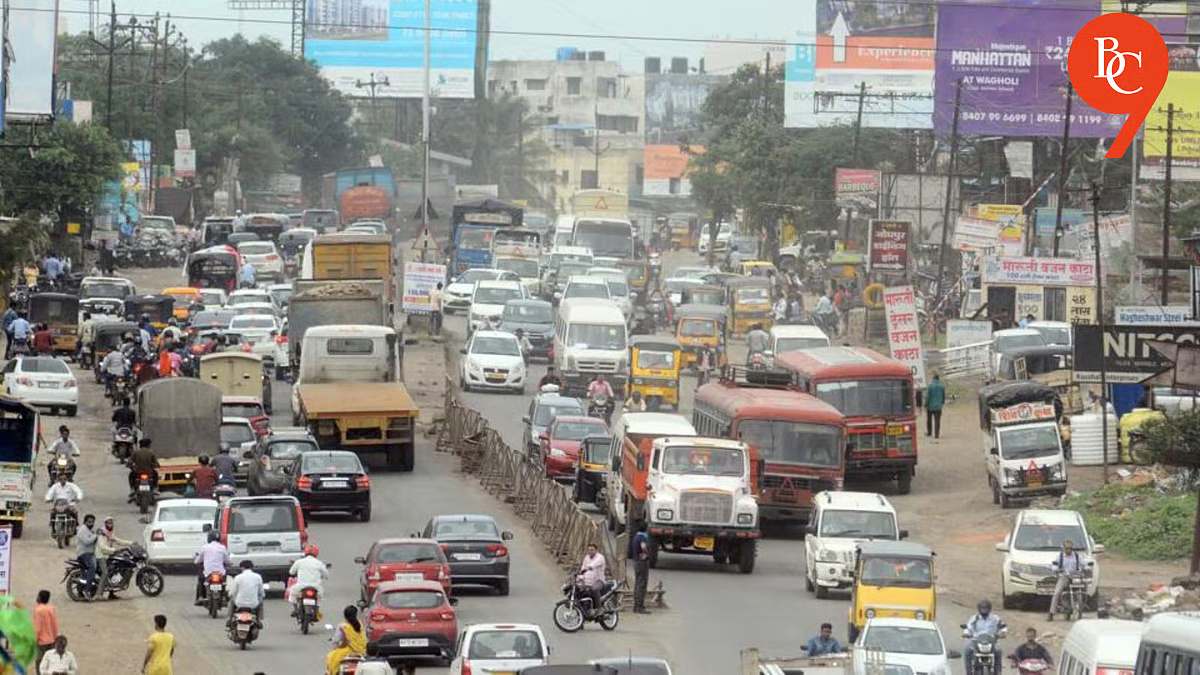
The Pune Metropolitan Region Development Authority (PMRDA) has launched an accelerated programme to ease chronic congestion across Hinjawadi, Wagholi, Shikrapur and neighbouring growth corridors, following a high-level review held at its Akurdi headquarters. The meeting brought together multiple planning, transport and enforcement agencies to address mobility gaps that have increasingly impacted residents, workers and freight movement across the region.
Officials said the priority is to restore key arterial roads to pothole-free condition ahead of December, while synchronising land acquisition for upcoming corridors. A senior official from the industrial development authority confirmed that the long-pending proposal for the Hinjawadi–Pirangut–Ghotawade stretch, including an elevated link between Phase I and Phase III, will now be submitted to district authorities for approval. The corridor is expected to ease travel for lakhs of employees working in the IT hub and reduce vehicle idling emissions, aligning with the region’s broader sustainability goals. PMRDA has also instructed the metro implementing agency to complete resurfacing of the road beneath Metro Line 3, ensuring the carriageway is restored to safe standards before it is formally handed back. Mobility experts note that such reinstatement is crucial for integrating metro construction with surface-level accessibility and for maintaining commuter safety.
In Hinjawadi, permanent traffic signals will be funded by the regional authority to streamline peak-hour flows. Enforcement agencies have been directed to take action against Ready-Mix Concrete units and construction operators generating dust pollution and operating dumpers unsafely. A transport department representative confirmed tighter checks on uncovered trucks, a frequent trigger for roadside dust that undermines air quality in rapidly expanding suburbs. Several structural mobility solutions are also being fast-tracked. New underpasses and service roads along the Pune-Mumbai Ring Road are being prioritised to remove conflict points and support long-term traffic distribution. Land acquisition for the Bhugaon bypass is nearing completion, with tenders in their final stage. Officials suggested that minor alignment changes may be approved to address farmer concerns, reflecting attempts to balance infrastructure expansion with equitable land-use decisions.
To reduce congestion in Wagholi and Shikrapur, parallel routes and bypass links are being coordinated with the municipal corporation. A 30-metre-wide alternative road between Kharadi, Kesnand and Bakori is already mapped, and officials from both agencies are working to resolve layout discrepancies to begin work. A new bypass between Kharadi, Kesnand and Lonikand is also being planned to decongest the eastern corridor. In Hinjawadi, surveys for natural drains have been completed, with a joint technical report expected soon to identify obstructions and protect natural water channels—an important step in building climate-resilient urban infrastructure. PMRDA will also support CCTV installation in the IT hub once cost estimates are received.
Officials say the programme reflects a shift towards coordinated, region-wide mobility planning rather than piecemeal interventions. The emphasis on dust control, drainage mapping, safer roads and multi-modal connectivity, they add, forms part of a long-term push for inclusive and sustainable mobility in one of India’s fastest-growing metropolitan regions.
Pune Launches Coordinated Traffic Improvement Drive For Hinjawadi, Wagholi And Shikrapur Zones