Pune Konkan Connectivity To Get New Expressway Link
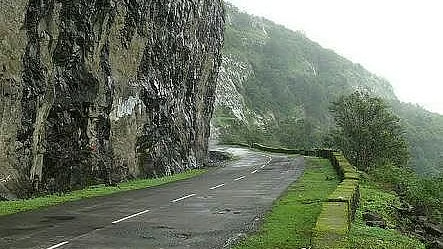
In response to chronic safety and congestion challenges on the scenic yet perilous Tamhini Ghat corridor, the National Highways Authority of India (NHAI) is advancing plans for a safer, more efficient transport link between Pune and the Konkan region. The initiative — which may involve a new alignment or tunnel — aims to enhance cargo movement, reduce travel delays and support more resilient regional infrastructure.
The existing route connecting Pune with coastal hubs such as Dighi Port and the industrial belt near Mangaon, Raigad district traverses steep gradients and narrow curves through the Western Ghats. During the monsoon season, frequent landslides and heavy tourist traffic have compounded safety risks and slowed freight traffic, prompting authorities to seek alternatives.A senior transport official involved in preliminary studies noted that the project’s ambitions go beyond a typical road upgrade — it could reconfigure the logistics backbone linking Maharashtra’s hinterland with its maritime gateways. Given the route’s newly conferred national highway status, boosting its reliability is seen as central to sustained economic flows in western Maharashtra.
Preliminary proposals under review include constructing an entirely new corridor from Panshet–Mangaon to Dighi Port, effectively bypassing the existing ghat section, as well as upgrading the Tamhini ghat road by easing dangerous curves and building a tunnel between Dongarwadi and Tamhini to shorten distances and fortify safety.Urban planners and transport economists say that addressing ghat-section limitations can have wide-ranging ripple effects for trade, commuting and tourism. A resilient Pune–Konkan corridor — less vulnerable to seasonal disruptions — could attract investment in manufacturing and logistics parks while fostering smoother access for both passenger vehicles and goods carriers. Enhanced connectivity also aligns with Maharashtra’s goal of decongesting urban nodes and promoting climate-adaptive regional mobility.
However, stakeholders caution that constructing new alignments through environmentally sensitive regions demands rigorous planning and community consultation. The Western Ghats are ecologically rich and legally protected under various environmental regulations. Project designers must carefully balance infrastructure needs with biodiversity preservation, landslip mitigation, and watershed integrity. Integrating green engineering standards and multi-modal transit options can help ensure that expanded road networks do not come at the cost of natural systems.Commercial transport associations have welcomed the exploration of alternatives but underscored the need for complementary improvements on feeder routes to prevent bottlenecks from shifting elsewhere. Truck operators, in particular, have highlighted the economic importance of consistent access to ports and warehousing hubs without the unpredictability that has long characterised the Tamhini stretch.
As NHAI moves from conceptual planning toward feasibility assessments and environmental clearances, the corridor’s transformation will likely unfold in phases. Early public consultations, detailed topographical surveys and environmental impact evaluations are next in line. For Maharashtra’s residents and businesses alike, the promise is a safer, more reliable link between the plateau and the coast — one that can support growth while cushioning communities and ecosystems from undue stress.