


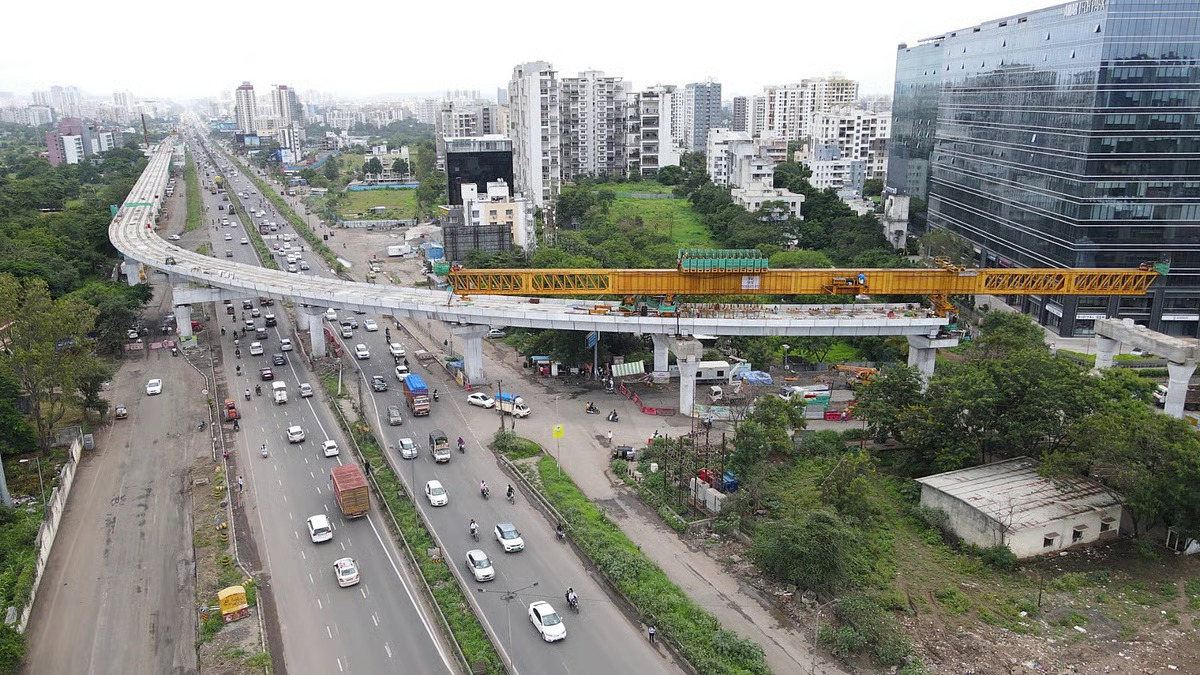
Pune’s 23.3-kilometre Hinjawadi–Shivajinagar Metro line has entered its final development stage, with the Maharashtra government officially transferring the project’s expansion responsibilities from the Pune Metropolitan Region Development Authority (PMRDA) to the Maharashtra Metro Rail Corporation (Maha Metro).
Officials confirmed that over 90 per cent of construction is complete, setting the project on track for operational readiness by March 2026. The handover marks a strategic shift aimed at consolidating metro infrastructure management under a single state-level body for greater efficiency and technical coordination. A senior PMRDA official noted that the line — developed under a Public-Private Partnership (PPP) model with Tata-Siemens as the private partner — will feature 23 stations and is designed to handle up to 1,000 passengers per train. The metro aims to provide seamless connectivity between Hinjawadi’s IT hub and the central business district of Shivajinagar, two of Pune’s most vital economic zones.
The corridor’s trial run between Maan Depot and PMR-4 station was successfully completed earlier this year, demonstrating readiness of the rolling stock, signalling systems, and elevated infrastructure. Once operational, the line is expected to cut travel time significantly and decongest major arterial routes such as Baner Road and University Road. Industry experts believe this expansion will play a critical role in reshaping Pune’s mobility landscape. “The Hinjawadi–Shivajinagar Metro line aligns with the city’s shift towards integrated, low-carbon transport systems, easing dependence on private vehicles,” said a senior urban transport planner.
The ₹9,000-crore project will operate as a single-phase corridor connecting residential, commercial, and educational clusters including Megapolis Circle, Infosys Phase II, Wipro Phase II, Balewadi Stadium, Baner Village, and Savitribai Phule Pune University. The entire stretch will link into the existing metro framework, creating a networked urban transport grid. Maha Metro’s takeover also signals a policy shift — with the government aiming to centralise metro project management outside the Mumbai Metropolitan Region, which remains under the purview of MMRDA. For Pune, this represents a transition towards an integrated, professionalised approach to sustainable public transport.
Once commissioned, the metro is expected to reduce vehicular emissions, improve air quality, and support the city’s broader sustainability goals under the state’s Urban Mobility Vision 2030.
Also Read : BMC Introduces Smart Laser And IoT Sensors To Combat Mumbai Waterlogging Crisis
