Pune Elevated Highway Plan Targets Industrial Mobility
A large highway development programme valued at nearly ₹45,000 crore is set to reshape regional mobility around Pune, with authorities outlining multiple elevated corridors and highway upgrades aimed at easing congestion and strengthening links to major industrial zones. The centrepiece of the initiative is a long elevated corridor on the Pune–Shirur route, designed to cut commuting time for one of the region’s busiest transport corridors while supporting freight movement to manufacturing hubs.
The programme forms part of a broader Pune elevated highway plan being pursued by national and state infrastructure agencies to improve connectivity between the city’s eastern industrial belt, surrounding satellite towns and national highway networks. Officials involved in the project review said several corridors are expected to be developed simultaneously to address growing traffic pressure on the city’s radial highways. The most prominent component of the Pune elevated highway plan is a 53-kilometre transport corridor connecting Kharadi to Ranjangaon, a key manufacturing district located along the Pune–Ahmednagar highway. Within this corridor, a 31-kilometre flyover section is expected to become one of the longest continuous elevated structures on an Indian highway.
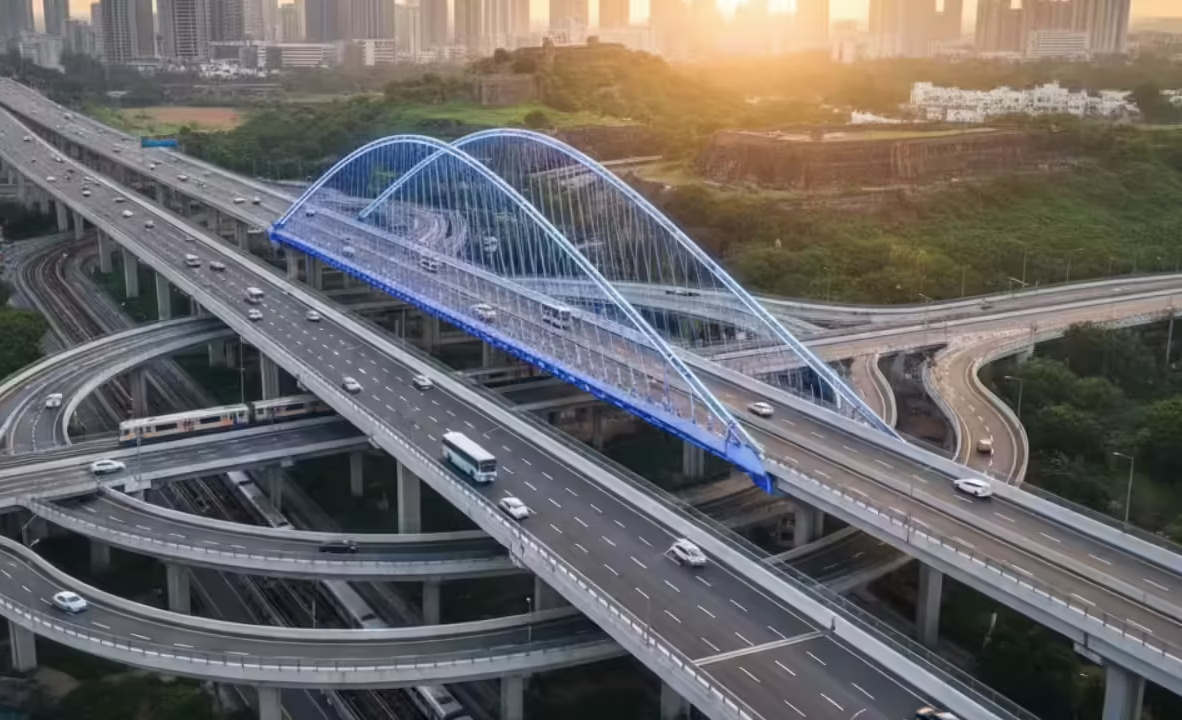
Transport planners say the elevated link is designed to significantly reduce travel delays caused by mixed traffic conditions on the current route, where heavy vehicles, industrial freight and daily commuters compete for limited road capacity. By separating through-traffic from local movement, the corridor could reduce peak-hour travel time across the stretch by nearly half. The project also introduces a multi-layered transport design in certain segments, where surface roads, elevated vehicle corridors and future mass transit infrastructure may operate simultaneously within the same right-of-way. Urban mobility experts say such stacked transport systems are increasingly being considered in rapidly growing metropolitan regions where land availability is limited.
Alongside the Pune–Shirur project, authorities have proposed additional corridors targeting major logistics routes. One proposal includes an elevated road linking Talegaon to Chakan, a manufacturing zone that hosts automobile and engineering industries. Another section involves widening the Chakan–Shikrapur corridor to accommodate growing freight traffic moving between industrial clusters and national highways. A separate elevated highway has also been planned on the Pune–Solapur route between Hadapsar and Yavat. The corridor is expected to ease congestion on one of the main gateways connecting Pune with southern Maharashtra and parts of Karnataka.
Infrastructure specialists note that these corridors could play a strategic role in strengthening supply chains serving the region’s industrial ecosystem. The Pune metropolitan area has emerged as a major manufacturing and technology hub, and efficient transport links are critical for both freight movement and workforce mobility. However, urban planners emphasise that highway expansion must be complemented by investments in public transport and sustainable mobility systems. Without integrated planning, large road projects risk encouraging higher private vehicle use and long-term congestion. If implemented as proposed, the Pune elevated highway plan could significantly reshape the city’s transport landscape. The challenge for policymakers will be ensuring that new road capacity works alongside rail, metro and bus networks to build a balanced, climate-resilient urban mobility system for the region’s growing population.
Pune Elevated Highway Plan Targets Industrial Mobility