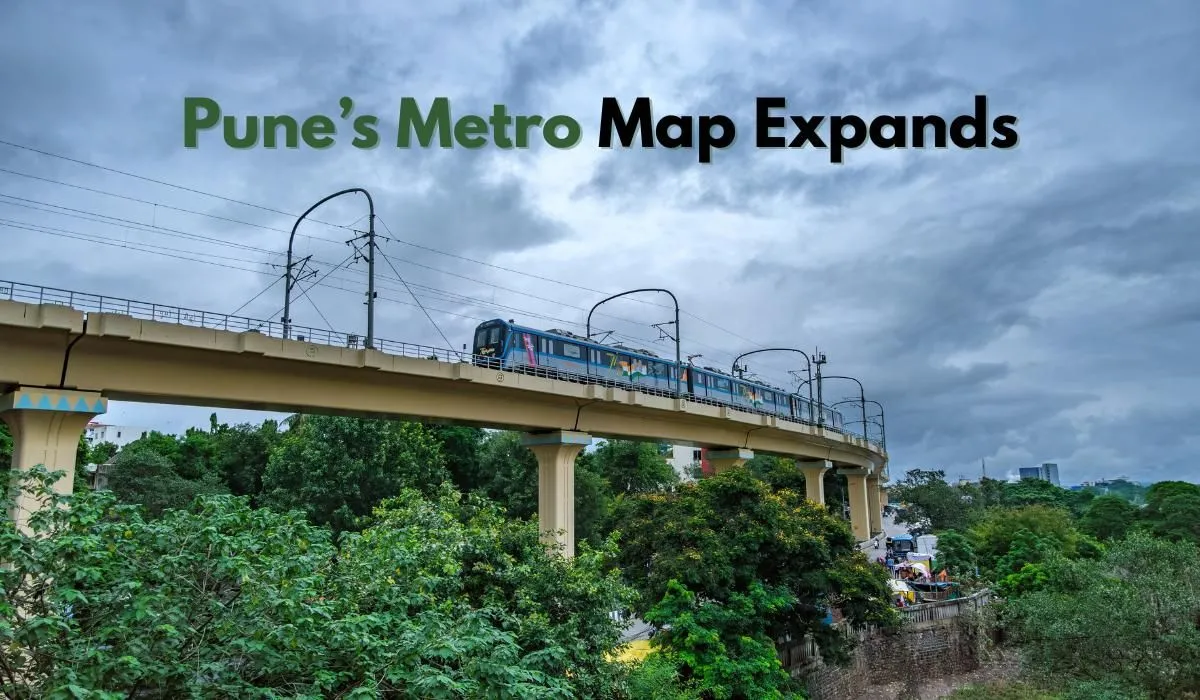
Pune’s push towards a low-carbon, future-ready urban transport system has gained momentum as the Maharashtra government approved a tripartite Memorandum of Understanding (MoU) for the Pune Metro Phase 2 extensions. The expansion aims to link Vanaz to Chandani Chowk and Ramwadi to Wagholi, enhancing the city’s mobility network with a focus on sustainability and equitable urban growth.
The project, estimated at ₹3,626.24 crore, will be jointly funded by the Union and State governments. According to senior officials, any additional costs beyond the approved Detailed Project Report (DPR) will require the State Finance Department’s sanction. If such costs arise, they will be covered through MahaMetro’s Dedicated Urban Transport Fund, ensuring that fiscal responsibility aligns with the project’s environmental and operational objectives.
Phase 2, approved by the Centre earlier this year, will add 12.75 kilometres to Pune’s existing metro grid and feature 13 elevated stations. The corridors—Vanaz to Chandani Chowk (Corridor 2A) and Ramwadi to Wagholi (Vitthalwadi) (Corridor 2B)—are designed to decongest major arterial roads, improve last-mile connectivity, and promote public transport adoption over private vehicle dependency.
The MoU defines financial and operational responsibilities among key stakeholders and empowers MahaMetro to raise funds through Transit-Oriented Development (TOD) mechanisms, additional Floor Space Index (FSI), and the strategic use of government-owned land parcels. Experts note that these revenue instruments reflect a growing trend among Indian metro systems to ensure long-term financial viability while minimising public expenditure.Officials overseeing the project stated that the signing of the MoU marks a decisive step towards implementation. Once the central government grants final approval, tenders will be floated for consultancy and construction, paving the way for the next stage of expansion.
Phase 1 of the Pune Metro fully operational since September 2024 spans 33.28 km with 31 stations and has already begun reshaping the city’s commuting habits. Parallel construction is ongoing on two other corridors connecting PCMC to Nigdi and Swargate to Katraj, further extending the network by nine kilometres.
Urban development experts suggest that the Phase 2 expansion is more than a transport initiative it is a vital step toward building a zero-carbon mobility ecosystem for Pune. By integrating clean-energy transit systems with responsible land use, the project reinforces Pune’s position as one of India’s leading cities transitioning towards sustainable, gender-neutral, and inclusive urban mobility.As the city awaits central clearance, optimism remains high that this extension will not only ease daily commutes but also catalyse economic activity, reduce vehicular emissions, and set a benchmark for eco-conscious infrastructure development in India.
Pune clears Rs 3,626 crore MoU for Metro Phase 2 expansion