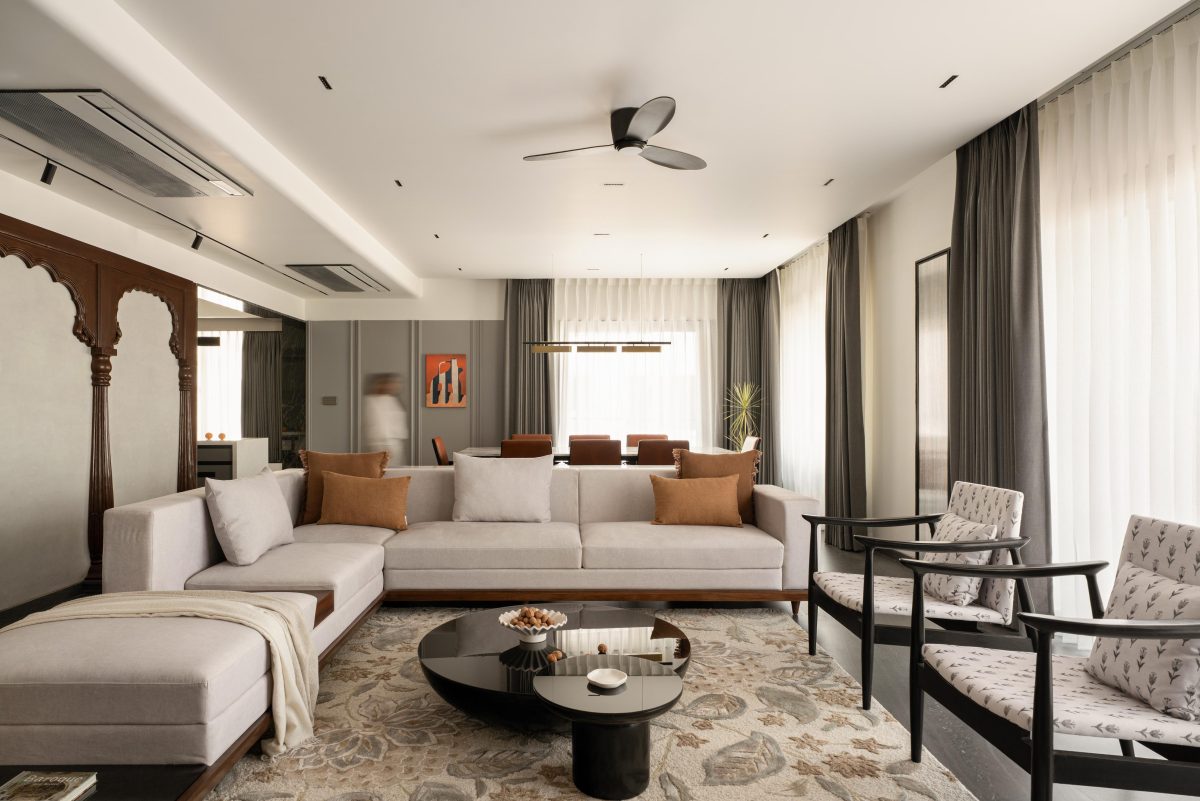
A newly completed 3,500 sq ft residence in Pune is drawing attention for reinterpreting the Maratha wada within a contemporary apartment setting signalling how heritage-informed design is re-entering India’s urban housing conversation. Located in one of the city’s established residential neighbourhoods, the project demonstrates how cultural memory can coexist with modern planning, technology and spatial efficiency.
At a time when Indian cities are expanding vertically and apartments increasingly replace courtyard homes, architects are exploring how traditional passive design strategies can inform modern housing. This Pune residence takes cues from the historic Maratha wada known for its layered spaces, natural ventilation and inward-looking openness but translates them into a minimal, contemporary framework suited to present-day family life. The apartment’s internal layout was comprehensively redesigned to improve light penetration, cross ventilation and spatial continuity. Non-structural partitions were removed to create stronger visual connections between shared areas such as the living and dining zones, while private rooms were repositioned to maintain acoustic and functional separation. Urban planners note that such spatial restructuring in high-density housing improves perceived spaciousness without increasing built-up area, a crucial factor in sustainable urban growth.
Material choices further anchor the project in regional identity. Teak wood, lime-finished surfaces and locally familiar basalt stone have been deployed in a restrained manner, offering durability and thermal comfort while reducing reliance on synthetic finishes. Industry experts point out that lime plasters and natural stone contribute to lower embodied carbon compared to many chemical-based interior treatments, aligning with broader conversations around climate-responsive housing. Architectural arches integrated into the living space subtly reference traditional wada geometry, but without ornamental excess. The aesthetic remains deliberately pared back. Designers describe this approach as “Minimal Indian Modern” , a language that relies on proportion, natural light and material integrity rather than decorative layering. The restrained palette of earthy neutrals enhances daylight reflection, lowering dependence on artificial lighting during daytime hours.
Technology has also been embedded discreetly to improve safety and long-term usability. Modern electrical planning, smart integrations and adaptable furniture layouts ensure the home can evolve with changing household needs, an increasingly important factor as Indian families seek longevity from high-value real estate investments.Beyond aesthetics, the project reflects a wider shift in Pune’s residential market. As buyers grow more conscious of environmental performance and cultural continuity, developers and designers are reassessing the relevance of indigenous building wisdom. Housing analysts suggest that such reinterpretations may influence mid-to-premium urban projects across Maharashtra, where rapid urbanisation often sidelines local architectural identity. In a city balancing IT-led growth with historic character, the re-emergence of Maratha wada principles within modern housing suggests that future-ready homes may increasingly look backward for climate intelligence even as they build forward for urban resilience.