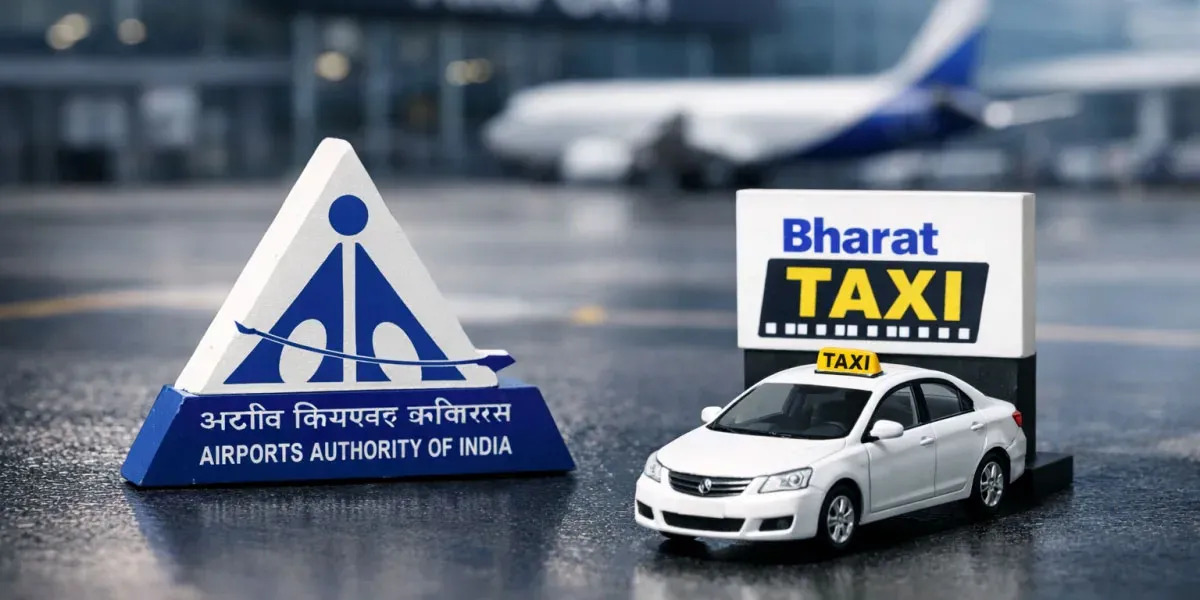
The Airports Authority of India (AAI) has partnered with a cooperative driver-led platform to introduce a fixed-fare airport taxi service across multiple regional cities, starting with Pune, Surat, and other key locations. The initiative addresses long-standing passenger complaints over unpredictable fare hikes during peak hours, adverse weather, or late-night travel, promising a more predictable and equitable mobility experience.
Urban transport analysts note that airport taxi services have historically been dominated by app-based aggregators using dynamic pricing, which often results in sudden cost spikes for travellers. By adopting a fixed, distance-based fare system, AAI and the cooperative model aim to stabilise commuter costs while simultaneously enhancing driver welfare, marking a rare convergence of public infrastructure oversight and cooperative enterprise in India’s gig economy. Under a recently signed memorandum, the programme will roll out in phases at 11 AAI-operated airports, including regional hubs in Chhatrapati Sambhajinagar (Aurangabad), Rajkot, Patna, Varanasi, Vadodara, Bhuj, Kanpur, Prayagraj, and Agra. The cooperative platform, which allows drivers to retain a larger share of earnings while having ownership stakes, seeks to address the sector’s structural inequities by providing fair remuneration and reducing operational dependence on corporate intermediaries.
Economic and urban mobility experts highlight several potential impacts of the initiative. For passengers, the clarity of fixed fares reduces the stress and uncertainty of airport transfers, particularly for business travellers and tourists unfamiliar with local pricing norms. From a city planning perspective, stabilising transport costs can support more predictable demand management, easing congestion during peak travel hours and enabling airports to better coordinate feeder services. Sustainability considerations also intersect with this rollout. Industry observers suggest that cooperative taxi schemes, by prioritising fair compensation and ownership for drivers, may encourage retention and professionalism, reducing vehicle churn and promoting more efficient route planning. In turn, this contributes indirectly to lower urban emissions per passenger trip, aligning with broader national goals of zero-carbon and climate-resilient urban transport.
Urban policy experts note that the model reflects a growing trend of integrating cooperative frameworks into public transport services, supporting equitable economic growth while fostering inclusive, people-first mobility solutions. While app-based ride-hailing remains dominant in metropolitan areas, fixed-fare cooperative taxis at airports offer an alternative that balances affordability, driver welfare, and operational transparency. The phased implementation across regional airports will provide a testing ground for expanding such models nationwide, offering policymakers and urban planners actionable insights on combining technology, governance, and cooperative enterprise to strengthen the resilience and fairness of India’s transport infrastructure.