


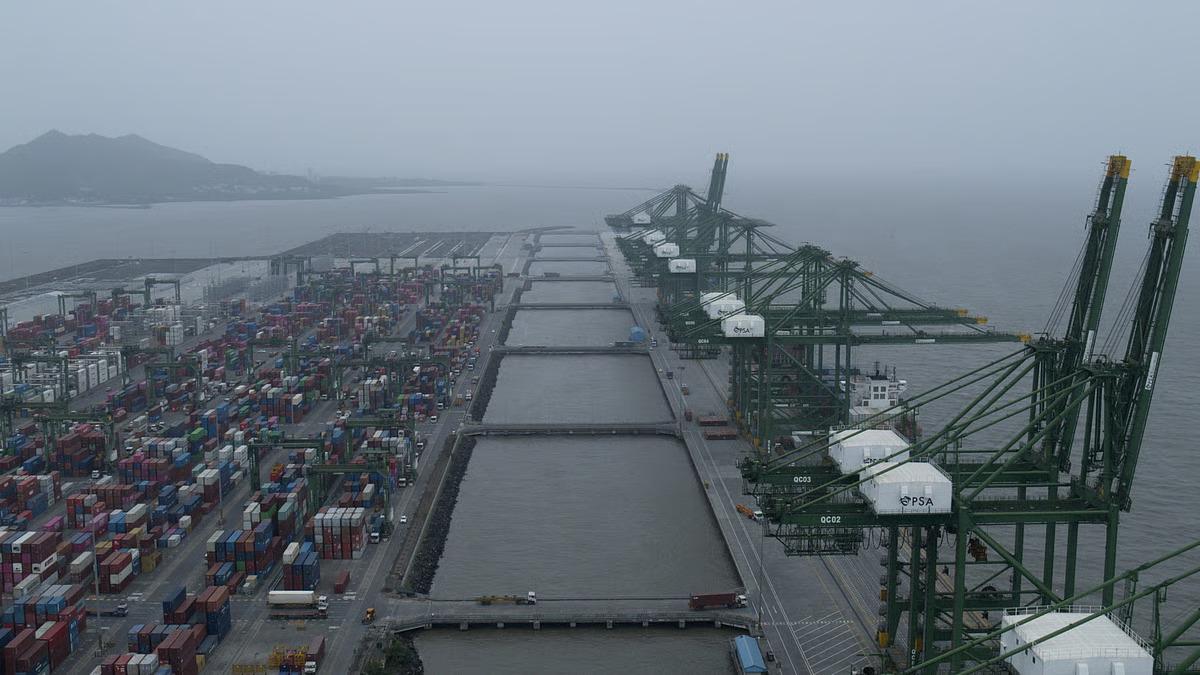
Mumbai has taken a decisive step towards reshaping its maritime future with the inauguration of Phase II of the PSA Mumbai Terminal at Jawaharlal Nehru Port. The new terminal represents India’s first fully renewable energy-powered container facility, embedding sustainability into a sector often seen as carbon-intensive, while simultaneously expanding the country’s trade capacity on a global scale.
Spread across 200 hectares, the terminal has been developed under the public–private partnership model with an investment of USD 1.3 billion, making it the largest foreign direct investment project in India’s port sector. Officials stated that the facility can handle 4.8 million TEUs annually and is equipped with a two-kilometre quay line designed to berth some of the world’s largest container ships carrying up to 18,000 TEUs. Beyond sheer size and capacity, the terminal sets new benchmarks for multimodal connectivity. It is the first container terminal in India fully aligned with the Dedicated Freight Corridor (DFC), featuring six compatible rail tracks and eight rail-mounted gantry cranes. According to port authorities, this infrastructure links the port directly to more than 60 inland container depots across the country, reducing transit times and enhancing resilience during logistical disruptions. With the Western DFC extension underway, connectivity is expected to improve even further.
Officials present at the launch emphasised that the expansion is a significant boost for Maharashtra, positioning the state as the country’s leading hub for container handling. They also underlined that the upcoming Vadhavan Port, being planned as a deep-draft greenfield project, will further consolidate Maharashtra’s role as a maritime powerhouse for the decades to come. In their address, leaders highlighted how the project underscores the strength of international partnerships in India’s infrastructure story. They noted that India’s relationship with Singapore, a key partner in this investment, has expanded from trade and investment to areas such as green shipping, renewable energy, skilling, and urban water management. The PSA Mumbai Terminal was described as a symbol of this wider cooperation, setting the stage for a future where sustainability and commerce are inseparable.
Maritime experts also noted that the adoption of 100 per cent renewable energy at such a large-scale facility is a watershed moment for India’s port sector. In addition to reducing emissions, it strengthens the country’s position in global supply chains that increasingly demand lower-carbon logistics. Agreements on green and digital shipping corridors are expected to complement this development by making port operations more efficient, transparent, and environmentally responsible. With Phase II now operational, Jawaharlal Nehru Port is positioned as one of Asia’s most advanced maritime hubs. The terminal not only enhances cargo-handling capacity but also signifies India’s commitment to green growth, digitalisation, and inclusive trade networks across the Indo-Pacific.
Also Read : BMC Reduces Budget, Reissues Tender For Mithi River Rejuvenation Works
