


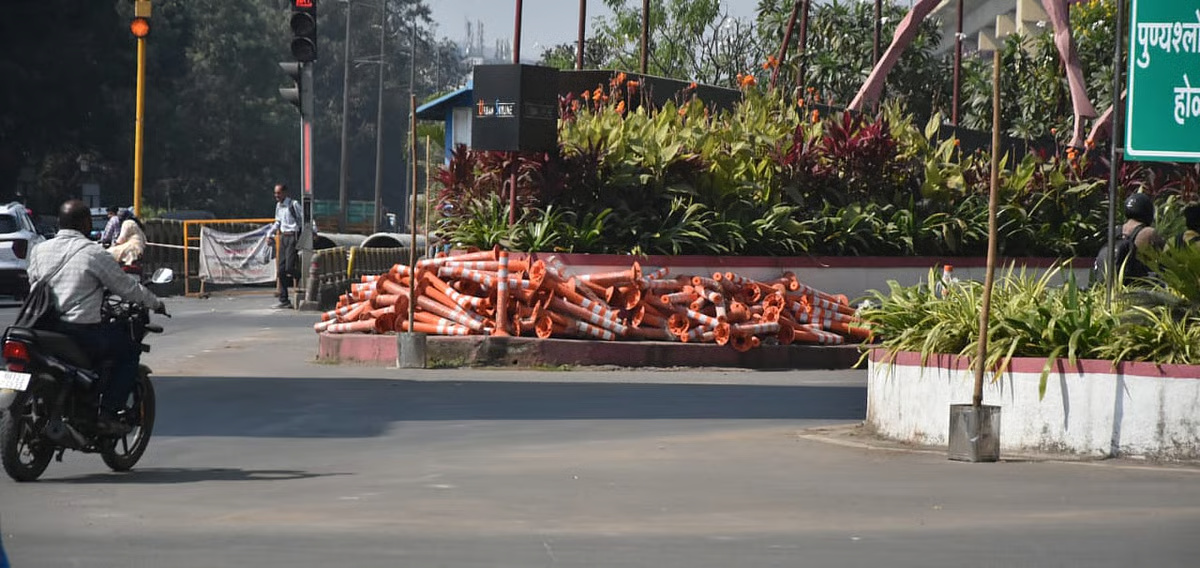
The Pimpri-Chinchwad Municipal Corporation (PCMC) has rescinded its recent decision to narrow the service road at Morwadi Square, also known as Ahilyadevi Holkar or Finolex Square, following mounting congestion and public complaints. The modification, part of a “junction improvement” pilot, involved installing cement blocks and plastic poles to prioritise pedestrian safety but inadvertently worsened vehicle traffic in this key urban corridor.
Morwadi Square lies at the heart of Pimpri-Chinchwad, along the service road of the Old Mumbai–Pune Highway. It connects residential and commercial hubs such as Pimpri Camp, Ajmera Colony, Chikhali, and Nehru Nagar. The square experiences continuous high-volume traffic, with vehicles including buses, two-wheelers, and private cars navigating a service road already limited to two functional lanes. Recent efforts to implement urban street design improvements—including wider footpaths and narrowed lanes—combined with the temporary barriers, led to long queues, particularly during peak hours, exacerbating congestion at adjacent intersections. Local residents reported daily frustration as traffic slowed significantly, with vehicles required to halt multiple times at signals along the square. “The congestion increased rather than decreased. While the intention was to ensure pedestrian safety, the practical outcome was gridlock,” said a long-term resident. City officials confirmed that the removal of the poles and cement blocks has provided immediate relief, although traffic volumes remain high due to ongoing BRT and Metro construction in the area, as well as water pipeline projects.
The decision to withdraw the trial measures followed intervention by the Pimpri Traffic Division, which raised concerns about congestion and commuter safety. “The measures were counterproductive. Our assessment indicated they contributed to bottlenecks, so the administration removed them,” said a senior police official. PCMC’s Joint City Engineer added that the initiative was intended as a temporary pilot to prioritise pedestrian movement away from fast-moving traffic. Future implementation of similar measures will now depend on completion of infrastructural projects, police approval, and better coordination with public transport operators. Urban planners highlight that Morwadi Square exemplifies the challenges of integrating pedestrian safety with vehicular efficiency in rapidly growing cities. Pilots such as these are often necessary to test design interventions, but they must account for existing congestion, public transport flows, and local commuter behaviour. Experts suggest that longer-term solutions may include dedicated bus lanes, regulated auto-rickshaw stands, and staged footpath expansions once construction activities are complete.
While the immediate road modifications have been reversed, PCMC officials emphasised that the trial provided valuable data to refine future urban traffic management strategies. Authorities plan to resume pedestrian-focused improvements once the Metro and pipeline projects are completed, aiming for safer, more equitable, and efficient streets across Pimpri-Chinchwad.
Also Read : Pune Municipal Corporation Starts Bavdhan Chandni Chowk Road Repair To Ensure Safer Commute
