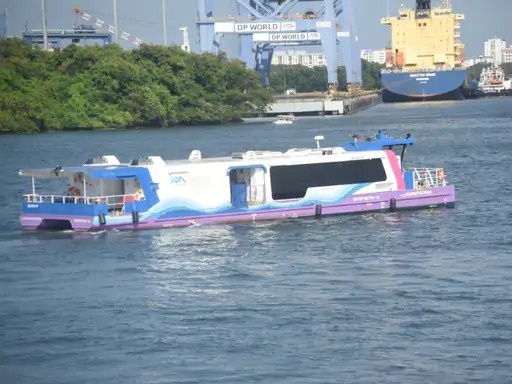
Work has formally begun on the Patna Water Metro project, marking a significant step in the city’s attempt to diversify urban transport beyond road-based systems.
The river-based mobility initiative will use the Ganga as a commuter corridor, aiming to reduce road congestion while introducing an environmentally cleaner mode of travel for one of eastern India’s fastest-growing cities. Initial construction activity is focused on infrastructure required to operate electric ferries, including charging facilities along the riverbank and preparation of terminals at key ghats. The system is designed to support energy-efficient vessels that can carry passengers across different points of the city using the river as a transit route rather than relying solely on crowded road networks.
Transport planners say the Patna Water Metro project reflects a broader shift toward multimodal mobility strategies in Indian cities. By integrating river transport with existing and emerging public transport systems, authorities hope to ease pressure on heavily used road corridors. Patna’s linear growth along the Ganga has historically limited east–west connectivity, creating traffic bottlenecks during peak commuting hours. Water-based transit offers an alternative route that bypasses many of these constraints. The first phase of the system is expected to operate on an approximately 10.5-kilometre stretch connecting several riverfront locations, creating a new passenger corridor across major ghats. Over time, planners envision expanding the network through multiple routes and terminals to improve connectivity between residential districts, commercial centres and transport hubs.
The project is being developed through collaboration between state authorities and national inland waterway agencies and represents an investment of roughly ₹908 crore. The long-term goal is to establish a modern urban water transport system using electric ferries that can reduce emissions, shorten travel times and improve commuting reliability. Urban transport specialists say river-based systems can play a valuable role in cities with navigable waterways. In Patna’s case, the Ganga is part of National Waterway-1, a major inland shipping corridor stretching from Varanasi to Haldia. Infrastructure investments made under national river navigation programmes have improved channel depth and terminal capacity, enabling cities along the river to explore passenger mobility solutions.
For residents, the Patna Water Metro project could eventually provide a practical commuting alternative between neighbourhoods located on opposite sides of the river or along the riverbank corridor. If integrated effectively with metro rail, buses and other local transport services, the water metro may also strengthen first- and last-mile connectivity. However, successful implementation will depend on reliable river navigation, seasonal water-level management and seamless integration with land-based transport infrastructure. Urban planners note that while the river offers untapped mobility potential, operational planning and passenger accessibility will determine whether the system evolves into a daily commuter network rather than a limited transport experiment.
With construction now underway, the coming phases of terminal development, vessel deployment and route planning will determine how quickly the river begins to function as a new urban transit spine for Patna.