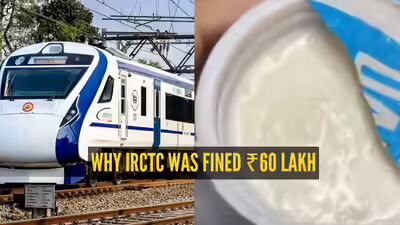
A passenger food-quality complaint on the Patna–Tatanagar Vande Bharat Express has triggered a rare financial penalty on the Indian Railway Catering and Tourism Corporation (IRCTC), raising wider questions about service quality as India’s premium train network expands. The incident, which led to a ₹10-lakh fine on IRCTC along with a larger penalty on the catering contractor, is being seen as a significant signal that service standards will be scrutinised more closely on high-profile trains.
The complaint originated after a passenger reportedly found contamination in a food item served during the journey. Following the incident, railway authorities initiated an inquiry and concluded that quality-control procedures had failed at multiple levels, from food preparation to final delivery onboard. The Railway Board subsequently imposed a penalty on IRCTC while also taking stricter action against the vendor responsible for supplying the meal. The episode has drawn attention because the train involved is part of the country’s flagship semi-high-speed network, which is being positioned as the backbone of modern inter-city travel. Over the past two years, premium trains such as Vande Bharat services have become a key component of the government’s mobility strategy, especially for tier-2 and tier-3 cities. However, transport experts argue that passenger experience depends as much on service quality as on travel speed or modern coaches. Official data shows that onboard catering is one of the most complex operational segments within Indian Railways. Annual reports indicate that IRCTC manages food services across hundreds of trains through a network of private vendors, base kitchens and packaged-food suppliers.
While quality audits and inspections are regularly conducted, even a single lapse on a premium service can attract widespread public attention because these trains are marketed as a high-standard travel option. Industry observers say the financial penalty may signal a shift toward stronger accountability as passenger expectations evolve. Complaints related to food quality have historically been handled at the vendor level, but the latest action suggests that the responsibility is now being placed higher up the operational chain. This could lead to tighter monitoring of food-handling processes, storage conditions and vendor selection, particularly on premium routes connecting major regional cities. The timing of the action is also significant. The network of semi-high-speed trains is expanding rapidly, and several new routes linking smaller urban centres are either operational or under planning. For these cities, premium trains are not only a transport upgrade but also a symbol of economic integration with larger urban markets. Repeated service lapses could therefore affect public confidence in the broader modernisation programme.
The immediate priority for railway authorities will be restoring passenger trust while ensuring stricter quality-control measures on upcoming routes. As high-speed and premium rail services continue to expand across the country, maintaining consistent service standards may become as important as building new infrastructure itself.