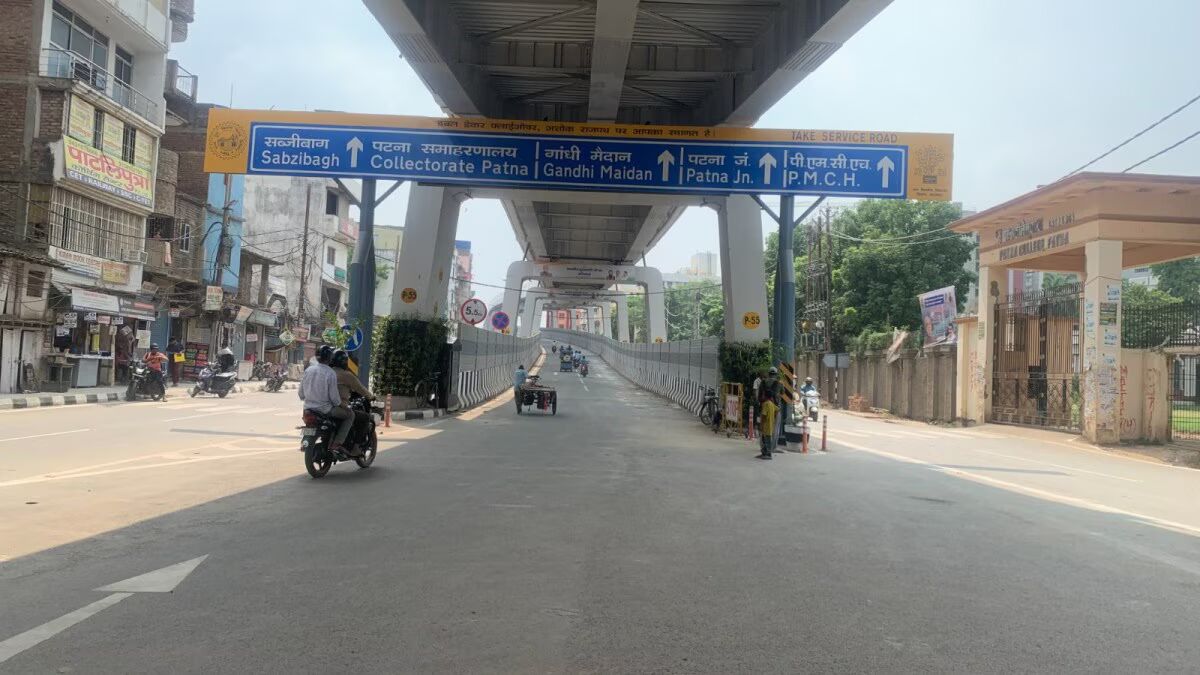
Patna is set to introduce a critical mobility upgrade around its largest public healthcare hub, with a direct flyover link to the multi-level parking facility at Patna Medical College and Hospital (PMCH) expected to become operational within weeks. The intervention is designed to ease chronic congestion in the Ashok Rajpath corridor while improving access to essential healthcare services.
The project involves constructing a dedicated ramp connecting the city’s double-decker flyover to the hospital’s upcoming parking complex, bridging a short but critical gap of under 100 metres. This direct access is expected to allow vehicles to bypass surface-level traffic bottlenecks, particularly during peak hours when patient inflow, emergency vehicles, and local traffic converge in the same stretch. Officials indicate that the PMCH flyover access system includes three ramps—two linking the upper deck of the flyover and one connecting the lower deck—integrated with the hospital’s internal circulation network. This layered connectivity reflects a shift in urban transport planning, where vertical mobility infrastructure is increasingly used to manage high-density zones without expanding road footprints.
The need for such interventions is particularly acute in Patna’s institutional corridors, where legacy road networks struggle to support rising demand. Ashok Rajpath, one of the city’s busiest arterial roads, serves educational institutions, markets, and healthcare facilities, making it highly susceptible to congestion spillovers. The introduction of the PMCH flyover access ramp aims to redistribute vehicular movement across multiple levels, reducing pressure on ground-level traffic. From an urban systems perspective, the project aligns with broader efforts to integrate healthcare infrastructure with city mobility networks. PMCH itself is undergoing a major redevelopment into one of the largest hospital complexes in the region, with significantly expanded capacity and modern facilities. Efficient access to such facilities is increasingly seen as a core component of healthcare delivery, particularly in cities where travel time can directly affect patient outcomes.
Urban planners highlight that infrastructure around hospitals often lags behind institutional expansion, leading to accessibility gaps. In this context, the ramp project represents a more synchronised approach—linking transport infrastructure upgrades with healthcare capacity expansion. It also reflects a growing recognition that public health outcomes are closely tied to urban design, mobility planning, and last-mile connectivity. The project is being executed by a state infrastructure agency, with construction involving structural integration between the flyover and the parking facility through supporting pillars and elevated connectors. Additional access points are also being planned to distribute traffic more evenly across the hospital campus, potentially reducing internal congestion.
However, experts caution that the long-term effectiveness of the PMCH flyover access system will depend on traffic management protocols, enforcement, and integration with public transport systems. Without complementary measures such as pedestrian pathways, emergency vehicle prioritisation, and demand management, infrastructure upgrades alone may offer only temporary relief. As Patna continues to expand its urban footprint, projects like this highlight the importance of designing infrastructure that is not only larger, but smarter—prioritising accessibility, efficiency, and resilience in essential service corridors.