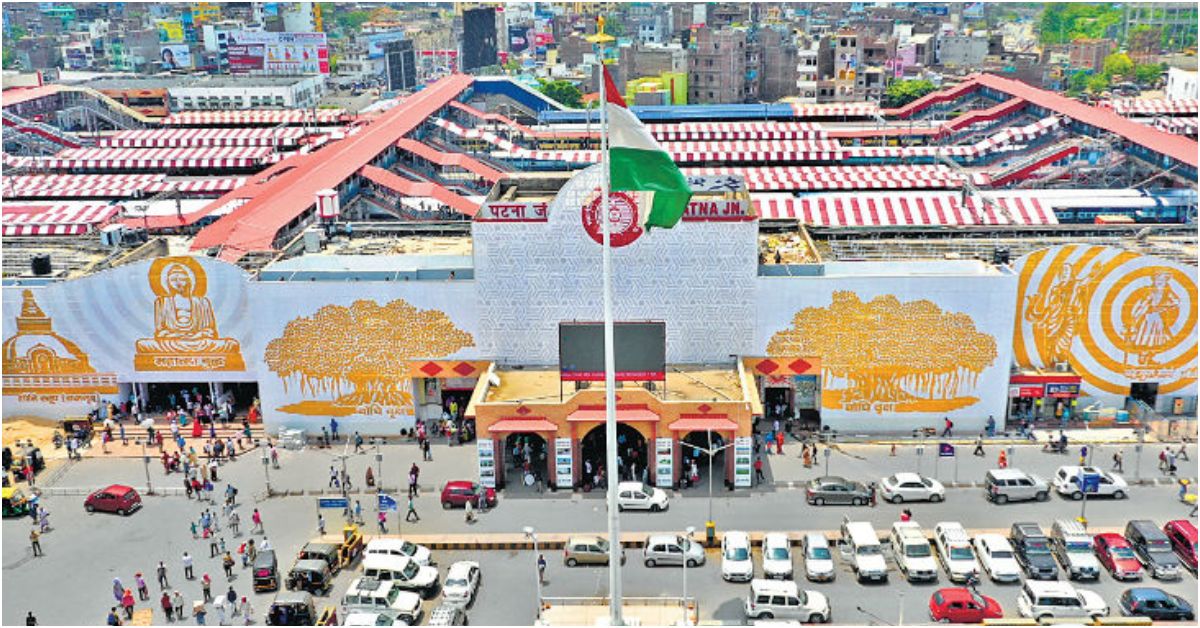
A coordinated push to upgrade Patna’s railway infrastructure is gaining traction, with passenger groups and planners calling for an integrated redevelopment of Patna Junction alongside capacity expansion on one of India’s busiest rail corridors. The proposals focus on modernising the station and strengthening the Deen Dayal Upadhyaya–Patna–Kiul route to address rising passenger and freight demand.
At the centre of the plan is the transformation of Patna Junction into a larger, multi-level transit hub capable of handling future traffic volumes. Stakeholders have urged authorities to scale up the current redevelopment framework, arguing that incremental upgrades will fall short of the city’s long-term mobility needs. The urgency stems from sustained congestion at the station, which functions as a key interchange in eastern India. As urbanisation accelerates and rail remains a primary mode of mobility for intercity travel, existing infrastructure is increasingly strained. Experts note that station redevelopment must go beyond cosmetic upgrades, incorporating multimodal integration, passenger flow optimisation, and expanded concourse capacity. Parallel to station modernisation, the expansion of the DDU–Patna–Kiul corridor has emerged as a critical priority. This stretch forms part of the historic Delhi–Howrah main line, one of the country’s most heavily utilised rail routes. Calls for tripling and quadrupling tracks aim to segregate passenger and freight movement, reduce delays, and unlock additional train services.
Recent approvals for additional lines between Punarakh and Kiul signal progress in this direction, with rail authorities recognising the need to enhance capacity on saturated sections. Infrastructure experts highlight that such expansions are essential not only for operational efficiency but also for supporting economic activity, as freight movement reliability directly impacts regional trade flows. The redevelopment of Patna Junction is also aligned with the broader Amrit Bharat Station Scheme, which seeks to transform railway stations into integrated urban nodes with improved amenities, accessibility, and sustainability features. These upgrades typically include better circulation areas, digital passenger systems, and enhanced last-mile connectivity—elements that are increasingly seen as critical to people-first urban design. Urban planners point out that rail infrastructure plays a foundational role in shaping city growth. A modernised station, combined with expanded rail corridors, can influence land use patterns, reduce road congestion, and improve access to economic opportunities. In Patna’s case, this becomes particularly relevant as the city simultaneously invests in metro rail and road infrastructure, creating opportunities for multimodal integration.
However, execution remains the key challenge. Large-scale rail projects often face delays due to land constraints, funding approvals, and coordination across agencies. Ensuring that redevelopment and line expansion progress in tandem will be essential to avoid bottlenecks shifting from one part of the network to another. Looking ahead, the proposed upgrades represent more than infrastructure enhancement—they signal a transition towards capacity-driven, commuter-focused rail planning. If implemented effectively, they could redefine mobility in Bihar’s capital while supporting more efficient, inclusive, and sustainable urban growth.