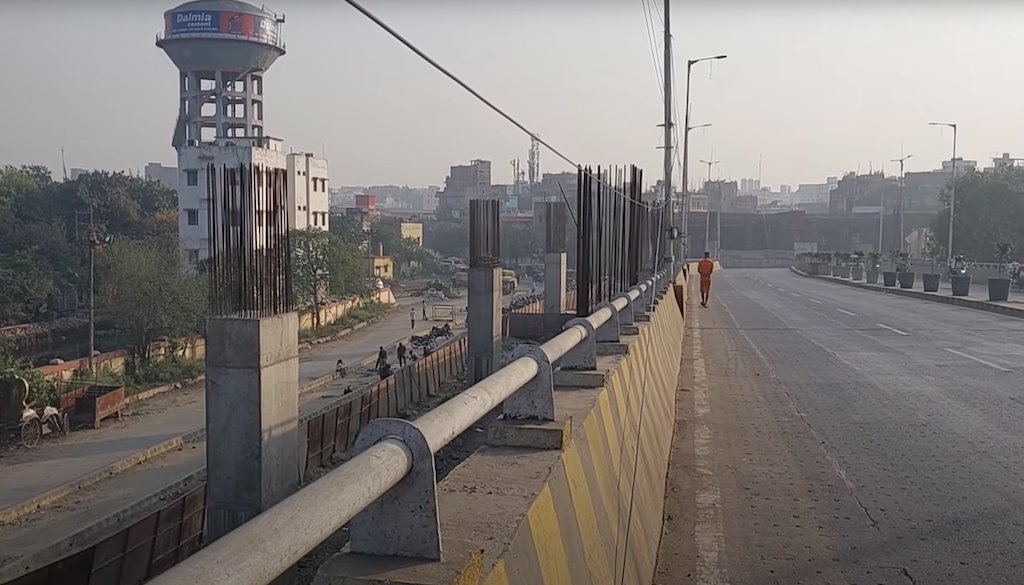
A major elevated corridor linking key congestion points in Patna is moving into an advanced construction phase, signalling a significant intervention in the city’s long-standing traffic bottlenecks. The Mithapur–Karbigahiya flyover project, designed to streamline movement across some of the busiest urban stretches, is expected to reshape daily commuting patterns while strengthening east–west connectivity.
The project, led by the state’s road construction authority, combines a multi-lane flyover with service roads to separate fast-moving traffic from local circulation. Spanning critical nodes such as Mithapur, Chiraiyatand and Karbigahiya, the corridor targets areas where vehicular congestion routinely disrupts mobility and economic activity. This Patna flyover project comes at a time when the city’s transport network is under increasing strain from rapid urban expansion and rising vehicle ownership. Key neighbourhoods connected by the corridor—including dense residential and commercial clusters—have long experienced peak-hour gridlocks, with commute times stretching unpredictably. The new infrastructure aims to create uninterrupted traffic flow by elevating through-traffic above ground-level intersections. Urban mobility experts suggest that the project’s design reflects a broader shift in infrastructure planning—from capacity expansion alone to traffic segregation and flow management. By introducing service lanes alongside the elevated structure, the corridor is expected to reduce conflict points between local and long-distance traffic, improving both safety and efficiency.
The economic implications are equally significant. Improved connectivity between eastern Patna, administrative districts and the airport corridor could enhance productivity by reducing travel delays and logistics costs. Areas such as Kankarbagh and Patna City are likely to benefit from faster access to employment centres and public institutions, potentially influencing real estate demand along the corridor. Officials indicate that construction is progressing in phases, with initial sections nearing completion and subsequent stretches advancing steadily. The full project is targeted for completion by late 2026, aligning with a wider pipeline of transport upgrades across the city. Importantly, the Patna flyover project also intersects with larger questions of sustainable urban growth. While elevated corridors can ease congestion in the short term, planners emphasise the need to integrate such projects with public transport systems, non-motorised mobility and land-use planning. Without this alignment, gains in travel time could be offset by induced traffic demand over time.
For residents, the immediate promise lies in reduced congestion and more predictable travel across key corridors. However, the long-term success of the project will depend on how effectively it is embedded within a broader, multimodal urban mobility strategy. As Patna continues to invest in transport infrastructure, projects like this will serve as critical test cases—determining whether infrastructure expansion can keep pace with urbanisation while delivering safer, more efficient and more inclusive mobility systems.