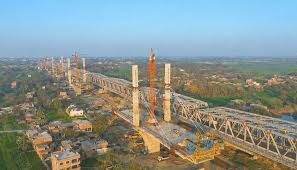
Patna Braced for New Bridge Network to Cut Travel Time
Patna, Bihar — Bihar’s ambitious infrastructure agenda has entered a new phase with plans to build a network of 51 bridges across the Ganga, Son, Gandak and Kosi rivers, a programme that state officials say could significantly reshape connectivity to and from Patna — a city long constrained by riverine barriers that inhibit movement and economic activity.
The initiative, jointly backed by the state government and the central government, includes 25 bridges already operational, 14 under construction and 12 more projects poised to begin soon, forming a comprehensive web of crossings designed to tie major economic corridors and regional towns to Patna’s urban core. Patna’s geography — with the Ganga coursing directly through its northern boundary — has historically shaped not just the city’s culture but also its transport and logistics patterns. Major crosses such as the Mahatma Gandhi Setu, one of India’s longest river bridges, and the recently completed Kacchi Dargah–Bidupur six-lane bridge have played pivotal roles in linking the state capital with northern Bihar and beyond. The expanded bridge programme, however, seeks to go well beyond these flagship links. With a pipeline of new crossings across the four major rivers, planners aim to dramatically reduce travel times between Patna and neighbouring districts, enhance freight flows for agricultural and industrial producers, and offer alternatives that relieve pressure on existing crossings.
A particularly consequential project in the regional network is the Bakhtiyarpur–Tajpur Ganga bridge, which will span roughly 5.5 kilometres to connect Patna’s periphery with Samastipur district. Once operational — targeted for mid-2027 — it is expected to ease congestion on other Ganga bridges while enhancing north–south connectivity. For Patna’s urban planners, this river bridge push dovetails with a broader vision of integrated regional mobility. Improved links across the Ganga and other rivers could support suburban expansion, alleviate bottlenecks in commuter traffic, and strengthen access to industrial clusters and logistics hubs emerging around the state capital. In a region where rural-urban commuting and supply chains have traditionally been constrained by river crossings, additional capacity promises to widen the catchment areas of Patna’s job markets, health facilities and educational institutions.
Economists and transport analysts also highlight the potential macroeconomic impacts. Reduced travel times and lower transport costs can unlock trade flows and attract investment in sectors such as warehousing, food processing and small-scale manufacturing — industries that depend heavily on reliable regional linkages. For farmers in districts north of the Ganga and beyond, quicker access to Patna’s wholesale markets could improve price realisations and reduce post-harvest losses. Yet, the scale of this infrastructure drive presents challenges. Engineering works on multiple large bridges across major riverbeds require rigorous coordination of land acquisition, environmental clearances, hydrological assessments and contract management. Executing them concurrently without compromising quality or timelines will test institutional capacity at multiple levels of government.
For residents of Patna, the anticipated benefits are tangible: shorter journey times, more options for north-south travel, and a transport backdrop that better supports the city’s expanding economic footprint. As Bihar presses ahead with construction and commissioning, policymakers will be watching how these cross-river linkages catalyse not only connectivity but also inclusive growth across urban and rural communities tied to Patna’s future.