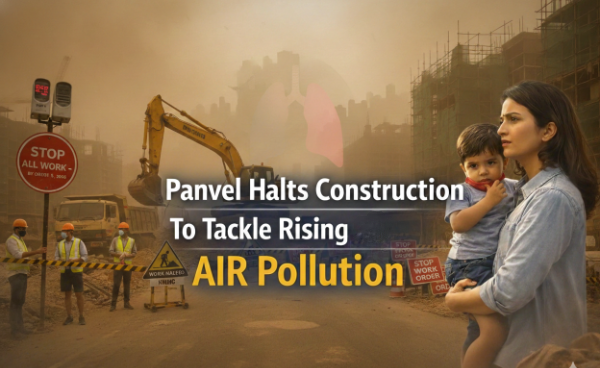
The Panvel Municipal Corporation has ordered an immediate halt to construction activity at 34 real estate projects across the city, intensifying enforcement against developers found violating mandatory dust control and air quality safeguards. The move follows a sharp deterioration in local air quality and signals a tougher regulatory stance as fast-growing satellite cities grapple with the environmental costs of rapid construction-led expansion.
The affected projects are spread across Panvel’s key growth nodes, including New Panvel, Panvel City, Kalamboli, and Kamothe — areas that have seen a surge in residential and mixed-use development driven by improved connectivity and proximity to major infrastructure corridors. Civic officials said the suspension orders were issued after follow-up inspections confirmed that repeated warnings to comply with pollution mitigation norms had been ignored. Urban planners point out that construction dust has emerged as one of the largest contributors to deteriorating air quality in peri-urban regions like Panvel, where large plots, open excavation, and heavy vehicle movement combine to release high levels of particulate matter. In late January, several monitoring locations recorded pollution levels in the ‘severe’ category, triggering urgent administrative intervention.
According to civic authorities, the violations extended beyond minor lapses. Sites were found operating without adequate perimeter barricading, dust screens, or water-sprinkling systems. Measures meant to contain emissions — such as covering building facades with damp cloth, using anti-smog equipment, and enforcing clean transport practices — were either missing or poorly implemented. In some cases, material spillage from construction vehicles was observed along public roads, worsening dust exposure for nearby residential areas. The enforcement drive also widened beyond construction activity. Notices have been issued to a large number of food establishments, including bakeries and restaurants, directing them to shift away from coal and wood-based fuel systems. Civic officials indicated that failure to transition to cleaner energy sources such as LPG or electricity could result in closure, as part of a broader effort to reduce localised emission hotspots.
From a real estate market perspective, the action underscores rising regulatory scrutiny on environmental compliance. Industry experts say developers will increasingly need to factor air quality management into project planning, timelines, and costs, particularly in rapidly urbanising regions falling under stricter pollution oversight. While temporary work stoppages may impact project delivery schedules, consistent enforcement could level the playing field by penalising non-compliance. The construction shutdown forms part of a larger municipal anti-pollution strategy backed by significant capital investment. Planned interventions include air purification units at traffic-heavy junctions, mobile dust suppression systems, and enclosed waste transfer facilities designed to reduce secondary pollution from garbage handling and transport.
As Panvel continues to attract investment and population growth, urban policy specialists argue that environmental governance will play a defining role in shaping its long-term liveability. The current action places responsibility firmly on builders and businesses to align with cleaner, climate-resilient development practices — a shift that may determine how emerging cities balance growth with public health in the years ahead.
Panvel Halts Construction To Tackle Rising Air Pollution