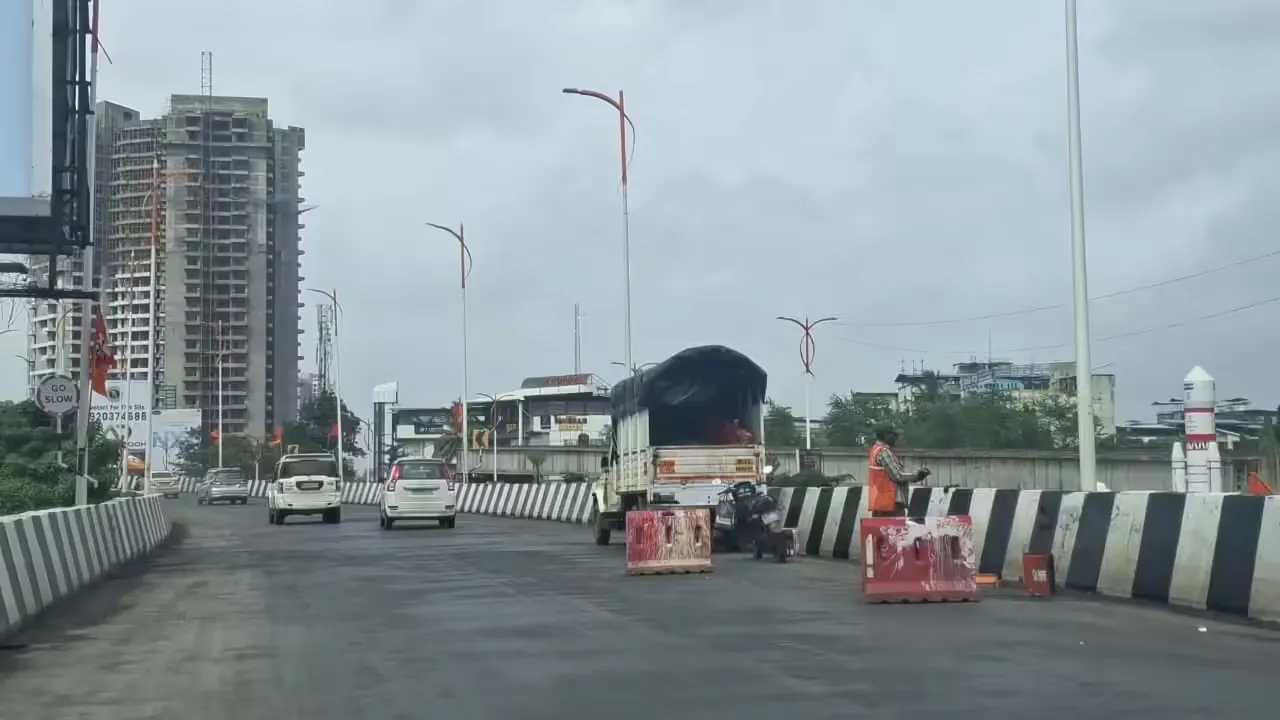
Palava flyover under VJTI audit after safety faults spark outrage
Palava’s newly opened flyover, hailed as a traffic decongestion solution just a month ago, is now under the scanner for safety and construction quality. The Maharashtra government has ordered a structural audit to be conducted by the Veermata Jijabai Technological Institute (VJTI), following growing public and political pressure over alleged defects in the partially completed bridge.
The flyover, opened partially with two of its four lanes operational, came under criticism soon after its inauguration when two motorcyclists reportedly skidded due to excess bitumen on the surface. The incident fuelled a wave of concern from commuters and civic observers, questioning the decision to open the bridge before completion and before a mandatory safety review.
According to officials, the Maharashtra State Road Development Corporation (MSRDC), which oversees the project, temporarily closed the affected lanes after acknowledging the bitumen issue. In an attempt to address traction concerns, grit powder was spread over the surface, but persistent rainfall washed it away, worsening the problem and creating surface irregularities that many mistook for potholes. The MSRDC later stated that the contractor had removed most of the remaining grit, but by then public anger had intensified. Multiple urban mobility experts stressed that premature openings of transport infrastructure without thorough checks risk public safety and erode public trust in civic planning.
The Public Works Department’s directive for a VJTI audit marks a significant intervention, intended to ensure the structure meets prescribed safety standards and can withstand the region’s heavy monsoon conditions. A senior PWD official confirmed that the audit will examine not only the current surface quality but also the foundational integrity of the flyover. This development has once again spotlighted the broader issue of quality assurance in urban infrastructure projects. Urban planners argue that in a rapidly growing metropolitan region, short-term traffic solutions should not override long-term safety imperatives. They recommend adopting stronger pre-opening safety protocols, transparent project tracking, and the inclusion of third-party audits before any new public structure becomes operational.
While the controversy has cast a shadow over the project, the partial opening has nonetheless reduced traffic bottlenecks in parts of Palava and neighbouring areas. However, residents now demand that the remaining two lanes be completed promptly and to the highest structural standards, ensuring that the bridge delivers its intended benefits without compromising safety. The outcome of the VJTI audit will determine whether the flyover can fully open in the coming months or whether further rectification will be needed. For now, the case serves as a reminder that resilient, safe, and sustainable infrastructure demands not just engineering expertise but also accountability at every stage of execution.