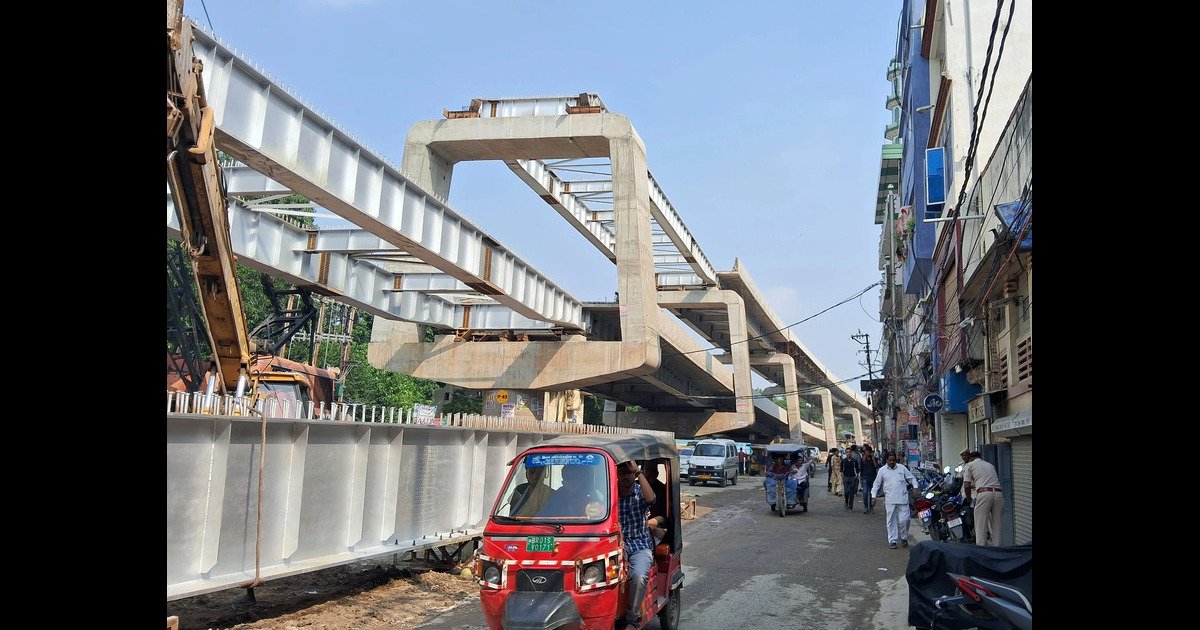
A major urban infrastructure transition is underway in Mumbai as one of its oldest road-over-rail bridges is being dismantled to make way for a modern double-decker structure designed to ease congestion and improve connectivity across the city’s central corridor. The redevelopment marks a shift from legacy infrastructure to a multi-level transport solution in one of the most densely used commuter zones.
The removal of the ageing bridge structure, located along a critical east–west link, has required highly coordinated engineering operations. Authorities overseeing the work under Central Railway have carried out phased demolition during night blocks to minimise disruption to train services. One of the most complex aspects has been maintaining the integrity of overhead electric lines, which power suburban rail services and have remained in place for decades. Engineers have used temporary support systems to stabilise high-voltage equipment while dismantling bridge components beneath it. This approach has allowed railway operations to continue without significant interruptions, highlighting the increasing reliance on precision engineering in dense urban infrastructure upgrades.
The upcoming double-decker bridge represents a new model for space optimisation in land-constrained cities. Its lower level is being designed to accommodate local vehicular traffic and pedestrian movement, with dedicated lanes and footpaths intended to improve safety and accessibility. The upper deck, meanwhile, will form part of a larger elevated road network, connecting to key arterial routes and planned mobility corridors. Urban planners view the project as part of a broader effort to enhance east–west connectivity in Mumbai, where rail lines often act as physical barriers between neighbourhoods. By integrating multiple transport layers within a single structure, the design aims to reduce travel time, improve traffic distribution, and support more efficient movement across the city.
The bridge is also being constructed using modular techniques, with segments pre-fabricated off-site and later assembled at the project location. This method reduces on-site construction time, limits disruption in high-density areas, and can improve quality control. Experts suggest that such approaches are increasingly being adopted in large urban projects to balance speed with precision. From an environmental and planning perspective, the redevelopment aligns with efforts to modernise infrastructure while minimising long-term congestion and emissions. Improved traffic flow and reduced idling time can contribute to lower vehicular pollution, particularly in heavily trafficked zones like the Parel–Prabhadevi belt.
However, experts caution that infrastructure upgrades must be complemented by broader mobility strategies, including public transport integration and pedestrian-friendly design, to ensure equitable access. Without such measures, capacity expansion alone may not fully address congestion challenges. As the final stages of demolition conclude and construction of the new structure advances, the project is expected to play a key role in reshaping movement patterns across central Mumbai. Its success will likely influence how future infrastructure in the city balances heritage, capacity, and sustainability in an increasingly complex urban environment.
Old Elphinstone Structure Replaced By Mumbai Double Decker Link