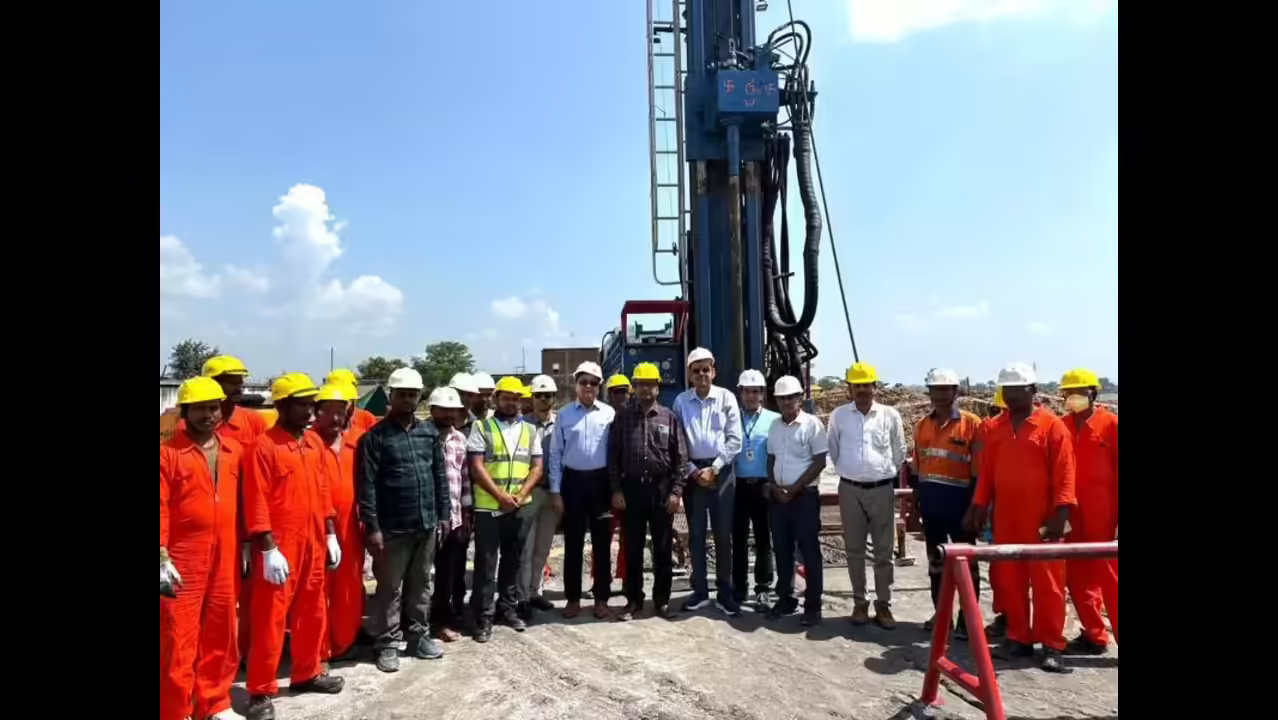
India has taken a significant step towards long-term climate mitigation with the successful drilling of its first underground carbon dioxide storage well in Jharkhand, marking a new phase in the country’s clean energy transition. The project, led jointly by a leading public sector power producer and a premier technical institute, tests the feasibility of permanently storing industrial carbon emissions deep beneath the earth’s surface.
The initiative focuses on geological carbon storage, a critical component of Carbon Capture, Utilisation and Storage (CCUS), which is increasingly seen as essential for economies with hard-to-abate sectors such as power, steel and cement. While renewable energy expansion remains central to India’s decarbonisation strategy, experts say emission-heavy industries will continue to generate carbon dioxide for decades, making secure underground storage unavoidable. The pilot well has been drilled to a depth of approximately 1,200 metres in a coal-bearing region of Jharkhand, selected for its geological suitability and proximity to industrial activity. A second monitoring well has also been initiated to study how injected carbon dioxide behaves underground and whether it remains safely contained over time. Multiple monitoring techniques are being deployed to assess leakage risks, storage capacity and long-term stability.
Officials involved in the project described it as a landmark example of academia-industry collaboration, facilitated by national policy institutions. The partnership has already delivered India’s first geological storage atlas focused on coal-rich basins, providing a scientific foundation for identifying viable carbon storage zones across the country. Preliminary assessments indicate that the North Karanpura coalfield holds substantial storage potential. One block alone could accommodate more than 15 million tonnes of carbon dioxide over a decade, according to project estimates. If validated at scale, such capacity could significantly offset emissions from nearby thermal power plants and heavy industries.
Industry experts note that India emits close to three billion tonnes of carbon dioxide annually, with the power sector contributing nearly one-third. While clean technologies such as solar, wind and green hydrogen can reduce emissions, they cannot fully eliminate process-related carbon output. Geological storage offers a permanent solution when conversion into commercial products becomes unviable at large volumes. Beyond emissions reduction, the project is expected to generate detailed risk assessments, regulatory insights and commercial deployment frameworks for future carbon storage facilities. Studies are already exploring similar drilling potential in offshore and other industrial regions, including mature hydrocarbon fields.
Urban planners and sustainability experts believe that integrating carbon storage into India’s energy and industrial landscape will be crucial for building climate-resilient, low-carbon cities. As infrastructure and energy demand continue to rise, solutions that balance growth with environmental responsibility will define the next phase of equitable urban development.
NTPC Leads India First Underground Carbon Dioxide Storage Drilling Project