


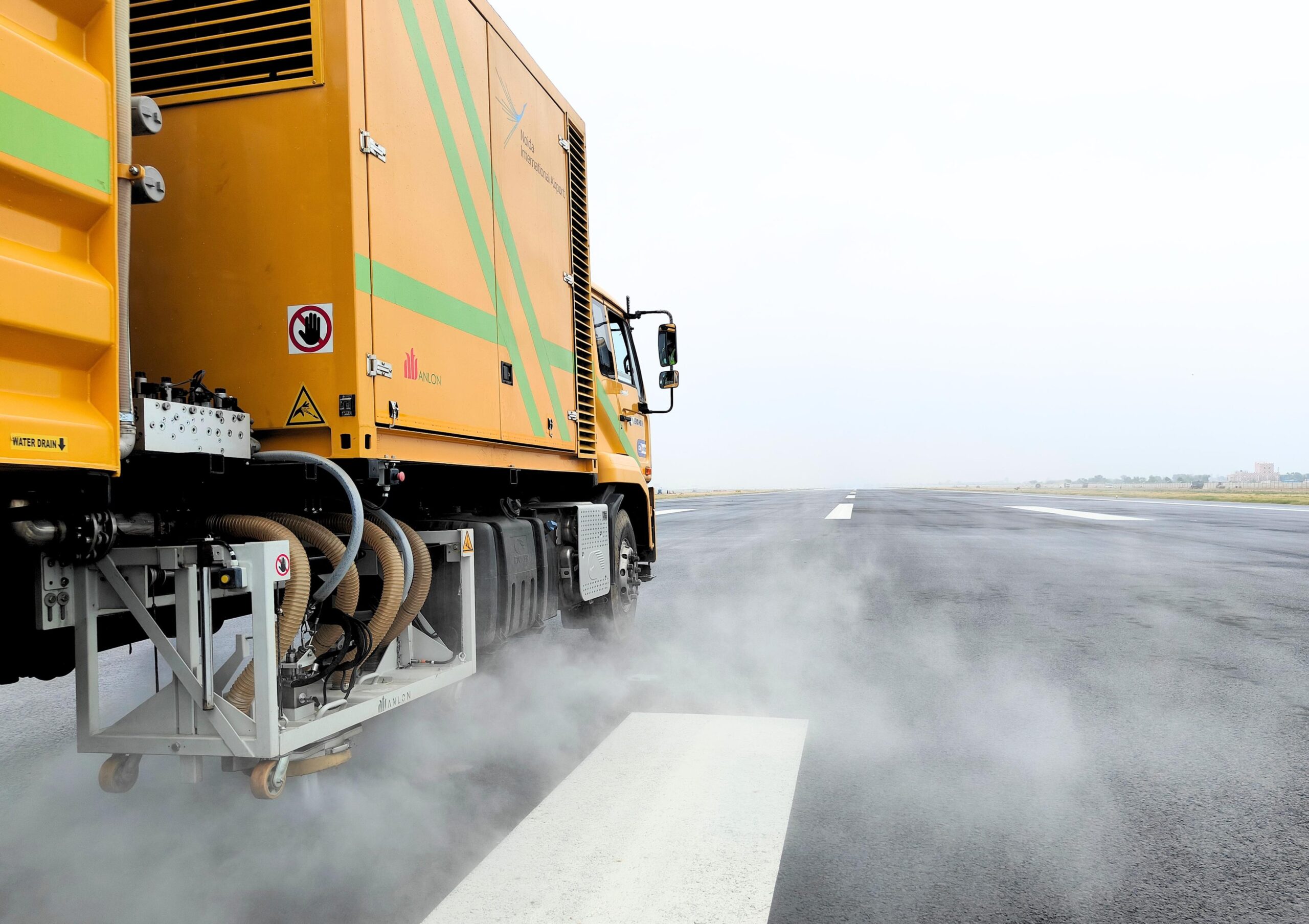
Noida International Airport, aligned with its April 2025 operational launch, has partnered with homegrown Anlon Technology Solutions to commission the Cleanjet RRM on an Eicher Pro 6028 chassis. The chemical‑free unit uses ultra‑high‑pressure water jets and onboard suction to strip rubber deposits, paint, and oil spills from runways, taxiways, and aprons—ensuring friction‑safe surfaces without harming pavement integrity.
Powered by a Bharat Stage‑VI‑compliant diesel engine, supplemented with a CAT C9.3B auxiliary unit and Hammelmann pump, the Cleanjet RRM cleans 800–1,100 m² per hour and sustains over four hours of continuous operation from its 8,000‑litre fresh‑water and debris tanks. These features align with the airport’s zero‑carbon ethos by reducing chemical use and supporting rapid maintenance cycles. The machine’s intelligent suction at the nozzle collects all used water, rubber particles, paint flakes and hydrocarbons—leaving surfaces immediately ready for aircraft use.
Driver assistance features include multi‑angle cameras and a 12‑inch real‑time display, with footage archived for safety reviews—bolstering accountability during maintenance runs. Its modular design allows the cleaning head to be quickly raised, lowered, or detached—enabling swift removal from runways during emergencies without dismantling the unit, a critical feature for uninterrupted airport logistics. This indigenous initiative enhances Noida’s growing role as an eco‑sustainable aviation hub. By reducing dependence on imported solutions and prioritising green maintenance, the airport reinforces its greenfield credentials—part of a larger strategy positioning it as Asia’s next-generation transit hub .
Comparable systems have been introduced in other Indian airports—Thiruvananthapuram’s machine clears both rubber and markings with water alone, addressing friction safety during monsoons. Mangaluru has similarly adopted high‑pressure jet units to maintain runway friction in wet conditions. Noida’s Cleanjet stands out through its domestic design and infrastructure integration. Ahead of its operational launch, Noida Airport is ramping up critical infrastructure—including a 3.9 km runway, ATS tower and ILS/PAPI systems—to ensure all pre‑flight protocols are in place. The private‑public model, led by Yamuna International Airport Ltd (YIAPL), is focused on strategic investment in safety technology and climate‑resilient operations.
Industry analysts note that indigenous maintenance solutions can lower costs, reduce downtime, and keep airports agile. The Cleanjet’s integration supports sustainable operational goals by eliminating chemical usage, reducing freshwater footprint, and ensuring shorter closures for cleaning cycles—vital for high‑traffic hubs. For passengers and carriers, this development offers assurance of friction‑safe runway conditions—critical during heavy monsoon periods and early commercial roll‑out phases. As Noida Airport prepares to receive its first flights, the Cleanjet RRM underlines a commitment to world‑class maintenance aligned with environmental responsibility.
This milestone not only signifies a step forward in India’s airport tech ecosystem but also affirms that local innovation can compete effectively in high‑stake aviation environments. As Noida moves towards functional operations, its emphasis on safety, sustainability, and self‑reliance may set new benchmarks for future airport projects nationwide. In endorsing this launch, Noida International Airport signals a forward‑looking blend of efficiency, resilience and eco‑conscious infrastructure—critical for India’s next‑generation aviation landscape.
Also Read :Goa–London Air India Flights Halted Until July 15
