


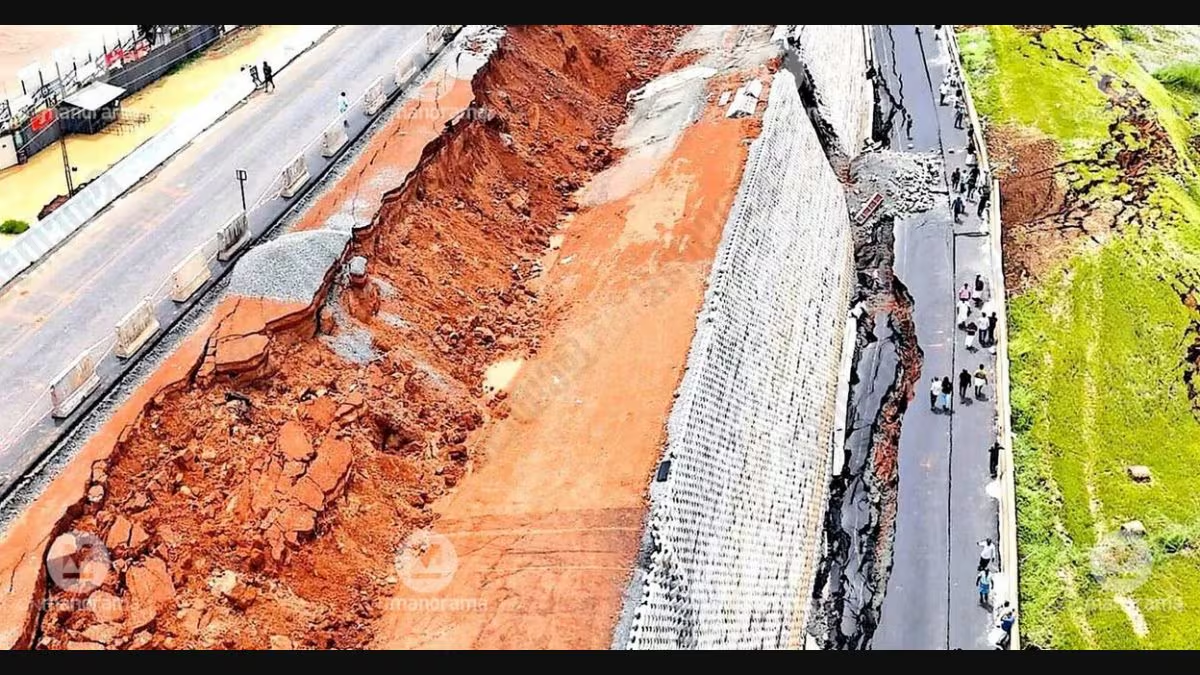
The National Highways Authority of India (NHAI) is facing intense scrutiny following revelations that no penalty has been levied against KNR Constructions, the project concessionaire, or its consultant, despite the collapse of an embankment on NH66 at Kooriyad. This inaction, disclosed via an RTI response, appears to contradict Union Ministry circulars mandating specific penal provisions for structural failures, raising serious questions about accountability in critical infrastructure projects vital for sustainable urban connectivity.
The incident, which occurred on May 19, saw the embankment of the highway cave in, miraculously sparing passengers in two cars. However, it sparked widespread outrage across Kerala, with NHAI drawing severe criticism for perceived lapses in ensuring structural safety. Local residents, who had previously raised ecological concerns about the project, intensified protests, asserting that their warnings were disregarded. This public backlash prompted NHAI to take initial disciplinary actions, including suspending KNR Constructions from future bids and issuing a show-cause notice for a monetary penalty of ₹11.8 crore, alongside suspending the concessionaire’s project manager.
Further actions taken by NHAI included suspending the Independent Engineer (Highway Engineering Consultant, Bhopal) from future bids and issuing show-cause notices for penalties of ₹20 lakh each to the design and safety consultants. The NHAI’s Project Director (in-charge) was also suspended, and the site engineer’s services terminated. KNR Constructions was tasked with clearing debris and reconstructing a new flyover at its own cost, estimated at approximately ₹80 crore. These measures, while seemingly stringent, contrast sharply with the subsequent RTI reply stating no penalty was levied.
The discrepancy between NHAI’s public statements and the RTI response has fuelled the controversy. While NHAI officials cited the contractor undertaking reconstruction at their own cost as the reason for not levying a penalty, this directly contravenes a June 2021 MoRTH circular. This circular explicitly mandates that for major structural failures due to construction defects without casualties, penal actions must include rectification by the contractor at their own cost in addition to a penalty of 5 per cent of the contract value of the failed work or 0.5 per cent of the whole work, whichever is less. Given the NH66 project’s total cost of ₹2368 crore, a 5 per cent penalty on the entire project would amount to ₹118.4 crore.
Preliminary assessments by experts indicate that the embankment failure was likely caused by the foundation soils’ inability to support high embankment loads, pointing to negligence by the concessionaire in confirming ground conditions. This incident underscores the critical importance of rigorous quality assurance and oversight in all phases of highway construction. For India, which is rapidly expanding its road network to facilitate economic growth and urban development, ensuring the integrity and safety of infrastructure is paramount. Transparent accountability and strict adherence to quality norms are indispensable for building resilient, eco-friendly, and gender-neutral cities where public safety is never compromised. The absence of final reports from the two expert committees constituted by MoRTH further prolongs the uncertainty surrounding this critical incident.
Also Read: Ministry eases FGD mandate relaxing 2015 norms to cut power tariffs
