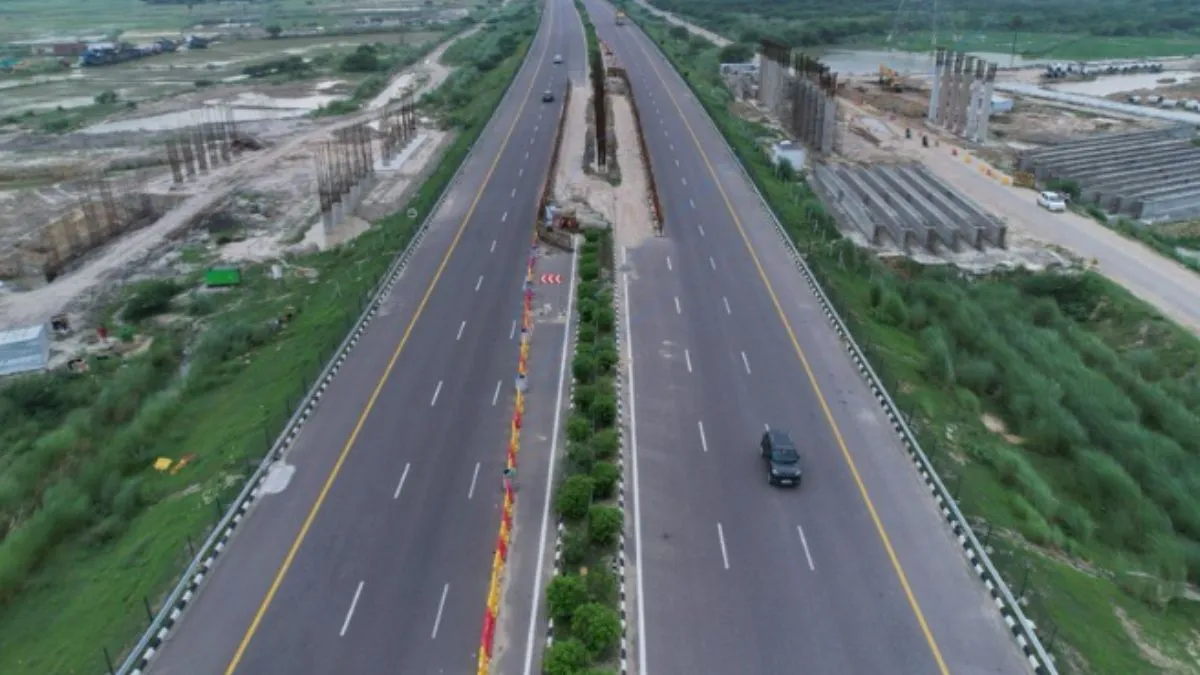
NHAI completes Indias first ever 12km wildlife corridor on Delhi Mumbai Expressway route
India has taken a landmark step towards environmentally conscious infrastructure by completing its first-ever dedicated wildlife corridor along a national highway. The 12-kilometre stretch, part of the Delhi-Mumbai Expressway, traverses the buffer zone of Rajasthan’s Ranthambore Tiger Reserve, providing safe passage for animals and setting a new national precedent for balancing development with conservation.
This pioneering section was developed by the National Highways Authority of India (NHAI) under the guidance of the Wildlife Institute of India and the Ministry of Environment, Forest and Climate Change. Not only does it protect endangered species such as tigers, leopards, bears, and other mammals from fatal road accidents, but it also marks a significant shift in how modern India plans its national infrastructure. The expressway corridor includes five elevated wildlife overpasses, each 500 metres long, and an underpass stretching 1.2 kilometres, currently the longest wildlife underpass in India. These features have been engineered to allow wildlife to safely migrate or roam between ecological habitats, particularly between the Ranthambore National Park and the Chambal Valley, both of which are ecologically vital and home to numerous protected species.
The need for such infrastructure is pressing. Across India, high-speed roads that slice through protected forest zones and buffer areas have long posed a serious threat to wildlife, often resulting in roadkills, habitat fragmentation, and declining animal populations. In Rajasthan alone, dozens of animal deaths have been reported over the past decade due to vehicles travelling through eco-sensitive belts. The new corridor seeks to directly address this longstanding conflict between development and ecology. What distinguishes this stretch from traditional highway projects is its comprehensive integration of eco-sensitive planning. Over 35,000 native trees have been planted along the corridor, and rainwater harvesting pits are strategically placed every 500 metres to prevent runoff and erosion. Furthermore, drip irrigation systems have been installed to reduce water usage by more than 50%, while modular formwork techniques and low-waste construction methods were employed throughout to minimise the environmental footprint.
While the corridor prioritises wildlife safety, it also delivers significant benefits to humans. By preventing animals from straying onto highways, the project substantially reduces the risk of high-speed collisions, making the roads safer for drivers, transporters, and commuters. For villages surrounding Ranthambore, it eliminates the unpredictable dangers posed by unplanned infrastructure and offers an example of how rural and conservation interests can coexist with national development. Crucially, the corridor sends a powerful signal: progress and preservation are not mutually exclusive. Instead of forcing a binary choice between ecology and growth, the project demonstrates that India’s infrastructure can evolve without erasing its environmental responsibilities.
Senior officials from NHAI described this corridor as a model for future projects, particularly in areas near protected forests or wildlife reserves. Plans are reportedly under discussion to replicate this blueprint on stretches near Pench, Kanha, and Kaziranga, all of which have seen increased wildlife fatalities due to rapid road expansion. The Delhi-Mumbai Expressway, part of India’s flagship Bharatmala Pariyojana programme, is an eight-lane, access-controlled highway spanning over 1,300 kilometres. Its integration of a wildlife corridor signals that India’s ambitions for industrial and economic connectivity are now being guided by environmental considerations as well.
This also aligns with the government’s broader sustainability goals under the National Wildlife Action Plan and the National Mission for Green Highways. With the Ministry of Road Transport and Highways emphasising green certification for new road projects, this development may well be a template for all future expressways and highways in ecologically sensitive zones. Wildlife conservationists have hailed the move. A senior scientist from the Wildlife Institute of India noted, “This is not just an engineering feat but an ecological milestone. It shows how collaboration between road authorities and conservation scientists can result in life-saving interventions for both animals and people.”
Community groups near Ranthambore have also voiced support, calling the corridor a “lifeline for the jungle.” Local residents who often witnessed animals crossing dangerously close to their homes now feel reassured that their coexistence with nature will be safer and more sustainable. As the expressway opens to more traffic in the coming months, the true test will be how well this balance between wildlife movement and vehicular flow holds. For now, the corridor is more than just a technical achievement — it is a symbol of a nation rethinking how to build.
India’s first national wildlife corridor stands as proof that the country’s infrastructure revolution need not come at the cost of its forests. It marks the beginning of an era where expressways can serve both mobility and biodiversity — an evolution long overdue, and urgently needed.