


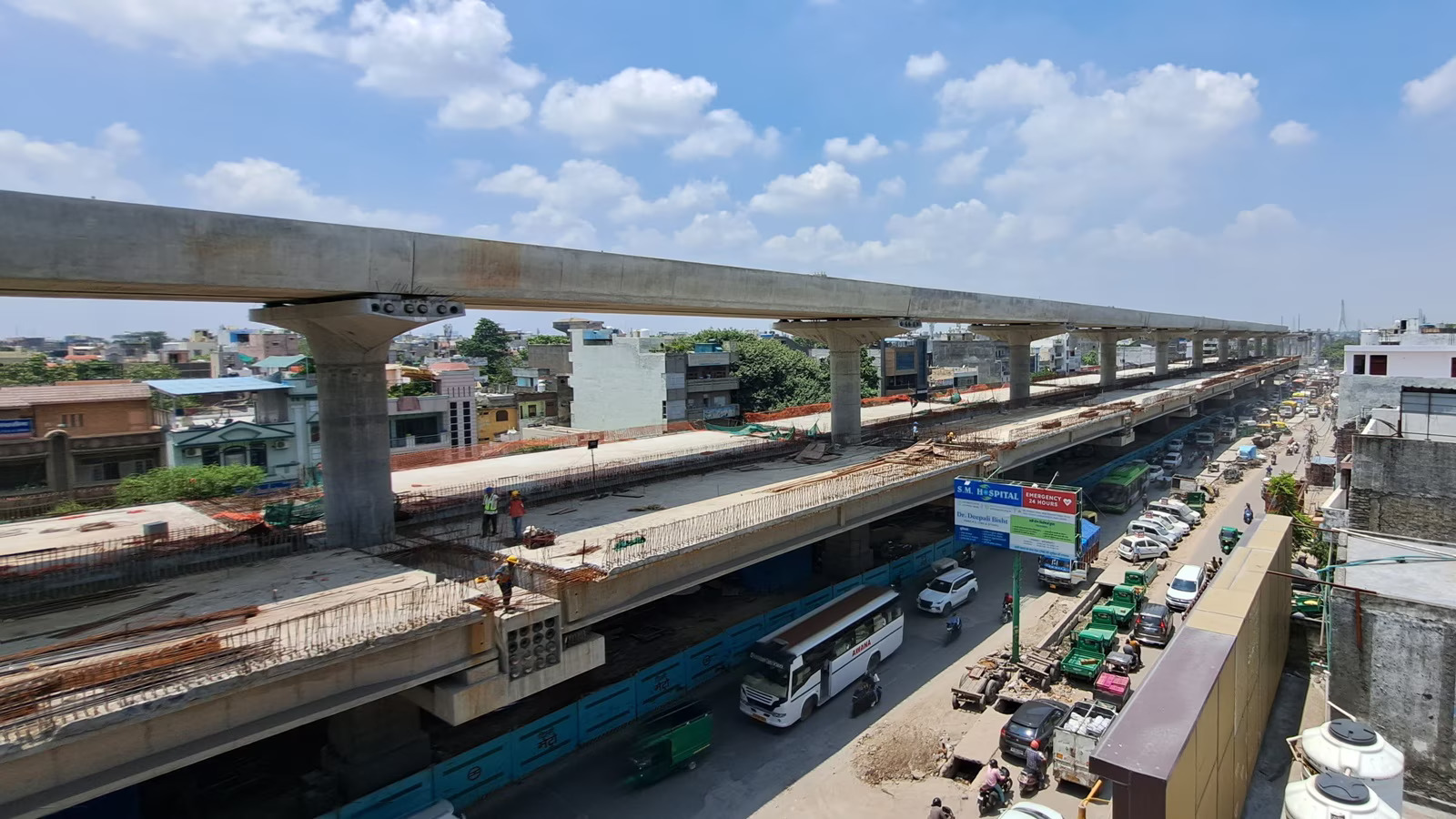
Delhi’s Public Works Department (PWD) is racing to complete two landmark double‑deck flyover viaducts—one on the Maujpur‑Majlis Park corridor between Bhajanpura and Yamuna Vihar, and another beneath the RK Ashram Marg–Janakpuri West line at Azadpur–Rani Jhansi Road—by December 2025.
The Bhajanpura‑Yamuna Vihar structure will be Delhi’s first double‑deck viaduct, featuring metro tracks on the upper level and a four‑lane flyover below. With construction nearly finished, the final ramp is awaiting tree‑cutting clearance, with commissioning slated for July . Its counterpart on GT Road—a 2.2 km, 2+2 lane flyover between Azadpur and Tripolia Gate—is intended to alleviate chronic congestion between Central and North Delhi. This section, part of the magenta‑line double‑deck structure, has received ₹20 crore in funding and carries a December 2025 deadline.
Delhi Metro Rail Corporation (DMRC) first proposed these integrated viaducts in 2021 under Phase IV to maximise land use and alleviate congestion by stacking transport modes vertically. Three such double‑deck structures are in progress, the third being on the Aerocity–Tughlakabad line. Engineering sources confirm that the sub‑structures of both the Bhajanpura and Azadpur viaducts are substantially complete. At Bhajanpura, the lower‑deck ramp awaits environmental clearance, while at Azadpur pier and foundation works are over 90% finished.
PWD officials highlight that constructing these flyovers in densely populated corridors is a formidable task, requiring intricate alignment with existing utilities and geographical constraints. The PWD minister has requested comprehensive briefings on these challenges and their engineering solutions. Analysts note that these viaducts offer significant environmental advantages. By stacking road and metro lanes, the city conserves scarce urban land, reduces travel times, and promotes metro adoption—a low‑carbon alternative to cars. This aligns with Delhi’s policy targets for sustainable, inclusive and gender‑friendly mobility.
Additionally, the flyovers’ traffic‑decongesting effects could be profound. The Bhajanpura corridor connects several North‑East Delhi neighbourhoods, while the Azadpur section serves commuters from Derawal Nagar, Rana Pratap Bagh and Vijay Nagar. Reduced idling on these corridors may markedly improve air quality. From a financial perspective, these projects exemplify efficient public infrastructure investment. With ₹20 crore already sanctioned for the Azadpur section and budget revisions underway for Bhajanpura, authorities appear focused on balancing fiscal discipline with delivery timelines.
Experts from urban planning think‑tanks praise the phased rollout and focus on integrated transport hubs. “Double‑deck viaducts optimise urban space while enhancing commuter choice,” said a Delhi transport specialist. They emphasise that careful attention to last‑mile access—pedestrian links, accessible ramps and cycling provisions—will determine long‑term success. However, limitations remain. Delhi’s tree‑felling norms are delaying critical ramp construction. Officials say that unless clearances are expedited, even well‑built structures may remain underused. Meanwhile, user‑experience advocates argue that signage, pedestrian safety and disabled‑friendly features must not lag behind structural progress.
Nevertheless, the PWD minister plans to inspect both viaducts personally in the coming weeks—a political gesture reflecting the government’s commitment to delivering high‑impact infrastructure well ahead of urban population growth pressures. As Delhi pushes forward with its Phase IV expansion, these two landmark flyovers stand out as test cases for pioneering vertical transport planning. Their successful completion may accelerate adoption of double‑deck infrastructure in other high‑density Indian cities.
For now, the promise of these flyovers signals a shift: from horizontal sprawl to layered connectivity, from congestion to momentum. If completed on schedule, they could redefine Delhi’s transport landscape, offering commuters faster, greener and more equitable journeys across the city.
Also Read : Pune Metro Line 2 Extension Approved With ₹3 626 Cr Investment
