

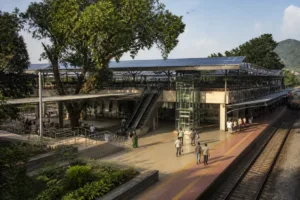
Neral railway station on Central Railway has received a Gold Rating from the Indian Green Building Council (IGBC) after an upgrade focused on commuter facilities, accessibility and environmental performance, according to a report by Mid-Day. The station is the main rail gateway for passengers travelling towards Matheran and the heritage narrow-gauge toy train.
The redevelopment, carried out by the Mumbai Railway Vikas Corporation (MRVC), cost approximately Rs 80 crore plus GST, the report said. The works include a 287-metre elevated deck on platform 1, a 120-metre elevated deck on platform 2, a 25-metre foot overbridge and an 87-metre skywalk at the Karjat end. The station also has two booking offices and two toilet blocks.
Passenger movement and access have been addressed through four escalators, five lifts and seating capacity for 437 passengers. The report said the station now includes accessible ramps, tactile pathways, dedicated ticket windows and toilet facilities for persons with disabilities, as well as wheelchair facilities and improved guidance signage.
The station’s transport role is supported by parking for 522 two-wheelers and 20 four-wheelers, bus connectivity within a kilometre, Wi-Fi, automatic ticket vending machines, CCTV surveillance, drinking-water facilities and snack stores. These additions are particularly relevant to a station that handles passengers travelling to a major tourist destination, although the report does not provide passenger-volume data or details of the facilities’ operating performance.
The IGBC recognition covers measures across sustainable station facilities, health and sanitation, energy efficiency, water efficiency, smart and green initiatives, and innovation and development. According to the report, Neral station has a 37.5 kWp rooftop solar power system, LED lighting, power-saving BLDC fans, star-rated electrical equipment and improved natural lighting and ventilation. Existing trees were preserved, while landscaping, waste segregation and composting facilities were added.
The water-management systems include two sewage treatment plants with a combined capacity of 45,000 litres per day, rainwater harvesting, groundwater-recharge pits, water-saving plumbing fixtures and water meters. The station is also reported to conduct regular water audits and energy audits, and to use CO2 sensors in air-conditioned areas.
Waste management measures include the production of organic manure for railway gardens and procedures for environmentally responsible disposal. The report also identifies tobacco-free and plastic-free zones, regular cleanliness drives and awareness posters as part of the station’s health and sanitation measures.
Together, the listed interventions indicate an attempt to treat a railway station as more than a platform-and-ticketing facility. The project combines vertical circulation, universal access, passenger amenities, parking and environmental systems within an existing transport hub. The available report, however, does not state the date on which the Gold Rating was awarded, the rating’s validity period, the station’s pre-upgrade energy or water consumption, or whether all listed facilities are fully operational.
For passengers, the immediate significance of the project is likely to be more reliable movement through the station, improved access for people with disabilities and better basic amenities. For railway and urban-infrastructure agencies, the project provides a documented example of how a regional station serving both daily users and tourists can incorporate renewable energy, water conservation and waste-management measures alongside capacity improvements.