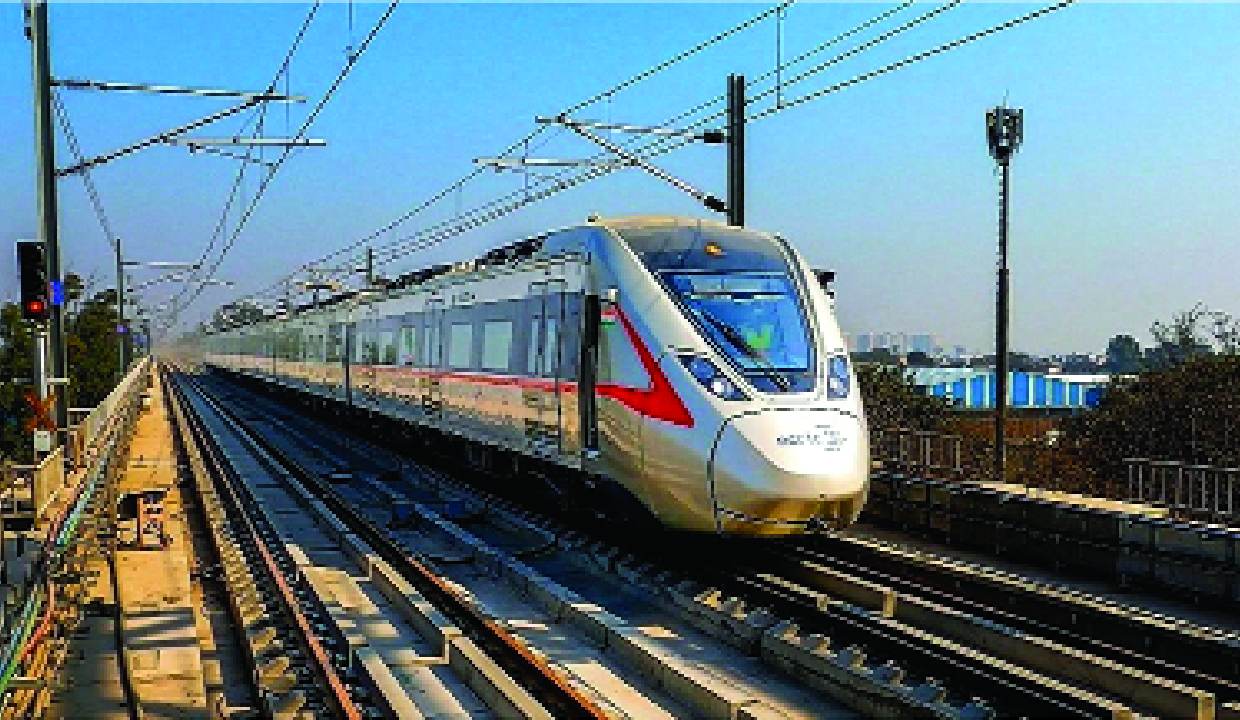
New Delhi: A proposed high-speed regional rail link connecting Gurugram, Faridabad and Noida is poised to recalibrate property demand patterns across the National Capital Region, with planners and developers anticipating a redistribution of residential and commercial growth along the transit spine. Estimated to involve an investment of roughly ₹15,000 crore, the NCR Namo Bharat corridor is entering an advanced planning stage, signalling the next phase of integrated mobility in the region.
Designed as a largely elevated rapid rail system, the corridor aims to cut travel time between the three economic centres to under an hour. Urban mobility experts note that predictable cross-city commuting can significantly alter housing choices, particularly in polycentric regions such as NCR where employment hubs are geographically dispersed. The NCR Namo Bharat corridor is expected to strengthen transit-oriented development across emerging micro-markets. Faridabad, traditionally viewed as a lower-cost alternative to Gurugram and central Noida, could witness the sharpest shift. Improved rail connectivity to corporate districts and IT clusters may enhance its appeal among end-users seeking larger homes and planned communities without sacrificing workplace access.
Real estate analysts observe that NCR’s housing cycle has recently been driven more by primary occupants than speculative investors. Stable end-user demand, combined with strong office absorption by technology firms and global capability centres, has underpinned price resilience. A seamless regional rail network could deepen this trend by encouraging households to weigh commute reliability alongside affordability and liveability. In Gurugram, integration with existing highways, metro corridors and arterial roads may create multi-modal nodes that ease congestion in established business districts. This, in turn, could moderate rental and capital value pressures by widening the residential catchment area for professionals working in the city.
Noida and Greater Noida, already supported by expressways and metro lines, stand to gain from stronger westward connectivity. Industry experts say improved cross-linkages can diversify demand across income segments, encouraging mixed-use projects that combine residential, retail and institutional functions around transit stations. From a sustainability perspective, the NCR Namo Bharat corridor aligns with broader efforts to reduce car dependency and transport emissions in one of India’s most polluted urban clusters. Transit-oriented growth, if supported by zoning reforms and pedestrian-friendly design, can limit unchecked sprawl while preserving peri-urban land.
However, planners caution that infrastructure alone does not guarantee balanced development. Timely execution, station area planning and integration with local bus and non-motorised transport systems will determine whether the corridor supports inclusive growth or simply inflates speculative land values. As the project advances towards implementation, market participants are already factoring its potential into land valuations and project pipelines. The longer-term impact will depend on delivery timelines and regulatory clarity, but the corridor has clearly entered the strategic calculus of NCR’s next real estate cycle.