


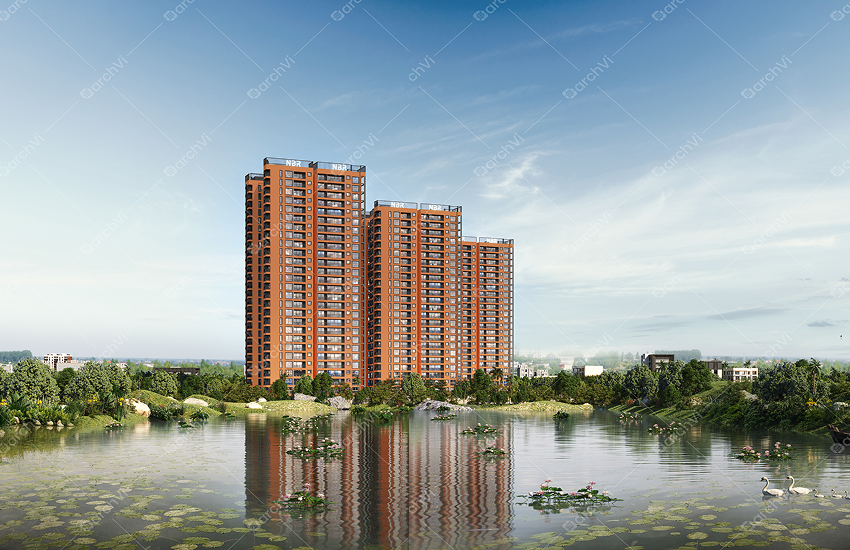
Bengaluru-based developer NBR Group has signalled a decisive shift toward premium residential development following strong market absorption at its flagship housing project in the city’s south-eastern growth corridor. The move reflects broader changes underway in Bengaluru’s housing market, where demand is increasingly tilting toward low-density, design-led communities outside congested urban cores.
The developer recently convened a large network of property consultants and channel partners after recording robust quarterly sales and near sell-out levels in the initial phase of its luxury residential project near the Sarjapur Road–Gunjur technology belt. Industry experts note that such closed-door industry gatherings often serve as early indicators of developer confidence and pipeline expansion, particularly in high-value housing segments. Located in Mullur, an area witnessing steady residential traction due to its proximity to IT employment zones and emerging infrastructure, the project has drawn attention for its spatial planning rather than sheer scale. Nearly nine-tenths of the land parcel is allocated to open and landscaped areas, aligning with a growing preference among homebuyers for breathable layouts, thermal comfort, and improved air circulation factors that have gained prominence in post-pandemic urban living. Urban planners tracking Bengaluru’s eastern corridor point out that Sarjapur and its surrounding micro-markets are transitioning from speculative investment zones into end-user-driven residential districts. Improved road connectivity, proximity to educational institutions, and the anticipated expansion of mass transit links are reinforcing demand for housing formats that prioritise long-term liveability over short-term density maximisation.
The project’s configuration limited units per floor, absence of shared walls, and a uniform apartment typology mirrors a wider market shift toward privacy-centric design. Analysts say such formats appeal to professional households and multi-generational families seeking quieter residential environments without relocating far from employment clusters. This has implications for land-use planning, as developers are increasingly required to balance exclusivity with efficient infrastructure utilisation. From a construction standpoint, the adoption of modern formwork and energy-efficient building systems reflects an industry-wide push toward faster execution and improved structural performance. While these technologies are often positioned as quality enhancers, sustainability experts stress that their long-term impact depends on operational efficiency, water management, and lifecycle maintenance rather than construction speed alone. The developer’s leadership has indicated that feedback from on-ground market intermediaries is shaping future project planning, particularly in terms of layout efficiency, amenity relevance, and buyer experience. Such engagement highlights how channel partners continue to play a critical role in interpreting evolving consumer expectations in a fragmented housing market.
As Bengaluru’s premium residential segment becomes more competitive, differentiation is increasingly driven by execution discipline, planning depth, and the ability to create resilient neighbourhoods rather than headline pricing. With further phases of the project now underway, the coming year will test whether low-density luxury developments can scale responsibly while aligning with the city’s broader infrastructure and environmental capacity.
Also Read: Assetz Strengthens Luxury Footprint in Southeast Bengaluru
NBR Group Signals Luxury Shift in East Bengaluru
