


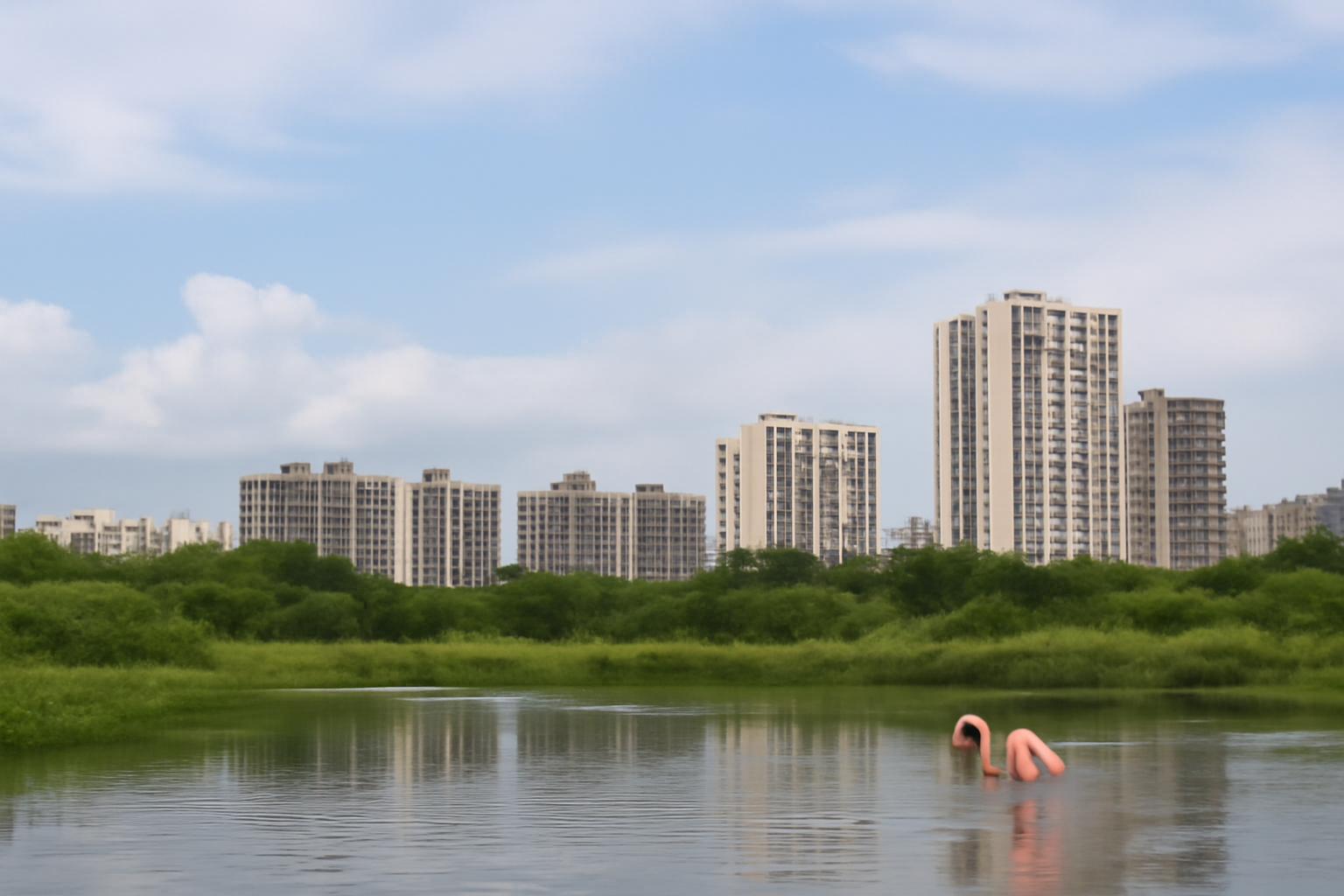
Navi Mumbai’s key wetlands—DPS Flamingo Lake, NRI, and TS Chanakya water bodies—will remain protected under the revised draft Development Plan (DP) released by the Navi Mumbai Municipal Corporation (NMMC). The inclusion of these wetlands in the new plan has been widely welcomed by conservationists, who had previously expressed concern over attempts by the City and Industrial Development Corporation of Maharashtra (CIDCO) to develop these ecologically sensitive areas.
The draft plan, now open for public suggestions and objections until August 23, maintains these wetlands in their protected status, contrary to CIDCO’s earlier proposal to reclassify them for urban development. DPS Flamingo Lake, a critical habitat for migratory birds, was marked for development in the previous draft. The NRI water body, which is an essential part of Navi Mumbai’s biodiversity, was slated for a golf course, while TS Chanakya, another vital wetland, was planned for residential development. These wetlands, part of the National Wetland Inventory Atlas and documented by the National Centre for Coastal Management (NCSCM), have faced numerous threats in the past. However, their ecological importance, particularly for local wildlife and water conservation, has been central to the fight for their preservation. With their designation as protected wetlands, these areas can continue to support biodiversity and contribute to the city’s environmental balance.
While the revised plan marks a crucial step forward, the battle is far from over. The state’s urban development department has recently issued a notification acknowledging the wetlands’ ecological value, but the final approval from the government is still pending. Activists like Sunil Agarwal have lauded NMMC’s move to safeguard these areas, though they remain cautious until the final sanction is obtained. The move to protect the wetlands has stirred mixed reactions among real estate developers, particularly those in proximity to the NRI wetland and Sector-60. The latter remains a residential zone in the updated draft, despite previous legal challenges to development projects in the area. In 2018, the Bombay High Court nullified CIDCO’s plans for a residential-cum-commercial complex and a golf course on the NRI site. However, CIDCO’s appeal to the Supreme Court remains pending, keeping the future of the area in limbo.
Despite the legal uncertainties, the decision to preserve the wetlands represents a crucial milestone in the ongoing efforts to ensure the sustainable development of Navi Mumbai. Environmentalists have rallied around the NMMC’s draft, calling for an official commitment to protecting these areas for future generations. The NMMC’s vision includes promoting these wetlands as eco-tourism destinations and preserving them as flamingo habitats, thus balancing environmental conservation with the city’s growth ambitions. While this victory is a step in the right direction, the situation remains fluid, and experts continue to monitor the progress of the final government notification. As public consultation continues until August 23, stakeholders are eagerly awaiting the outcome, hoping that the wetlands’ protected status will be solidified in the final draft.
NatConnect Director B N Kumar welcomed the protection of the three major wetlands. He urged the state govt to officially designate them as wetlands, including Lotus Lake at Sector-27, Nerul, which CIDCO marked as Plot-2 for residential development.
Navi Mumbai, which spans across the Thane and Raigad districts, has long been a focal point for urban development, but with this new plan, there is hope that the city can pursue growth in a manner that respects its unique natural assets. In this light, the protection of the DPS Flamingo Lake, NRI, and TS Chanakya wetlands stands as a testament to the growing awareness and importance of sustainable urban development in India.
Also Read : Mumbai to Launch Ropeway for Metro to Film City
Navi Mumbai to Safeguard Wetlands in New Development Plan
