


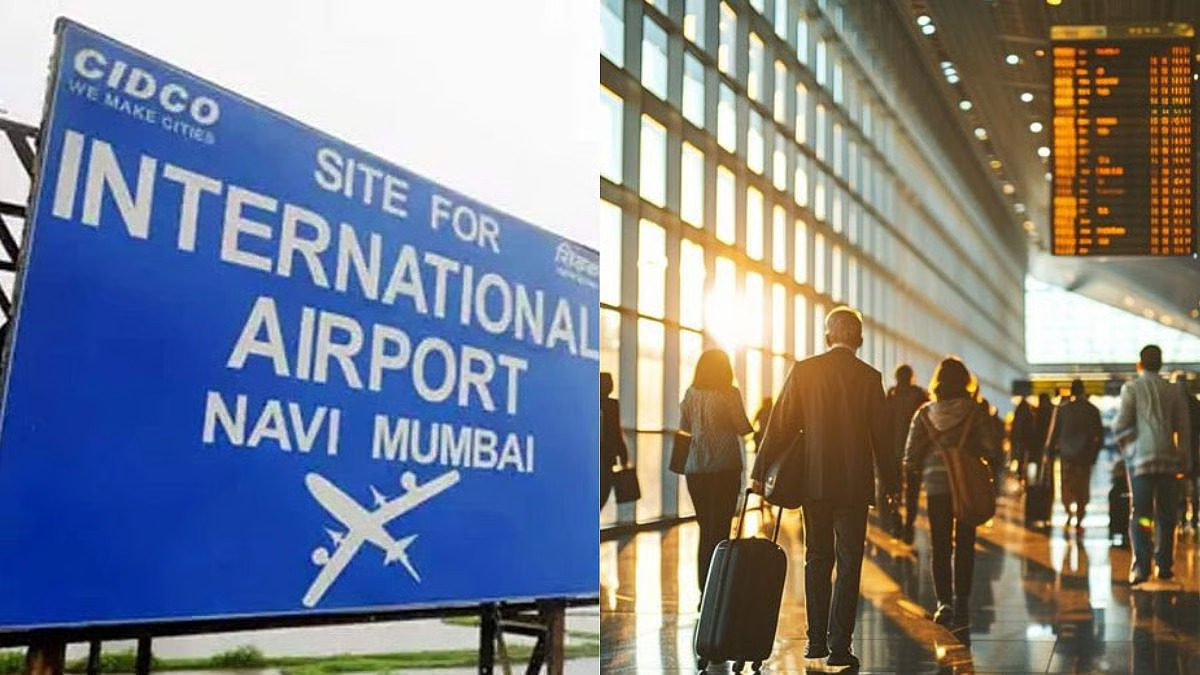
The much-anticipated Navi Mumbai International Airport (NMIA) is nearing operational readiness, with the first domestic commercial flight expected to take off around December 15. While an official announcement from Navi Mumbai International Airport Limited (NMIAL) is awaited, multiple government departments have confirmed that preparations are on track for a mid-December launch, followed by cargo and international operations in early 2026.
Officials associated with the project have stated that the airport’s security, policing, and immigration infrastructure are in advanced stages of completion. The Airport Police Station, constructed within the NMIA precinct, is expected to be handed over to the police force by December. The Maharashtra government has sanctioned over ₹5 crore for its establishment, including recurring and non-recurring expenditure. The new unit will comprise 108 personnel across various ranks and will operate under the Navi Mumbai Police Commissionerate, carved out from Panvel City and Ulwe jurisdictions. Parallel to this, the Central Industrial Security Force (CISF) has begun phased deployment at the airport. An official from the CISF confirmed that around 200 personnel have already been stationed at key zones, with plans to expand deployment to nearly 2,000 officers as operations scale up. The force is now conducting sweeping and anti-sabotage checks across the airport’s perimeter to ensure a threat-free environment before commercial services commence. A dedicated CISF control room will also oversee security at Terminal 3.
Airport authorities and state agencies have intensified coordination to meet the operational targets, with technical, safety, and environmental certifications progressing simultaneously. According to officials, the cargo handling facilities are being fine-tuned to align with green logistics standards — a critical step toward NMIA’s vision of becoming a low-emission, energy-efficient airport. The development of NMIA represents a crucial milestone in Maharashtra’s aviation and infrastructure landscape. Once operational, it is expected to ease congestion at Mumbai’s Chhatrapati Shivaji Maharaj International Airport (CSMIA) and significantly boost the state’s connectivity and trade potential. The airport’s master plan incorporates sustainability measures such as rainwater harvesting, solar energy systems, and efficient waste management mechanisms to ensure minimal environmental impact.
Experts have noted that the NMIA’s strategic planning positions it as a future-ready aviation hub capable of balancing rapid growth with environmental accountability. With state-of-the-art facilities and renewable power integration, the airport is expected to set benchmarks for eco-conscious infrastructure in India’s aviation sector. As December approaches, anticipation continues to build among citizens and industry stakeholders alike. The airport’s successful launch would not only mark a major infrastructural achievement for Navi Mumbai but also underline Maharashtra’s broader commitment to sustainable, inclusive, and future-focused urban development.
Also Read: MPCB And BMC Begin Major Crackdown On RMC Plants Violating Air Pollution Norms Across Mumbai
