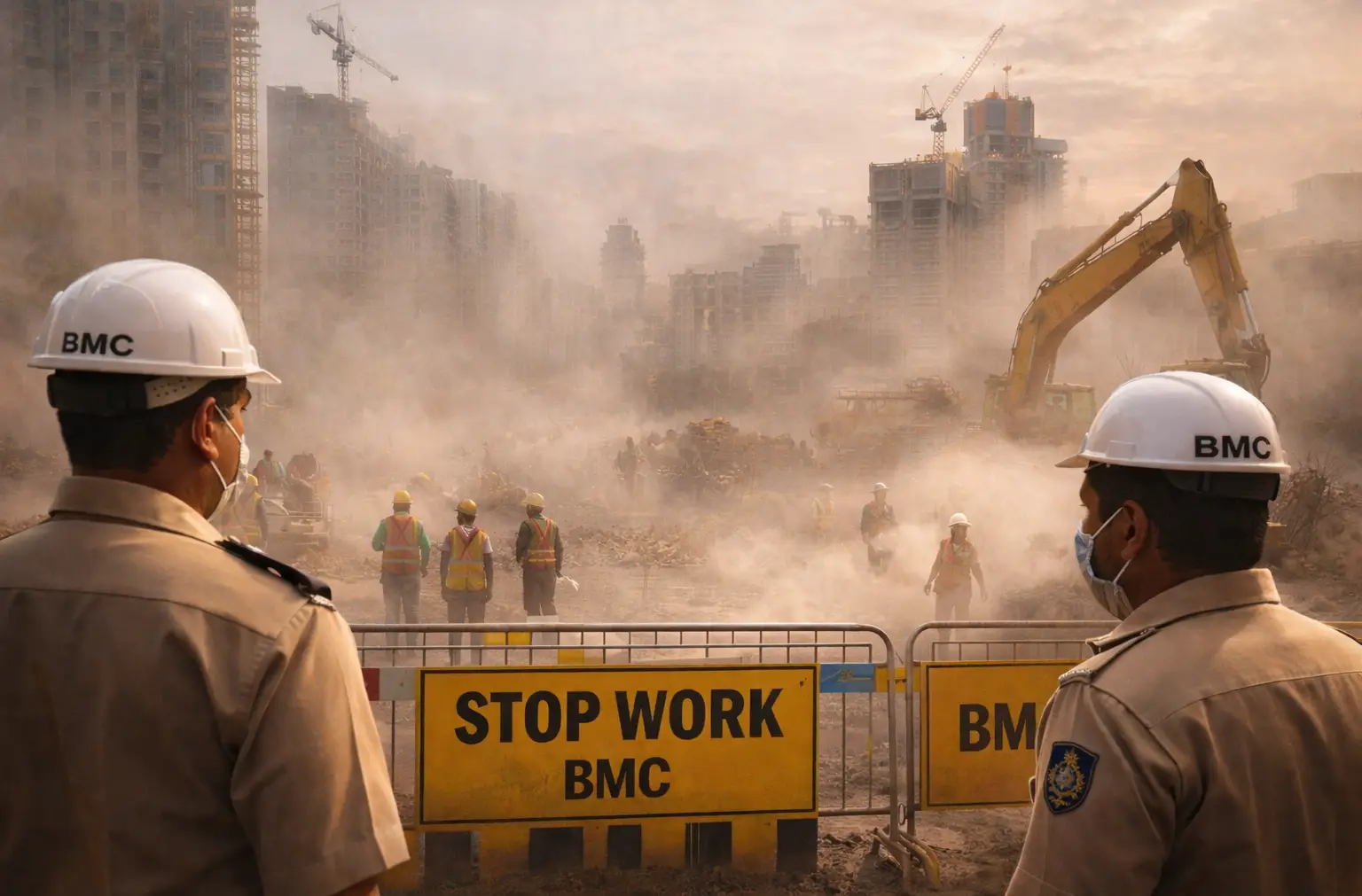
Construction activity at multiple locations in Navi Mumbai has been halted after civic authorities intensified enforcement against projects found violating air pollution control norms, signalling a sharper regulatory stance as urban air quality remains under pressure during winter months. The action, concentrated in Sanpada and Ghansoli, reflects a broader recalibration of how fast-growing satellite cities manage construction-led environmental stress.
According to civic officials, work was stopped at nine active construction sites over the past week following inspections that revealed non-compliance with mandatory dust suppression and site management protocols. The enforcement follows judicial directions requiring municipal bodies to strictly implement pollution-control measures at construction zones, particularly in high-density residential and commercial clusters. Senior officials involved in the inspections said several projects failed to meet baseline environmental safeguards. These included inadequate perimeter barricading, lack of dust-curbing coverings on partially constructed structures, and non-operational fogging and water-sprinkling systems intended to limit particulate dispersion. In multiple instances, construction materials were transported without protective covers, while basic worker safety equipment was missing at sites.
Urban planners note that such lapses have cumulative impacts in compact urban regions like Navi Mumbai, where construction zones often sit alongside housing, schools, and transport corridors. “Construction dust is one of the most persistent contributors to localised air pollution. Without enforcement, even small violations can significantly degrade neighbourhood air quality,” said an environmental planning expert. The latest closures follow inspections across different civic divisions, where authorities have adopted a zero-tolerance approach towards repeat offenders. Officials indicated that enforcement is no longer limited to private developers, with public-sector agencies also being scrutinised for adherence to pollution norms at large-scale housing and infrastructure projects.
This push comes amid growing concern over rising particulate levels across the Mumbai Metropolitan Region, particularly during winter inversions that trap pollutants close to the ground. Civic data shows that air quality indices have repeatedly breached moderate levels since the start of the year, prompting regulators to focus on construction emissions alongside vehicular pollution and waste burning. From an economic standpoint, the crackdown underscores a shift in urban governance priorities. While construction activity remains central to employment generation and housing supply, municipal authorities are signalling that project timelines will now be weighed against environmental compliance. Real estate analysts say this could encourage developers to invest more consistently in dust-control infrastructure rather than treating it as a temporary requirement during inspections.
The civic body has also expanded the use of financial penalties and tightened rules on water usage, mandating treated wastewater at construction sites to reduce pressure on potable supplies. Repeated violations, officials warned, could lead to suspension or cancellation of development permissions. As Navi Mumbai continues to grow as a residential and commercial hub, urban policy experts argue that sustained enforcement—rather than episodic drives—will be critical to balancing development with public health and climate resilience. The coming months are likely to test whether stricter oversight becomes a permanent feature of the city’s construction landscape.
Navi Mumbai Halts Work at Multiple Dust-Polluting Sites