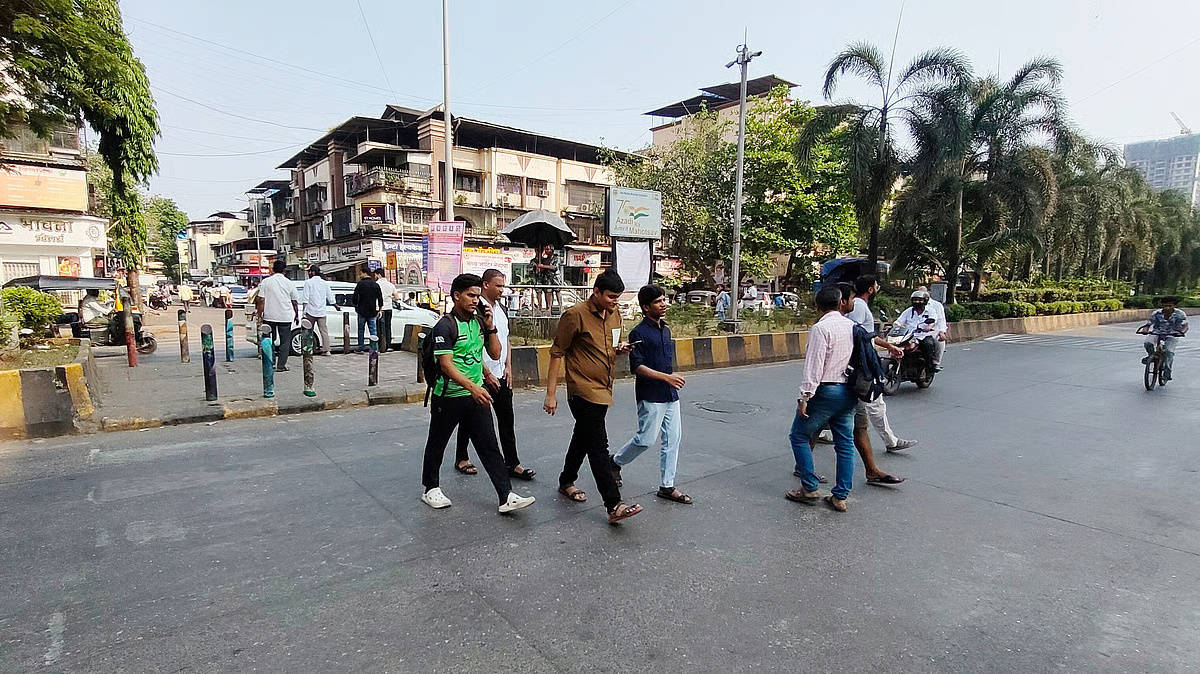
The Navi Mumbai Municipal Corporation (NMMC) has cleared a long-awaited skywalk proposal for Koparkhairane, aiming to reduce persistent pedestrian-related congestion on one of the city’s busiest corridors. The structure, planned for Sector 15, is expected to improve safety and streamline movement along the Vashi–Koparkhairane stretch, where unmanaged crossings have repeatedly disrupted peak-hour traffic. The approval marks a significant step in strengthening non-motorised mobility infrastructure in Navi Mumbai’s rapidly growing suburban belt.
For nearly two decades, residents had been calling for a structured pedestrian facility to ease movement between high-density residential clusters and key commercial nodes. Sector 15 experiences some of the sharpest evening and late-night footfall as thousands of commuters walk from the railway station towards adjoining sectors. According to local observers, the absence of grade-separated facilities has long led to chaotic road behaviour, heightened accident risk and extended travel delays. Officials from the corporation said the new skywalk will be developed at an estimated cost of ₹6.59 crore, with tendering set to begin shortly. The design includes one escalator and one lift, enabling access for senior citizens, people with disabilities, pregnant women and daily commuters who otherwise navigate wide and congested carriageways. The placement near Gulabchand Dairy was chosen after repeated traffic bottlenecks were reported between D-Mart Chowk and Teen Tanki.
Urban mobility experts note that pedestrian infrastructure in Indian cities often receives delayed attention, despite walking being the dominant mode for last-mile travel. They argued that well-designed skywalks—when supported with adequate lighting, safety measures and integration with public transport—can contribute to more inclusive and equitable street systems. However, they cautioned that past examples in Navi Mumbai, including an underused skywalk near the Vashi market, highlight the need for strong behavioural and enforcement measures to ensure adoption. Residents point out that the new location faces far denser pedestrian movement than earlier sites, particularly during evening peak hours. The junction is flanked by schools, colleges, markets, bus stops and a concentration of informal vendors. Several minor and major accidents have been reported over the years, prompting repeated requests from the traffic police to restrict vehicle lane switching and introduce safer pedestrian pathways.
According to officials, the skywalk will be built at a height of around 5 metres, with a width of 3.5 metres and an approximate length of 12 metres. Once tendering is completed, construction will begin in phases, with the civic body expected to coordinate closely with traffic authorities to minimise disruption. Urban planners say the project reflects a shift towards designing cities that prioritise safety, accessibility and shared public spaces. If executed effectively, the skywalk could serve as a model for pedestrian-friendly interventions across other dense nodes in Navi Mumbai. For residents of Koparkhairane, the long-pending infrastructure signals a move towards safer streets and a more humane mobility environment.
Navi Mumbai Approves Rs 6.59-Crore Koparkhairane Skywalk To Ease Pedestrian Chaos