


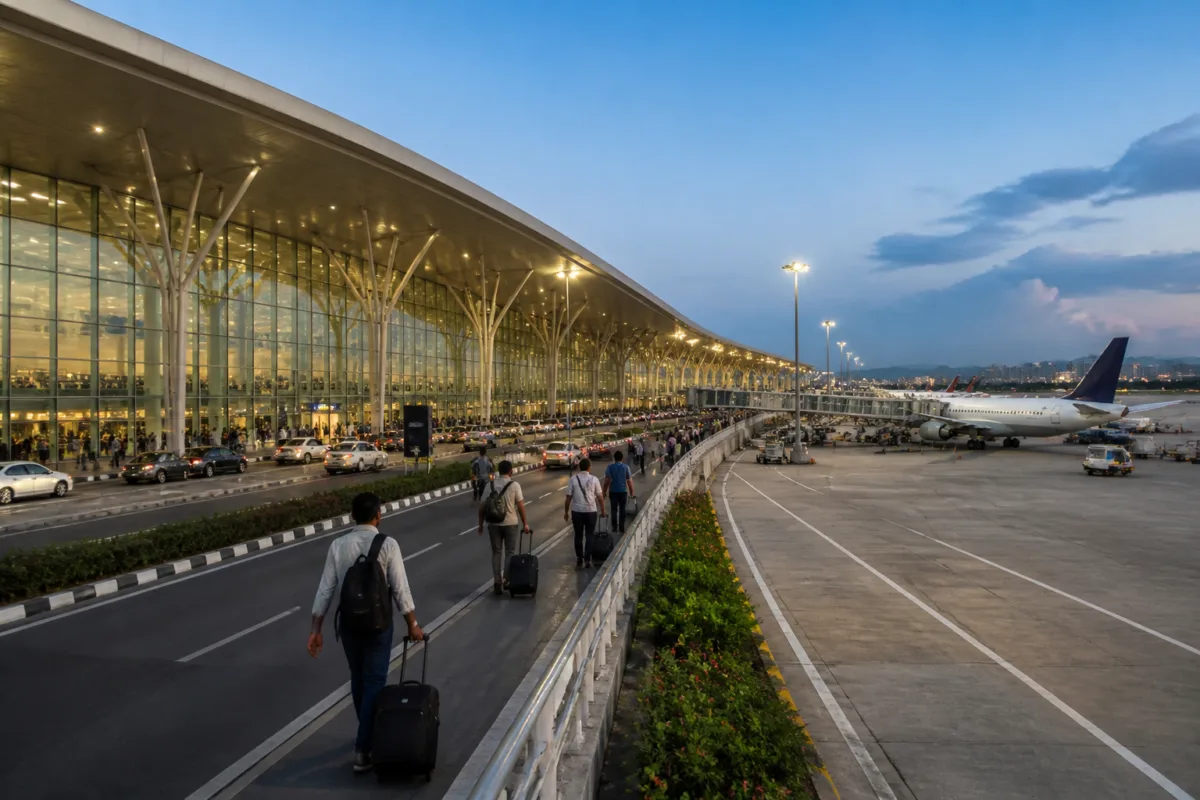
Navi Mumbai International Airport is likely to receive flights on 14 international routes from March 28, 2027, as Mumbai’s Chhatrapati Shivaji Maharaj International Airport temporarily suspends slots during the phased redevelopment of Terminal 1, according to a letter cited by PTI and reported by Mid-Day.
Foreign airlines operating from CSMIA have recommended shifting services to Navi Mumbai airport on a destination basis, the report said. MIAL Chief Airport Officer Vishnu Mohan Jha wrote to the civil aviation secretary stating that the airlines had recommended the arrangement to Adani Airport Holdings Ltd, which operates CSMIA.
The affected destinations are Bahrain, Dammam, Dhaka, Doha, Fujairah, Jakarta, Jeddah, Kathmandu, Kuwait City, Madinah, Muscat, Ras Al Khaimah, Riyadh and Sharjah. Under the proposed arrangement, flights from the Mumbai Metropolitan Region to each destination would operate from a single airport rather than being divided between CSMIA and Navi Mumbai airport.
MIAL has asked members of the airline operators committee to indicate which slots they could voluntarily shift. The letter said that if airlines did not do so, MIAL would move all flights to the 14 destinations. It described the arrangement as a way to provide seamless onward connections, reduce passenger inconvenience and create an integrated travel experience. About 91 per cent of CSMIA’s existing capacity would remain unaffected, according to the letter.
The shift is part of a wider plan to move around five million passengers per annum from CSMIA. Indian carriers’ plans account for approximately three million passengers per annum, the report said. IndiGo announced on October 25 that it would progressively shift 12 daily international departures to Navi Mumbai airport, expanding its international network there to 12 destinations between February and July 2027.
The Air India Group said Air India Express would begin four daily domestic flights from the new airport in December 2026. Planned services to Kuwait, subject to regulatory approvals, and existing services to Oman are scheduled to follow from January 2027. Flights to Jeddah, Riyadh, Dammam, Doha, Muscat and Sharjah are expected to move under the Northern Summer 2027 schedule. Akasa Air has also announced that its Mumbai–Jeddah service will operate from Navi Mumbai airport from December 2026.
The proposed international route transfer coincides with the planned demolition of the existing Terminal 1 at CSMIA, scheduled to begin in April 2027. T1, commissioned in 1964, has a designed capacity of 15 million passengers per annum. The report said structural audits by Structwel in 2017 and IIT Bombay in 2024 had flagged concerns about the terminal’s infrastructure. MIAL’s letter described the redevelopment as having been delayed for more than nine years.
The rebuilt T1 is expected to handle 20 million passengers per annum. Its contact stands are planned to increase from seven to 25, check-in counters from 74 to 109, baggage belts from five to 11 and security lanes from eight to 15, with five additional lanes for transfer passengers. Joint releases by the airlines and Adani Airport Holdings have placed completion in 2030.
CSMIA’s Terminal 2 is also scheduled for expansion, with construction of a northwest pier planned to begin in January 2027. The pier is expected to become operational by March 2029 and add four domestic bus boarding gates. CSMIA’s overall capacity is expected to rise from 55 million passengers per annum to 65 million after the T2 work. MIAL said historic slots surrendered during the transition would be restored once the T2 work is completed.
Navi Mumbai airport’s initial capacity is 20 million passengers per annum, including 15 million domestic and five million international passengers, with planned expansion to 90 million. The airport has 55 check-in counters, 24 electronic gates, 26 emigration counters and 32 immigration counters. A readiness assessment cited in the report said its runway, airside facilities and airspace could accommodate additional services. Under a modified variable tariff plan approved in September, new international routes will pay no landing fee in their first year and half the rack rate in the second year, while long-haul routes will receive a discount in the third year.

