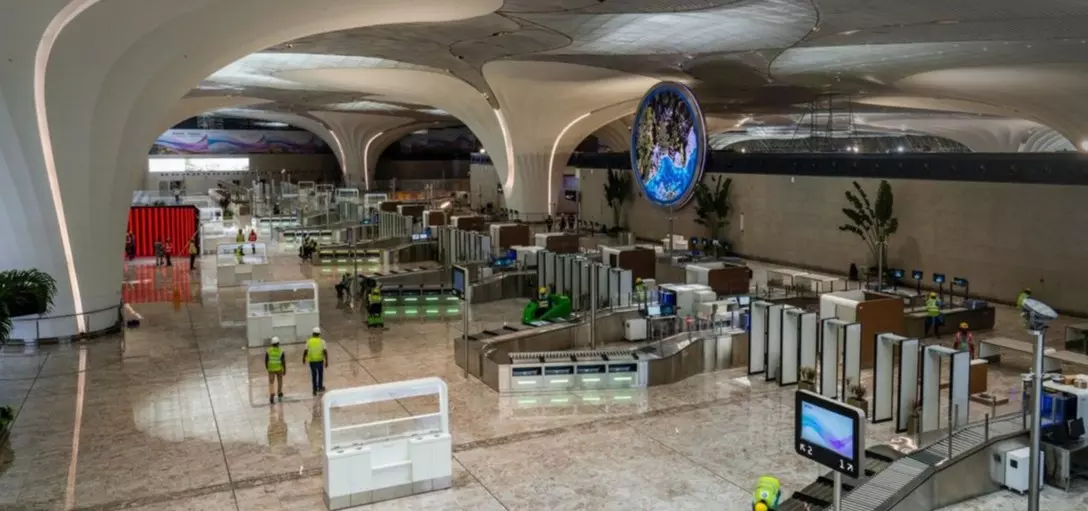
Navi Mumbai’s new international airport has recorded a significant operational milestone, handling over 100,000 passengers within the first 19 days of commercial flight services, signalling robust initial demand and emerging regional connectivity dynamics in the Mumbai Metropolitan Region (MMR). The passenger footfall — achieved between late December 2025 and mid‑January 2026 — reflects early traction for the greenfield facility as it ramps up services amid evolving travel patterns and infrastructure synergies.
Navi Mumbai International Airport Ltd (NMIAL), the joint venture between Adani Airport Holdings Ltd (AAHL) and CIDCO, reported that the airport handled 109,917 travellers — comprised of roughly equal arrivals and departures — with January 10 emerging as the busiest single day at the facility so far. The metrics encompass 734 air traffic movements, including scheduled and general aviation flights, and more than 22 tonnes of cargo, demonstrating that both passenger and freight segments are operational from the outset. For urban and transport planners, this early passenger volume is noteworthy given that the airport’s commercial operations only began on December 25, 2025, and that full network connectivity and associated transit links are still under development. The airport’s initial design capacity targets 20 million annual passengers, intending to relieve congestion at the older Chhatrapati Shivaji Maharaj International Airport and recalibrate the region’s air travel ecosystem as demand grows.
Regional connectivity data shows that Delhi, Goa and Bengaluru sectors have been the most frequented routes in this early phase, indicating strong intercity demand from MMR’s burgeoning middle class, business travellers and leisure flyers. As airlines expand their flight portfolios, this mix is likely to diversify further, potentially attracting south and east India sectors. The airport’s initial operating weeks also highlight how infrastructural upgrades are interlinked with broader regional planning. Despite strong passenger numbers, debates around ground connectivity, particularly with road and rail access to the airport from central Mumbai and Thane, continue — an urban challenge that authorities are addressing through multimodal transport links, including coastal road connectors and potential waterway services to integrate NMIA with suburban nodes.
Furthermore, the early uptake underscores the potential economic stimulus that the airport can generate for adjacent urban corridors. Property markets, allied tourism services and logistics clusters are already showing heightened investor interest, driven by expectations of improved accessibility and employment opportunities. This aligns with Maharashtra’s agenda to decentralise growth clusters and reduce pressure on core Mumbai infrastructure.However, early operational data must be contextualised with caution. With full phased expansion and related services still to come — including enhanced domestic and future international flight schedules — current figures represent initial momentum rather than sustained long‑term trends. Analysts stress that robust surface connectivity, airline partnerships and passenger experience optimisation will be critical to cement the airport’s role as a major regional hub.
Looking forward, scaling NMIA’s operations while syncing with urban transport frameworks and sustainable development imperatives will determine whether this new infrastructure can catalyse equitable economic opportunities across the MMR, reduce congestion at existing hubs and support climate‑aligned mobility solutions.