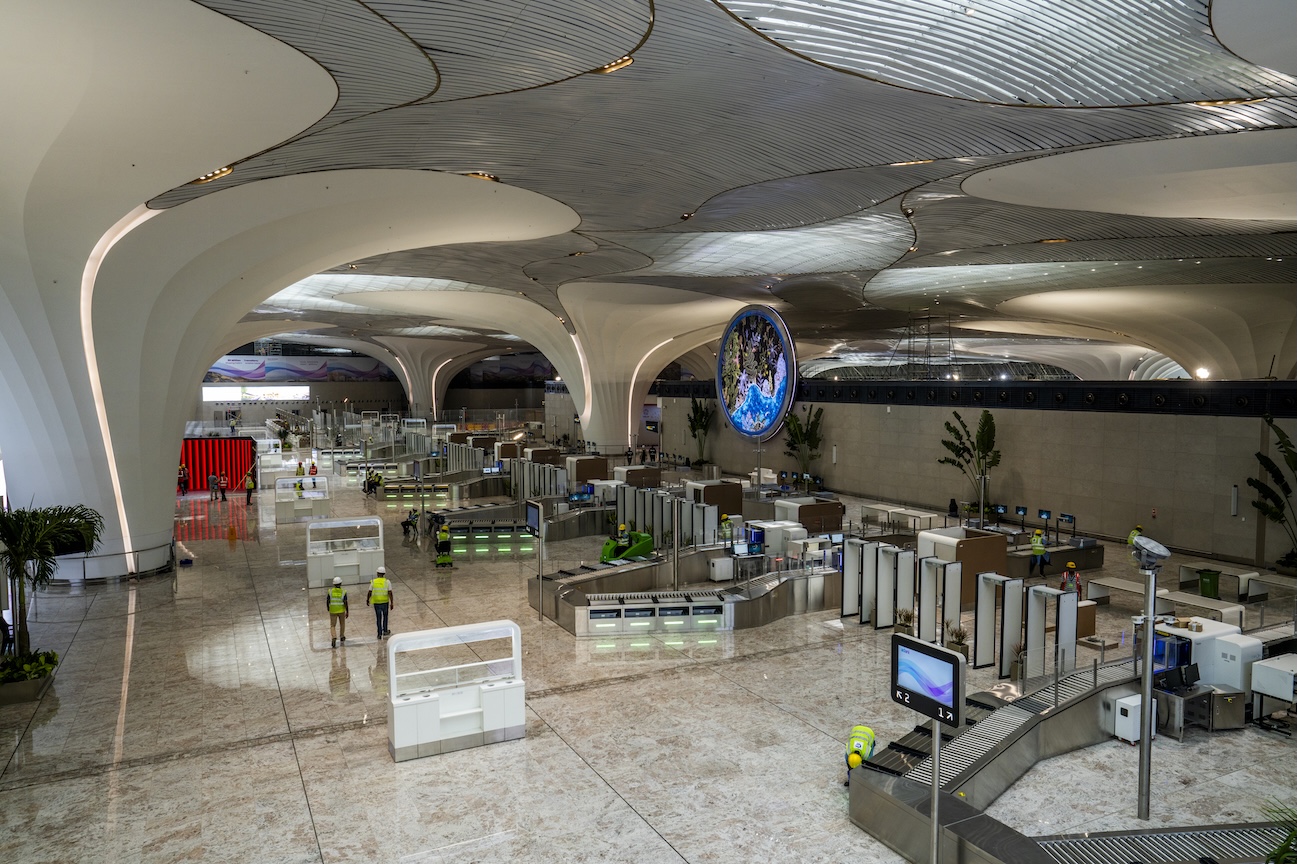
Navi Mumbai’s long-awaited greenfield airport is rapidly transitioning from a symbolic infrastructure milestone to a functional metropolitan gateway, with authorities projecting daily passenger volumes to reach 50,000 by the end of the year. The scaling up of flight operations marks a significant shift for the Mumbai Metropolitan Region (MMR), easing long-standing congestion pressures while opening new economic corridors across Navi Mumbai and adjoining districts.
Commercial operations began in late December, and early passenger uptake has exceeded initial operational benchmarks, according to officials familiar with the rollout. The airport is currently handling a limited number of daily movements within restricted operating hours, but this phase is being treated as a controlled ramp-up rather than a soft launch. Industry planners say the strategy allows airlines, ground handlers, and civic agencies to stabilise operations before capacity expansion. From February, the airport is scheduled to transition to round-the-clock operations, a move expected to double daily flight movements. Aviation experts note that extended operating hours are crucial for attracting long-haul and international services, as well as late-evening business travel, which remains underserved in the region. Notices issued to pilots and operators indicate preparations are already underway for expanded airspace usage and night operations.
Airlines have begun responding to early demand signals. Domestic carriers have added late-evening departures on high-density routes, while others have publicly identified Navi Mumbai Airport as a strategic base for future growth. According to sector analysts, the airport’s design and slot availability make it particularly attractive for carriers seeking operational flexibility compared to saturated metro airports. The mix of passengers using the facility has also drawn attention. While leisure travel remains strong, corporate travel demand from Navi Mumbai, Panvel, and industrial clusters along the Mumbai–Pune corridor is rising steadily. Urban economists say this trend reflects the gradual decentralisation of Mumbai’s employment hubs, with aviation infrastructure playing a catalytic role in reshaping work and travel patterns.
Beyond aviation, the airport’s expansion carries broader urban implications. Improved connectivity is expected to stimulate transit-oriented development, logistics parks, and mixed-use real estate around the airport influence zone. Urban planners caution, however, that growth must be aligned with climate-resilient infrastructure, public transport integration, and equitable access to avoid replicating congestion and environmental stress seen elsewhere in the region. With international operations slated to begin in the coming months, Navi Mumbai Airport is positioned to emerge as a second aviation anchor for India’s financial capital. The next phase will test how effectively infrastructure expansion can balance economic momentum with sustainability, liveability, and long-term urban resilience.
Navi Mumbai Airport Scales Up Passenger Capacity