


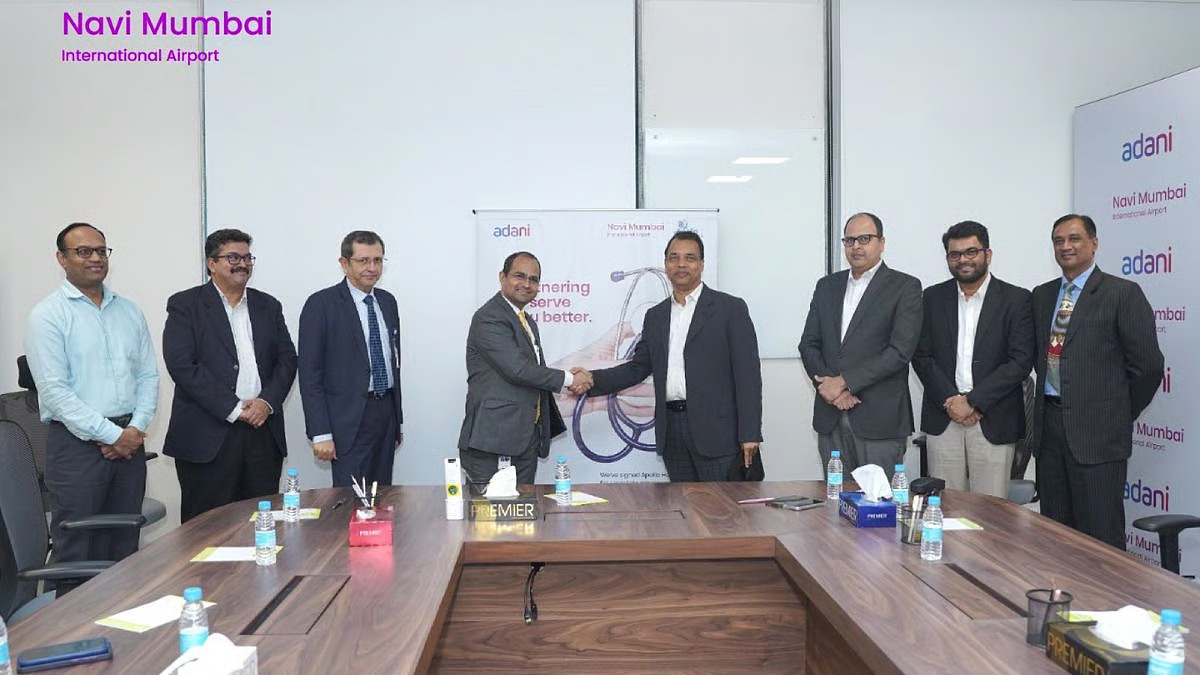
Navi Mumbai International Airport (NMIA) has partnered with Apollo Hospitals to establish round-the-clock healthcare services within its upcoming passenger terminal. The collaboration aims to ensure swift medical response, emergency preparedness, and preventive healthcare at one of India’s most anticipated aviation hubs.
Under the newly signed Memorandum of Understanding (MoU), Apollo Hospitals will set up a 24×7 medical centre at Terminal 1 of the airport. The facility will provide immediate medical attention for both passengers and airport personnel and will also function as an emergency response unit. Equipped with critical care infrastructure and disaster management systems, the centre will be staffed by three doctors, eight nurses, and two ambulance drivers — all trained and certified in Advanced Cardiovascular Life Support (ACLS). According to airport officials, the healthcare unit will be complemented by two fully equipped Intensive Care Unit (ICU) ambulances stationed at the site for rapid response in case of medical emergencies. To further strengthen cardiac care, 65 Automated External Defibrillators (AEDs) will be installed across the terminals, ensuring that life-saving intervention is available within minutes during a cardiac event.
A senior NMIA representative said the partnership reflects the airport’s commitment to prioritising passenger and workforce welfare. “With the expected high footfall once operations begin, having a medical system that meets global standards is crucial for ensuring safety and preparedness,” the official noted. Healthcare experts described the partnership as a sign of India’s growing emphasis on integrating medical readiness into urban and transport infrastructure. Airports are increasingly becoming multi-functional urban spaces, serving not just as transit hubs but as self-contained ecosystems that demand comprehensive emergency preparedness.
The integration of advanced healthcare facilities at NMIA aligns with the larger goal of building sustainable, resilient, and inclusive infrastructure under India’s urban development agenda. With Navi Mumbai poised to emerge as a major commercial and residential hub, the collaboration also strengthens the city’s overall healthcare network. The Navi Mumbai International Airport, being developed in multiple phases, is designed to handle 20 million passengers annually in its initial stage. Initiatives such as this one reinforce the airport’s vision of setting new benchmarks in safety, comfort, and sustainability for India’s next-generation transport infrastructure.
Also Read: Maharashtra Gears Up For Civic Polls To Reshape Urban Growth And Governance
