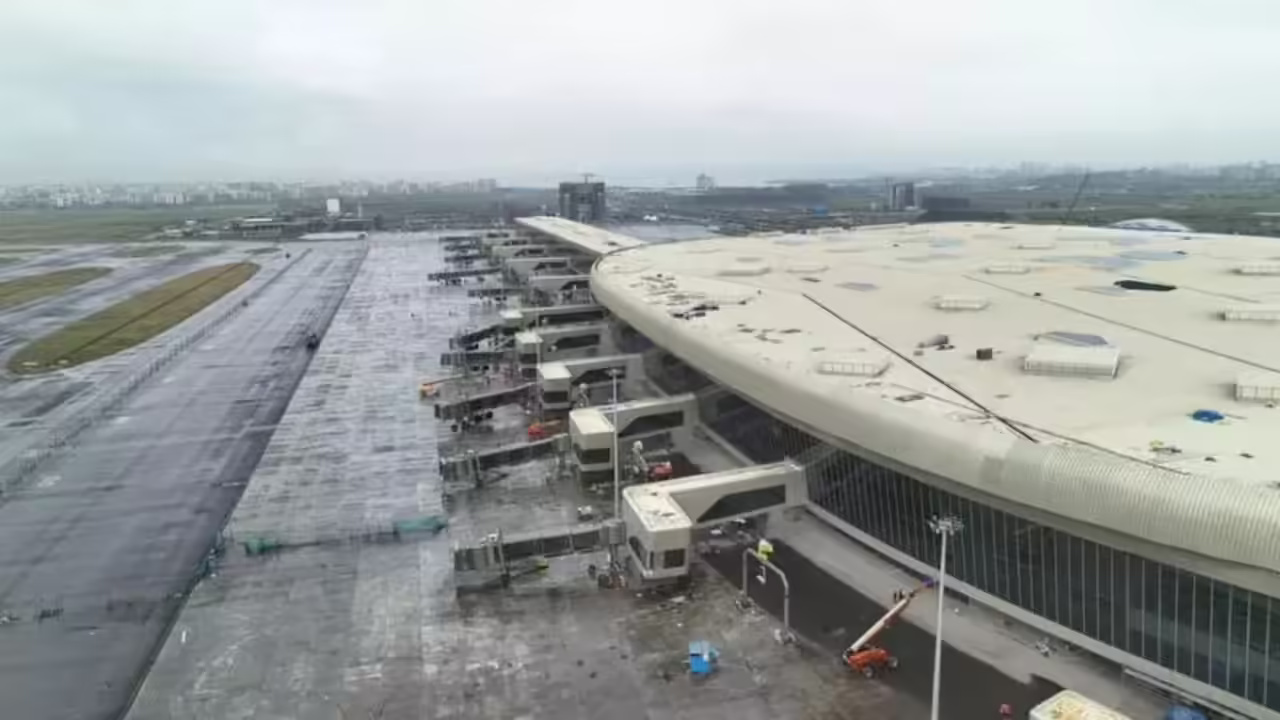
Navi Mumbai’s upcoming international airport is entering a new phase of long-term planning as the state planning authority initiates a feasibility assessment for a potential third runway, signalling an effort to future-proof aviation capacity across the Mumbai Metropolitan Region.
The City and Industrial Development Corporation, the project’s nodal agency, has invited bids to appoint a consultant to conduct a detailed technical and commercial study for an additional parallel runway at the airport site. Officials said the six-month assignment is intended to evaluate whether further airside infrastructure would be required beyond the airport’s already ambitious phased development programme. According to the tender outline, the study will examine air traffic projections, operational constraints, land availability, safety parameters and financial viability. Proposals are open to eligible firms as well as joint ventures, reflecting the complexity and scale of the assessment. An official familiar with the process said the aim is not immediate construction, but informed decision-making for the decades ahead.
The move comes amid mounting pressure on aviation infrastructure in the Mumbai region. At present, the city relies heavily on a single operational airport with limited scope for expansion due to urban density. Aviation planners note that while efficiency upgrades have stretched capacity in the short term, structural constraints remain. With the Navi Mumbai airport expected to become operational shortly, authorities are preparing for a coordinated multi-airport system to absorb rising passenger and cargo demand. Once fully developed, the new airport is planned to handle up to 90 million passengers annually and process over three million tonnes of cargo. It will initially operate with two independent parallel runways and multiple interconnected terminals, with expansion phases scheduled through the mid-2030s. Officials say these provisions are expected to address medium-term growth, but longer-term forecasts suggest demand could exceed current planning assumptions.
Industry experts argue that examining a third runway at this stage reflects a shift towards anticipatory infrastructure planning rather than reactive expansion. A senior aviation consultant said early feasibility studies allow authorities to safeguard land, integrate environmental safeguards and align future development with regional transport and climate objectives. “Airports planned today must operate efficiently for at least half a century,” the consultant noted. From an urban development perspective, the proposal also raises questions around sustainability and regional balance. Planners emphasise that any future expansion must be aligned with public transport connectivity, low-emission ground operations and careful environmental management, particularly given the airport’s proximity to sensitive ecosystems.
While the feasibility study does not guarantee execution, it underscores the scale of ambition shaping Navi Mumbai’s aviation role. For a region grappling with congestion, economic growth and climate responsibilities, long-term planning at the airport could prove critical in shaping a more resilient and balanced metropolitan future.
Navi Mumbai Airport Eyes Third Runway As CIDCO Launches Long Term Study