Navi Mumbai Airoli Sees Major Commercial Lease Uptick
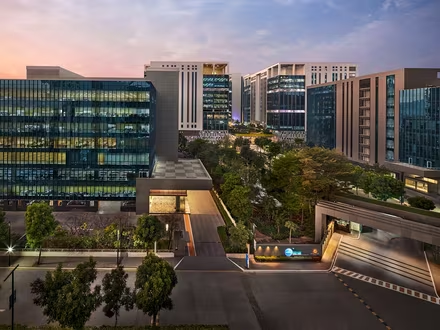
The Mumbai Metropolitan Region’s (MMR) office real estate market continued its momentum in early 2026 with a significant long‑term lease reflecting growing demand for large‑format commercial space in Navi Mumbai’s Airoli business district. HERE Solutions India Pvt. Ltd., the India arm of a global location‑technology company, has signed a lease exceeding 2.1 lakh square feet at Mindspace Airoli West (Gigaplex) — a landmark transaction that underscores Airoli’s emergence as a preferred office hub outside South Mumbai’s traditional central business districts.
The agreement spans more than 10 years, signalling robust corporate confidence in the region’s ability to support sustained operations and workforce expansion. The leased space covers three floors within the modern campus and is poised to anchor HERE’s India operations as firms increasingly seek scalable, high‑quality facilities that combine infrastructure efficiency with strategic connectivity. This development aligns with broader market patterns where Navi Mumbai nodes — particularly Airoli, Ghansoli, and knowledge parks along the Thane‑Belapur Road corridor — are gaining traction among national and multinational occupiers. Traditionally, corporate demand was concentrated in Mumbai’s core districts such as Nariman Point, Bandra‑Kurla Complex and Lower Parel, but shifts in occupier preferences towards cost efficiency, commuting ease, and amenity‑rich campus environments have reshaped the regional real estate calculus.
For landlords and real estate investment trusts (REITs) managing institutional‑grade assets, securing long‑duration leases with established tenants offers predictable revenue streams and enhances asset valuations. Mindspace Airoli West, part of the portfolio of a major institutional landlord, has become a focal point for such activity. Commercial transactions here serve as bellwethers of sustained leasing appetite in the MMR as occupiers balance growth strategies with operational cost structures. From an urban development perspective, expanded office occupancy in peripheral hubs like Airoli carries implications for broader metropolitan dynamics. It can relieve commuter pressure on rail and road networks serving central corridors, incentivise ancillary services and retail clusters, and spur enhancement of public transport connectivity. However, planners caution that infrastructure uplift must keep pace with demand to avoid localized congestion and housing affordability pressures that often accompany concentrated employment growth.
The financial terms — including a starting rent benchmark and annual escalation clauses — reflect market calibration where tenants negotiate long‑term cost stability amid rising construction costs and competitive leasing environments. Analysts note that such deals can influence leasing benchmarks in neighbouring nodes, particularly as companies across technology, consulting, and services sectors reassess footprint strategies post‑pandemic. Importantly, this transaction contributes to a narrative of decentralised office growth in the MMR. While South Mumbai and Lower Parel maintain prestige appeal, emerging districts offer a blend of quality space, improved connectivity via suburban rail and highways, and potential for integrated live‑work‑play development — a triad increasingly valued by employers and urban residents alike.
As demand for commercial space evolves, stakeholders — including city planners, transport authorities and developers — must continue synchronising infrastructure, mobility and land use strategies to foster equitable, resilient and economically vibrant urban growth in Navi Mumbai and the wider MMR.