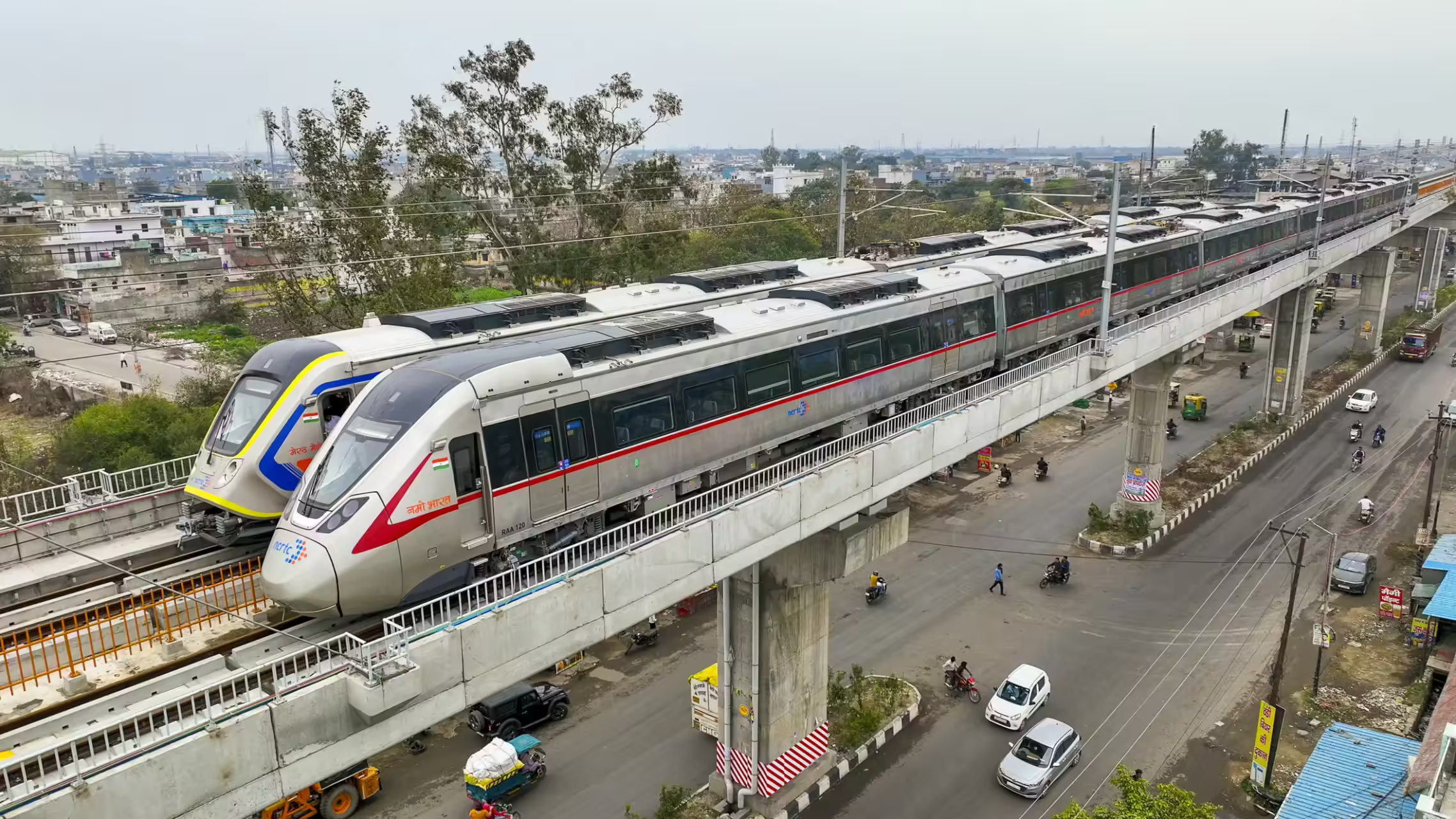
Namo Bharat Rapid Transit Marks Key Infrastructure Launch
Lucknow — Senior officials in Uttar Pradesh are spotlighting the inauguration of the full Namo Bharat Regional Rapid Transit System (RRTS) corridor connecting Delhi and Meerut as a landmark shift in India’s transport infrastructure, with implications for urban mobility patterns across the National Capital Region (NCR) and adjacent cities.
The project’s completion and operational launch signal a transition toward high-speed, integrated transit that could reshape commuter dynamics, economic linkages and emission-reduction strategies in one of the country’s most populous regions. The 82-kilometre Namo Bharat corridor, developed by the National Capital Region Transport Corporation (NCRTC), has begun full operations after phased commissioning. Designed for speeds up to approximately 180 km/h, the system dramatically cuts travel times between the national capital and western Uttar Pradesh, with the complete stretch now traversable in under an hour — a stark contrast to previous road journey durations of three hours or more.
Unlike conventional commuter rail, Namo Bharat is India’s first Regional Rapid Transit System (RRTS) designed to bridge inter-city distances while offering metro-like frequency and comfort. Integrated with the new Meerut Metro — which operates on shared infrastructure and supports intra-city movement at speeds up to 120 km/h — the corridor embodies an evolving model of layered transport that connects metropolitan centres with surrounding urban and peri-urban zones. Urban transport specialists indicate that these high-speed services could catalyse more balanced regional growth. By improving access to jobs, education and services across city boundaries, the corridor supports decentralised labour markets and discourages over-concentration in core urban cores like Delhi alone. Enhanced connectivity can also stimulate demand for housing, retail and services in satellite cities such as Meerut, reshaping urban growth footprints and potentially easing pressure on overburdened city infrastructures.
Environmental sustainability is another expected advantage. Shifting commuter traffic from private vehicles and long-distance buses to high-capacity electrified rail reduces road congestion and lowers carbon emissions — a priority for planners aiming to align India’s transport expansion with climate resilience goals. Many planners advocate that integrated rapid transit corridors should complement local public transport networks and active modes such as walking and cycling to maximise emissions reductions. Gender and workforce inclusion have also surfaced as noteworthy aspects of the system’s rollout. Reports indicate that a large proportion of operational staff on the Namo Bharat corridor are women, highlighting opportunities for greater female participation in advanced transport systems and breaking traditional gender norms in technical and operational roles.
However, urban analysts caution that high-speed corridors must be paired with strong last-mile connectivity to be fully effective. Seamless access from homes and employment centres to rapid rail stations — via buses, e-rickshaws or non-motorised pathways — determines how equitably the benefits of such transformative infrastructure reach diverse populations. Without thoughtful network integration, rapid services risk under-utilisation by commuters who cannot conveniently access stations. For Lucknow and other fast-growing cities, the milestone also underscores the emerging role of regional transit in planning frameworks. As urbanisation intensifies, transport strategies that transcend municipal borders — connecting cities within broader economic hinterlands — are increasingly critical to managing congestion, promoting equitable growth and reducing environmental impacts.
As the Namo Bharat corridor begins regular operations and future expansions are planned, the focus will shift to ensuring that the infrastructure supports resilient, inclusive mobility while enabling broader systemic shifts toward sustainable regional development.