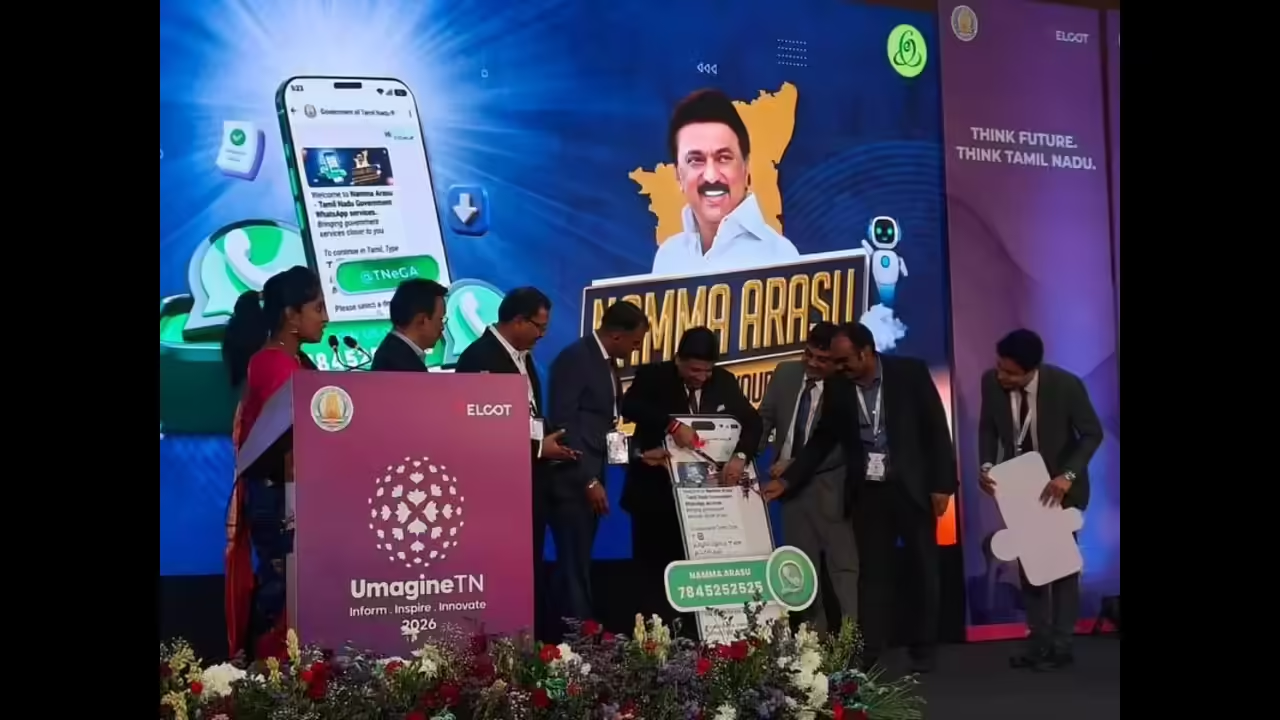
The Tamil Nadu government has rolled out a WhatsApp-based chatbot, ‘Namma Arasu,’ enabling citizens to access 50 government services through a single conversational platform. Developed by the Tamil Nadu e-Governance Agency (TNeGA) in collaboration with Meta, the initiative is designed to simplify service delivery, reduce bureaucratic delays, and expand digital accessibility across the state.
‘Namma Arasu’ provides services ranging from certificate downloads and utility bill payments to welfare schemes, property registration, ration card management, grievance filing, temple donations, and tourism bookings. Citizens can access the bot in both Tamil and English via +91 7845 252525. Officials indicated that a second phase, adding 50 more services, will be rolled out within three months based on user feedback.The platform adopts an “intent-based mapping” approach, making it context-aware rather than relying solely on keyword-based responses. TNeGA’s chief executive explained that this allows the chatbot to interpret nuanced citizen requests, improving the efficiency and intuitiveness of service access. Such technology-driven governance tools are increasingly being leveraged to bridge the urban-rural digital divide and reduce the friction associated with traditional e-Seva counters.
Urban governance analysts note that integrating multiple citizen-facing services into a single digital interface can enhance administrative transparency and accountability. “A unified platform like Namma Arasu reduces the need for physical visits to government offices, cutting travel time, transaction costs, and the administrative load on local civic staff,” said a senior urban policy consultant. In a state like Tamil Nadu, where urban-rural connectivity and literacy gaps remain significant, such initiatives also serve as a model for inclusive, technology-enabled public service delivery.The rollout coincided with a series of investment announcements, including MoUs worth over Rs 9,800 crore, projected to generate more than 4,200 jobs. Agreements with companies such as Better Compute Works and EROS Gen AI highlight the state’s push for digital infrastructure expansion, AI-enabled solutions, and skill-intensive employment opportunities. Analysts point out that government-supported digital initiatives paired with private sector collaboration can catalyse economic growth, strengthen civic services, and build a more resilient urban ecosystem.
While early adoption may be concentrated in urban centres, officials emphasise that the chatbot’s simplicity and mobile-first design aim to ensure accessibility for rural populations as well. As cities and districts integrate such digital tools, the long-term success of Namma Arasu will hinge on citizen uptake, continuous updates, and user-friendly interfaces that respond to evolving service needs.