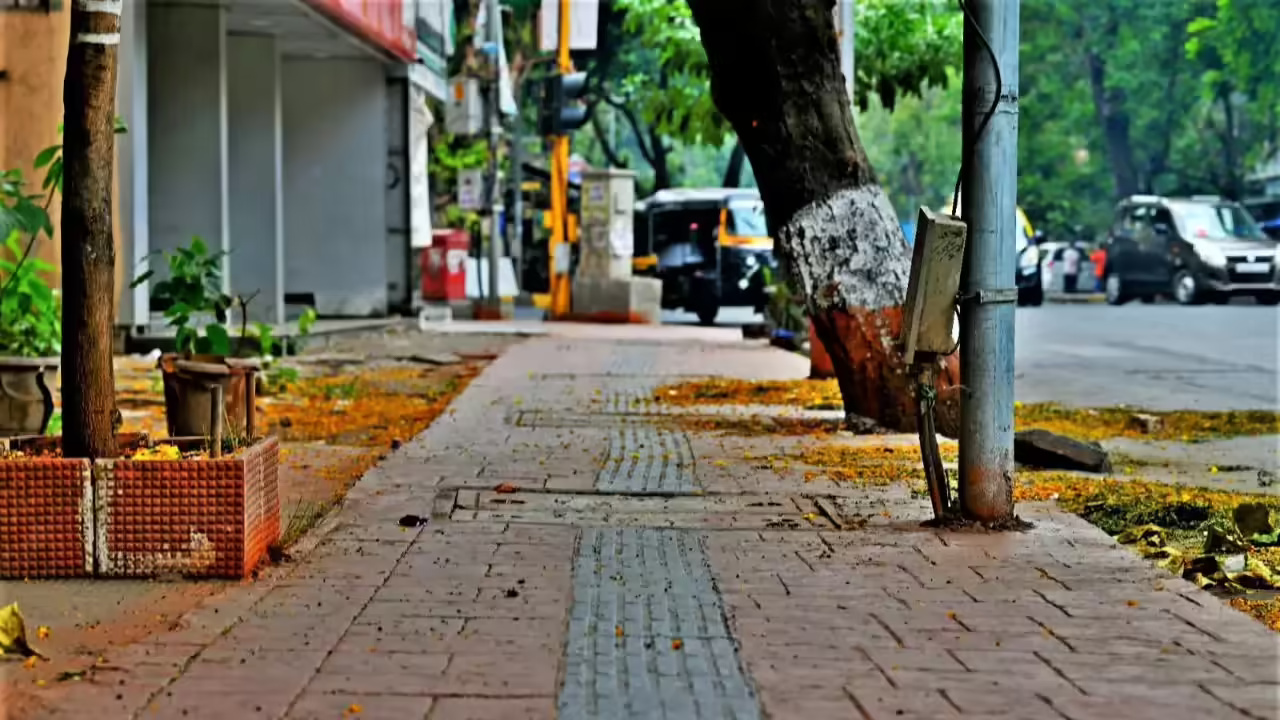
BMC Launches Rs 100 Crore Footpath Revamp To Transform Walkways Across Mumbai
Nagpur’s streets are witnessing growing tension between pedestrian access and informal commerce as Nagpur footpath encroachment spreads across several neighbourhoods, limiting safe walking space for residents. Pavements designed to support non-motorised mobility are increasingly occupied by street stalls, temporary shops and parked vehicles, raising concerns about pedestrian safety and the city’s broader urban planning goals. Across busy commercial corridors and residential zones, large sections of footpaths are now blocked or partially inaccessible. Residents report that many pavements have gradually turned into informal marketplaces, forcing pedestrians including schoolchildren, elderly residents and people with disabilities to walk on the carriageway alongside moving traffic. Urban planners say such conditions undermine one of the basic principles of sustainable city design: safe, continuous pedestrian infrastructure. Footpaths are meant to provide a barrier between people and traffic, encouraging walking as a healthy, low-carbon form of urban mobility. When these spaces are compromised, cities risk becoming more car-dependent and less inclusive.
Municipal officials acknowledge that Nagpur footpath encroachment has become a recurring challenge in areas with dense commercial activity. Street vending forms an important part of the local urban economy, supporting thousands of livelihoods. However, balancing this informal sector with the need for organised pedestrian space remains a complex governance issue. According to urban development specialists, the solution lies not only in enforcement drives but also in long-term planning that formally integrates street vendors into city design. Many Indian cities are experimenting with designated vending zones, structured markets and clearly demarcated walking corridors. Such measures aim to protect livelihoods while ensuring pavements remain usable for pedestrians.The situation also reflects a wider infrastructure gap. In many locations, footpaths are either narrow, poorly maintained or discontinuous, making them vulnerable to occupation. Without consistent design standards — such as minimum width, proper drainage and accessibility features — pavements often fail to function as intended.Transport experts point out that cities aspiring to reduce congestion and emissions must prioritise pedestrian infrastructure. Encouraging walking reduces reliance on private vehicles, improves air quality and supports more equitable mobility. When footpaths disappear, the most vulnerable urban users are pushed into unsafe conditions.
Municipal authorities have indicated that periodic inspections and removal of illegal structures are being undertaken. Yet enforcement alone rarely produces lasting change unless accompanied by urban design solutions that allocate space for both movement and commerce. For Nagpur, the challenge of Nagpur footpath encroachment highlights a broader shift underway in Indian urban policy — one that increasingly recognises streets as shared civic spaces rather than corridors solely for vehicles. As the city continues to expand and modernise its infrastructure, ensuring that pavements remain accessible, safe and inclusive may prove essential for building a people-first and climate-resilient urban future.