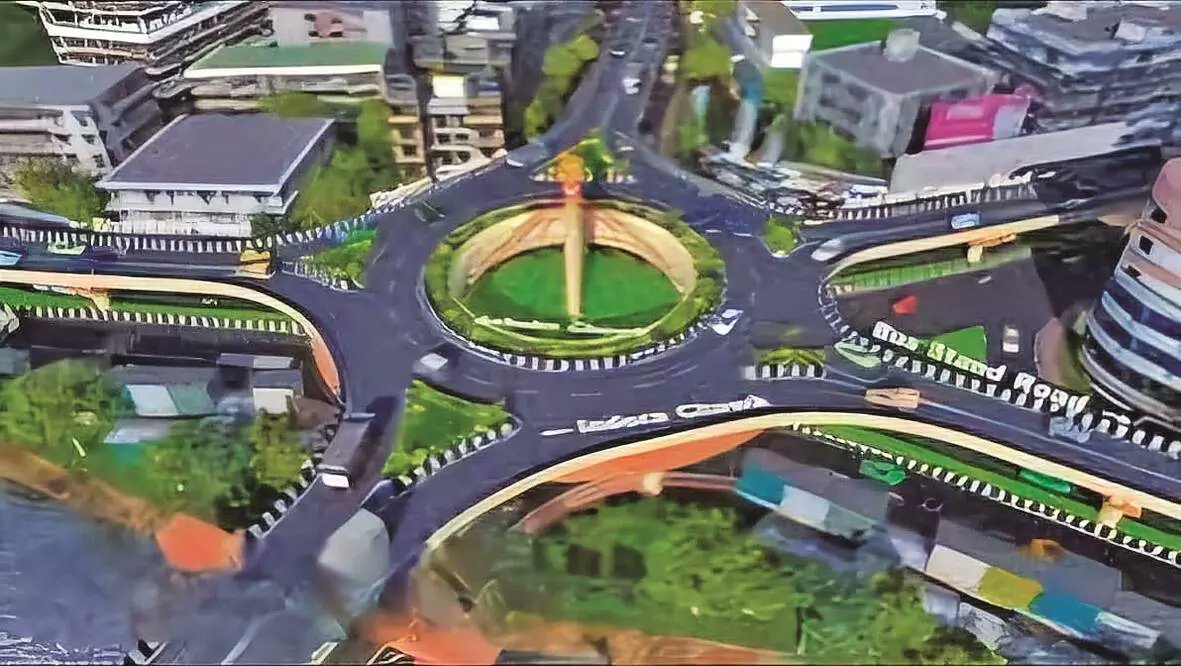
The near-completion of the Nagpur Ashok Chowk flyover marks a significant step in easing congestion across one of the city’s busiest transport corridors, with authorities positioning the project as a key intervention in improving urban mobility and travel efficiency.
Located along the Indora–Dighori stretch, the flyover forms part of a larger high-value road infrastructure programme designed to decongest central Nagpur and streamline east–west traffic movement. The elevated structure, along with associated road improvements, is expected to reduce travel time across key junctions that have historically witnessed heavy bottlenecks during peak hours. The Ashok Chowk junction itself has been a critical pressure point in the city’s traffic network, linking major routes such as Bhandara Road, Reshimbagh, and the Government Medical College area. With the introduction of a multi-arm elevated rotary and connecting ramps, the project aims to segregate through-traffic from local movement—an approach increasingly adopted in Indian cities to manage growing vehicular volumes. For commuters, the Nagpur Ashok Chowk flyover is expected to deliver immediate benefits in terms of smoother traffic flow and reduced delays. However, its significance extends beyond travel time savings. Urban planners note that such grade-separated infrastructure plays a critical role in shaping land use patterns, influencing real estate development, and enhancing connectivity between emerging residential and commercial zones.
The project is part of a broader push to modernise Nagpur’s transport infrastructure using advanced construction technologies. The larger corridor incorporates high-performance materials designed for durability and lower maintenance, reflecting a shift toward long-life urban infrastructure systems that can withstand rising traffic loads and climate stress. At the same time, the development has not been without challenges. Construction in dense urban areas has led to temporary disruptions, traffic diversions, and concerns around proximity to residential structures in certain stretches. Such issues highlight the complexities of retrofitting large-scale infrastructure into already built-up city environments.The Nagpur Ashok Chowk flyover also aligns with broader efforts to create more efficient and lower-emission urban transport systems. By reducing idling time and traffic congestion, elevated corridors can contribute to lower fuel consumption and improved air quality—an increasingly important consideration as cities confront climate and pollution pressures.However, experts caution that flyovers alone cannot resolve long-term mobility challenges. Sustainable urban transport requires integrated planning that includes public transit expansion, pedestrian infrastructure, and traffic demand management. Without these complementary measures, cities risk becoming over-reliant on road-based solutions.
Looking ahead, the operationalisation of the flyover will be closely watched as a test case for how effectively such projects translate into real-world mobility improvements. For Nagpur, which is positioning itself as a logistics and infrastructure hub, the success of this corridor could influence future investment decisions in urban transport.As the Nagpur Ashok Chowk flyover moves toward full functionality, it represents both an infrastructure milestone and a reminder of the need for balanced, forward-looking urban planning in rapidly expanding cities.