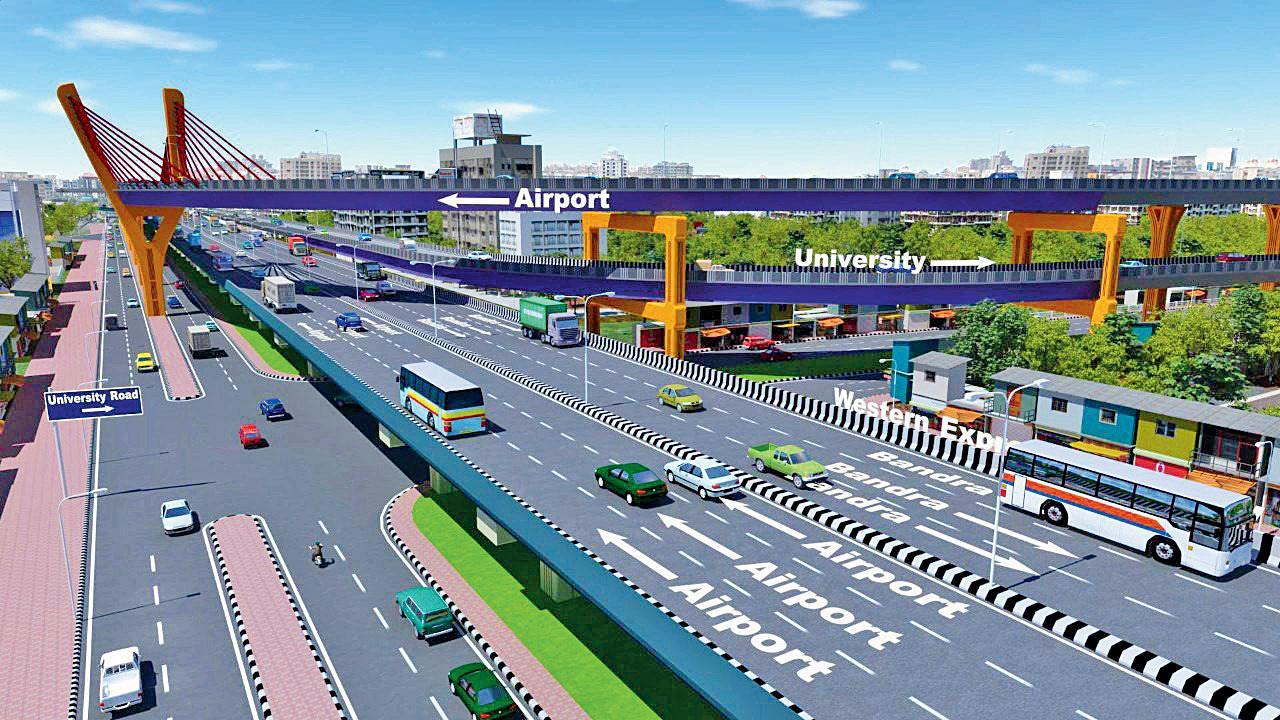
A key urban mobility link between Santacruz and the business district of Bandra–Kurla Complex is approaching completion but will open slightly later than expected as engineers finish final structural work. The Vakola BKC Elevated Road, designed to ease congestion and shorten cross-city travel, is now likely to be operational in April, offering a faster route between Mumbai’s eastern and western suburbs.
The elevated corridor forms part of the broader Santacruz–Chembur Link Road extension, a critical transport project intended to strengthen east–west connectivity across the city’s congested suburban landscape. Urban mobility planners say the project will create a signal-free connection between major junctions around Vakola and the financial hub of BKC, helping reduce pressure on existing arterial roads. Transport officials involved in the project indicated that the delay is linked to the installation of a major structural component near the Western Express Highway junction. The segment involves a curved alignment, requiring additional safety precautions during girder installation and traffic management. Temporary traffic blocks are expected to be implemented to allow construction teams to safely complete the remaining engineering work.
Stretching roughly 1.2 kilometres, the Vakola BKC Elevated Road has been developed at an estimated cost of around ₹645 crore. The corridor will feature two traffic lanes in each direction, allowing uninterrupted vehicle movement and reducing delays caused by traffic signals or junction conflicts. Urban planners note that once operational, the route could significantly reduce travel time between Santacruz and BKC — a journey that currently takes up to 30–35 minutes during peak hours. With the elevated corridor providing a direct connection, commuting time is expected to fall to approximately 5–10 minutes, depending on traffic conditions.
Beyond convenience for motorists, the project carries broader implications for Mumbai’s evolving urban transport network. BKC has emerged as one of India’s most prominent financial and commercial districts, attracting thousands of daily commuters. Improved road connectivity from surrounding neighbourhoods could support economic activity while reducing traffic bottlenecks along existing surface roads. Infrastructure experts also point out that better east–west links are essential for building a more balanced and efficient mobility system in the Mumbai Metropolitan Region. Many of the city’s roads primarily run north–south, forcing commuters to rely on a limited number of cross connections. Strategic infrastructure such as the Vakola BKC Elevated Road helps address this structural gap by distributing traffic across additional corridors.
However, planners caution that road projects alone cannot solve urban congestion. Integrating road upgrades with expanded public transport networks, pedestrian infrastructure, and transit-oriented development will remain critical for building a sustainable mobility ecosystem. As final construction tasks move toward completion, transport authorities are expected to carry out safety checks and operational trials before opening the elevated link to public traffic. Once launched, the corridor is expected to reshape daily commuting patterns between Mumbai’s residential suburbs and one of its most important business districts.
Mumbai’s Vakola–BKC Elevated Corridor Nears Completion Amid Final Technical Work