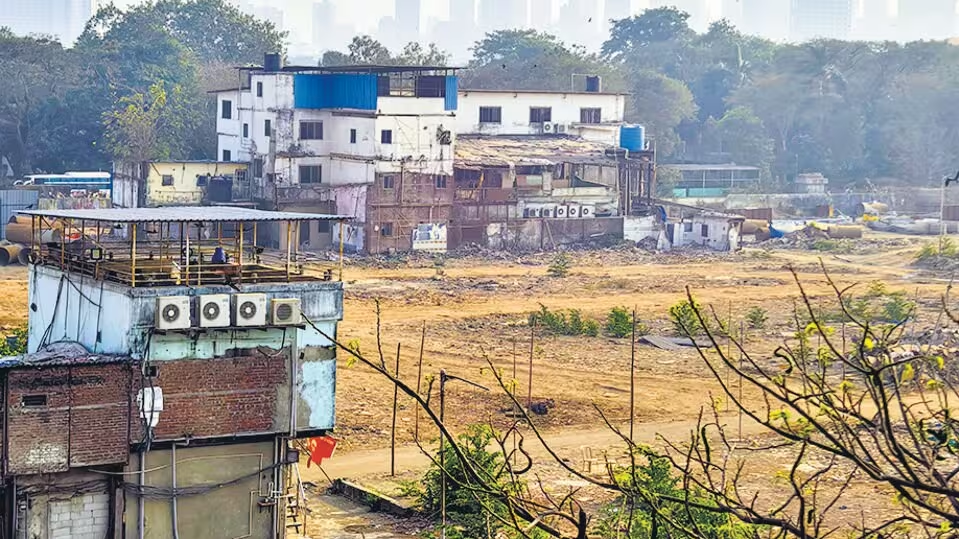
Mumbai Worli STP Land Review Triggers Policy Re-think
Mumbai’s urban infrastructure planning has come under renewed scrutiny as the Maharashtra government conducts a detailed review of decisions that reduced land earmarked for the Worli Sewage Treatment Plant (STP), highlighting tensions between housing priorities and essential sanitation infrastructure in one of India’s fastest-growing megacities. The reassessment follows a recent court order that halted development on land reserved for critical utility expansion, underscoring broader challenges in balancing sustainable city planning with competing land uses.
State urban development officials, along with representatives from the Brihanmumbai Municipal Corporation (BMC) and the Slum Rehabilitation Authority (SRA), met this week to examine the implications of shrinking the STP’s reserved area from roughly 2.8 hectares to about 1.8 hectares — a change instituted last year without a formal amendment to the city’s development plan. Questions now centre on whether the decision undermines the plant’s operational capacity and future expansion potential at a time when the metropolis grapples with growing wastewater volumes.The review was triggered after the Bombay High Court intervened, ordering a stop to construction of transit camp buildings on the plot and directing authorities to clarify the legal basis for the land reduction. The court also flagged concerns about procedural irregularities, as objections from civic engineers regarding encroachments on utility land were reportedly overlooked in project approvals.
Urban planners point out that sewage treatment facilities are a backbone of climate-resilient cities, as they protect coastal ecosystems and public health while enabling responsible urban growth. Mumbai, with its dense population and coastal geography, faces acute pressure on sanitation systems as residential and commercial development expands. Reducing land for an STP in a prime location like Worli, they say, risks constraining future capacity precisely when climate change and rising water use demand robust wastewater management. Experts emphasise that proper allotment and protection of utility land — including clear development plan provisions — are essential for sustaining essential services.The government review is also drawing political attention. Civic advocates and opposition councillors have urged clearer guidelines to prevent approvals on municipal or utility-reserved land without rigorous legal oversight, arguing that piecemeal decisions could weaken infrastructure resilience and erode public trust. One municipal letter to the BMC emphasised that any SRA endorsements on such land should require transparent consent and audit mechanisms to safeguard critical urban assets.
From a policy standpoint, the episode highlights the complexities of land governance in Mumbai, where high land values and development pressures often intersect with essential public goods. As the city pursues climate adaptation goals — including improved sanitation coverage and flood mitigation — ensuring that utility expansion is protected in planning frameworks will be vital. Analysts suggest that formalising procedures for land reservation and modification under the Maharashtra Regional and Town Planning Act could reduce future conflicts and align urban growth with sustainability imperatives.
As the review progresses, the focus will be on reconciling housing and rehabilitation needs with the imperative of robust sanitation infrastructure, with stakeholders advocating for clear, legally sound mechanisms that support equitable and climate-resilient urban development.