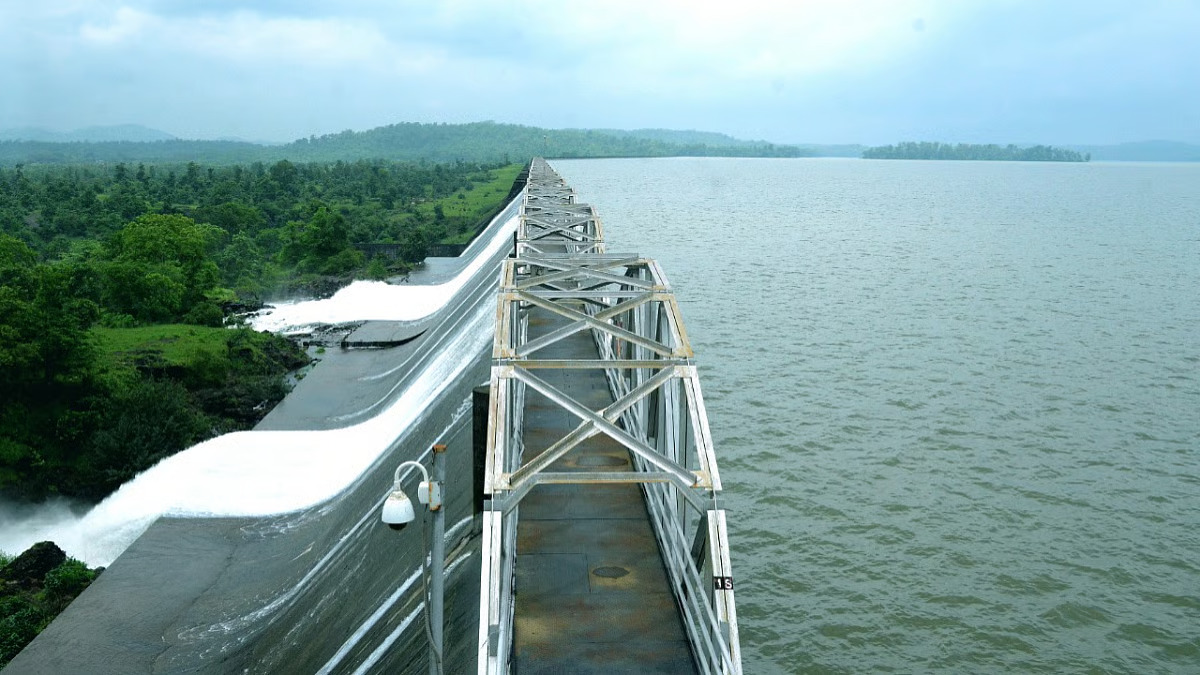
Mumbai’s municipal water system continues to hold a moderate reserve despite the city’s intensifying heatwave, with civic authorities reporting that the Mumbai water reservoir levels currently stand at nearly half of the total storage capacity. Officials say the available reserves should sustain daily supply for the metropolitan population until the arrival of the monsoon, though rising temperatures and increasing consumption are placing pressure on the city’s water infrastructure.
According to the latest civic data, the seven reservoirs that supply drinking water to Mumbai collectively store more than 6.8 lakh million litres of water, equivalent to roughly 47 per cent of their total designed capacity. This level is slightly stronger than the reserves recorded at the same point last year, offering a measure of stability as the city enters one of its hottest pre-monsoon periods. Urban climate experts note that the Mumbai water reservoir levels remain closely tied to seasonal rainfall patterns. A relatively strong monsoon during the previous year helped replenish the reservoirs, allowing the city to begin the summer with improved water availability compared with earlier drought-prone seasons.
However, municipal officials monitoring the system warn that prolonged heat conditions could accelerate water loss through evaporation. With temperatures in parts of Mumbai touching around 40 degrees Celsius during the week, the combination of heat and humidity is also pushing up domestic consumption across residential neighbourhoods. Civic engineers overseeing water distribution say the city currently delivers roughly 4,000 million litres of potable water every day to homes, businesses and public facilities. The supply is drawn from seven key reservoirs located across the Mumbai metropolitan region, including systems that rely on both local catchments and distant river basins.
Despite this large supply network, the city’s water management challenge extends beyond reservoir storage. Municipal records indicate that a significant share of the daily supply does not reach consumers due to leakages, pipeline losses and unauthorised connections. Experts say reducing these losses is one of the most cost-effective ways to strengthen urban water security without expanding supply infrastructure. Urban planners also point out that the demand curve for Mumbai’s water is steadily rising. Rapid urbanisation, expanding housing developments and increasing commercial activity have pushed the city’s daily requirement above current supply levels, highlighting the need for long-term augmentation projects.
To address the projected demand gap, civic authorities are advancing new infrastructure initiatives designed to diversify water sources. Among them is a planned dam project in the Palghar district that is expected to add several hundred million litres of water to the city’s network each day once completed. In parallel, engineers are working on a desalination facility along the western coast that would convert seawater into potable supply, marking Mumbai’s first major experiment with large-scale desalination technology. Urban sustainability specialists say such projects will play a crucial role in maintaining stable Mumbai water reservoir levels in the future, especially as climate variability increases pressure on rainfall-dependent water systems. For now, authorities indicate that existing reserves remain adequate, but long-term resilience will depend on reducing distribution losses, diversifying sources and strengthening climate-adaptive water planning.
Mumbai Water Reservoir Levels Remain Stable During Heatwave