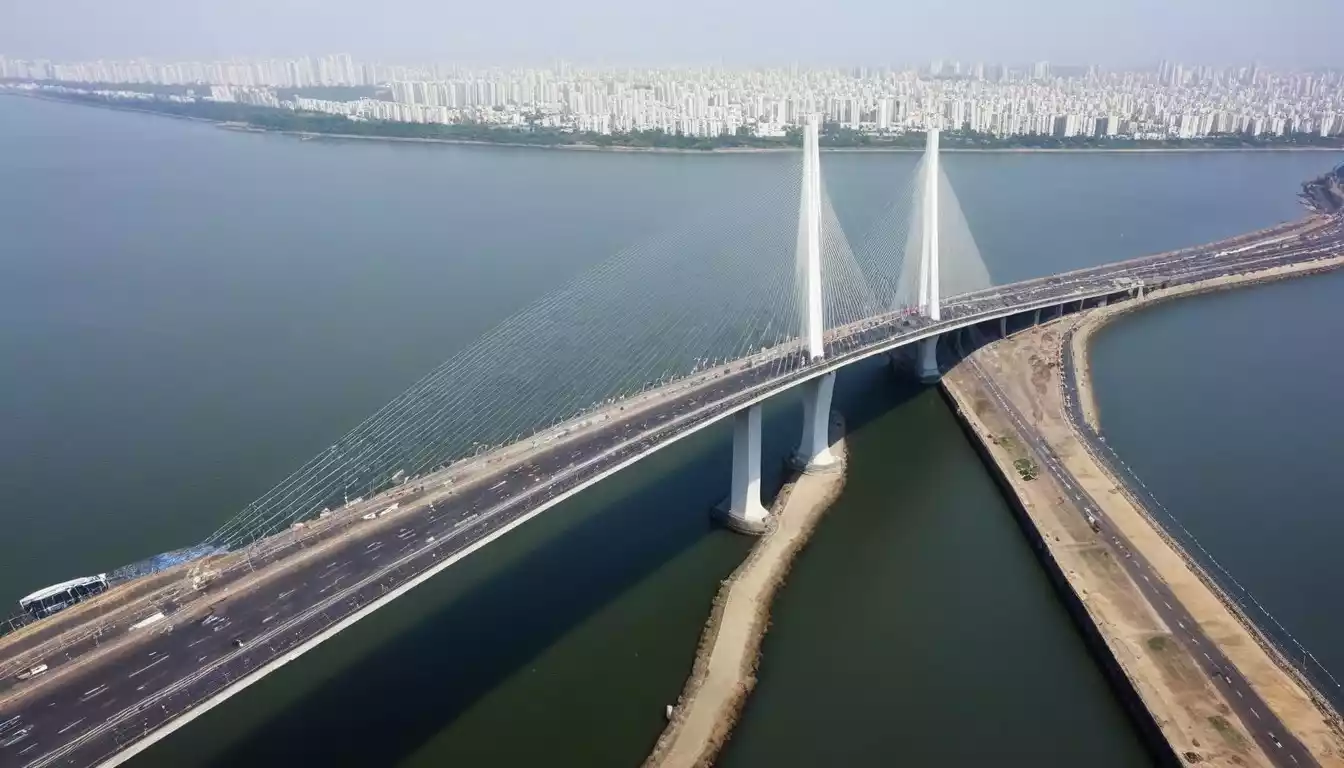
Work on the Versova-Bandra Sea Link (VBSL), part of the northern phase of the Mumbai Coastal Road project, has advanced 900 metres into the Arabian Sea, marking the farthest point from the city’s shoreline. Officials indicate that this milestone reflects both engineering progress and the city’s ongoing efforts to upgrade critical transport infrastructure while addressing urban mobility challenges.
The VBSL, formally named the Swatantryaveer Savarkar Sagari Setu, is designed to connect Bandra, Versova, Juhu, and Carter Road through a series of cable-stayed bridge connectors. Construction involves complex marine piling and the establishment of floating ready-mix concrete plants at pillar locations. Urban planners and engineers note that the project’s execution over open sea presents far greater technical challenges than similar creek or river crossings due to variable seabed conditions, strong currents, and changing tidal patterns. Spanning 25 kilometres, the VBSL will serve as a key nodal intersection linking the existing Bandra-Worli Sea Link to the south, the Nariman Point-Worli phase of the Coastal Road, and the northern Versova-Kandivali-Bhayandar corridor. Transportation analysts emphasise that the project is expected to significantly reduce commute times between western suburbs, potentially cutting journeys from nearly two hours to under 20 minutes, thereby improving urban connectivity and reducing congestion on peripheral arterial roads.
The Maharashtra State Road Development Corporation (MSRDC) is overseeing construction, with a projected operational life of 100 years. Urban development experts highlight that the project has also required environmental clearances for the removal of 1,585 mangroves, reflecting the regulatory complexities inherent in balancing ecological considerations with infrastructure expansion. Climate-resilient engineering measures, including deep-sea foundations and reinforced connectors, are being deployed to address rising sea levels and increasingly unpredictable weather patterns. Economists suggest that the VBSL could stimulate localized real estate growth, particularly in northern suburbs, while also supporting broader economic activity by streamlining freight and commuter traffic. However, planners caution that long-term urban sustainability will depend on integrating public transport alternatives, green corridors, and pedestrian-friendly infrastructure alongside major vehicular arteries.
Officials report that about 26% of physical progress has been achieved since work resumed in the past few years, with the project slated for completion by December 2028. Analysts observe that completing the VBSL on schedule could serve as a template for other large-scale coastal and marine infrastructure projects in India, demonstrating the balance between engineering ambition, climate adaptation, and urban mobility needs.
Mumbai Versova-Bandra Link Advances Toward Completion