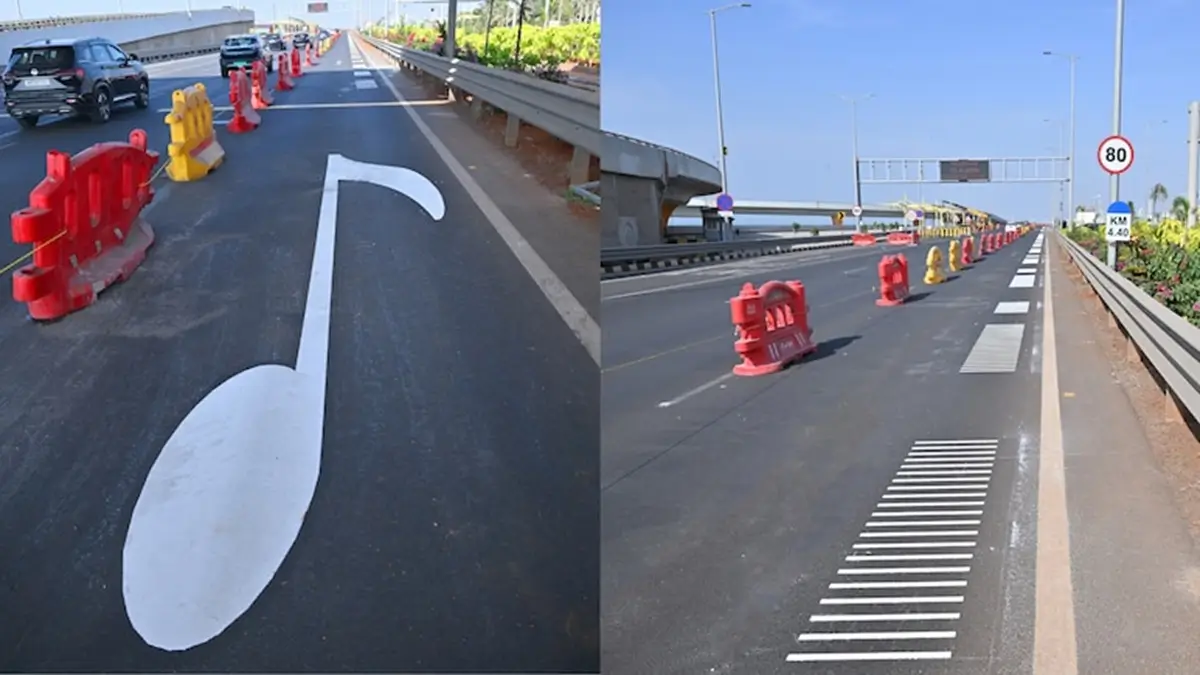
Mumbai has quietly added an unusual layer to its expanding road infrastructure: sound. Along a short stretch of the city’s Coastal Road corridor, vehicles travelling at a steady speed now trigger a recognisable melody generated not by speakers, but by the road surface itself. The installation marks India’s first functional “musical road”, blending traffic calming with experimental urban design at a time when cities are rethinking how infrastructure influences driver behaviour.
The musical segment is located on the northbound carriageway of the Coastal Road, formally named Dharmaveer Chhatrapati Sambhaji Maharaj Marg, shortly after vehicles emerge from the tunnel section between Nariman Point and Worli. The engineered strip spans roughly half a kilometre and is designed to work only within a specific speed band, encouraging motorists to maintain consistent speeds rather than accelerate abruptly. Transport officials involved in the project say the intervention is rooted in road safety rather than novelty. Musical roads have been tested internationally as a way to improve driver alertness on long, monotonous corridors. By rewarding steady driving with an audible cue, planners aim to reduce sudden braking and lane weaving—common contributors to accidents on high-speed urban arterials.
The melody selected for Mumbai is Jai Ho, a globally recognised composition associated with the film Slumdog Millionaire. Engineers note that familiarity plays an important role: recognisable tunes make it easier for drivers to perceive when they are travelling too fast or too slow, as the music becomes distorted outside the optimal speed range. Technically, the system relies on precisely cut rumble strips embedded into the asphalt. Each groove is placed at calculated intervals and depths so that tyre vibrations produce specific sound frequencies when vehicles pass over them. When driven at the intended speed—roughly comparable to regulated coastal road limits—these vibrations align to form musical notes. The vehicle cabin acts as a natural amplifier, allowing occupants to hear the tune even with windows closed.
Urban planners point out that the concept builds on an existing safety tool. Conventional rumble strips are widely used to alert distracted drivers, but musical variants refine the same principle into a more engaging feedback mechanism. Importantly, the system requires no electricity, sensors, or digital hardware, aligning with low-energy infrastructure principles increasingly favoured in climate-conscious city planning. Clear signage has been installed ahead of the musical section to alert motorists and guide speed choice, reducing the risk of sudden braking. Officials say the installation will be closely monitored to assess whether it improves speed discipline and reduces minor collisions along the corridor.
Beyond its novelty, the project reflects a broader shift in Mumbai’s infrastructure thinking—one that combines engineering with behavioural design. As the city invests heavily in roads, metros, and coastal defences, such pilots offer insight into how infrastructure can subtly influence safer, more predictable mobility without relying solely on enforcement. If the trial demonstrates measurable safety benefits, similar treatments could be considered for other long urban corridors. For now, Mumbai’s musical road stands as an experiment in how infrastructure can communicate with users—literally—while advancing people-first, resource-efficient transport design.
Mumbai Unveils Indias First Musical Road Featuring Jai Ho Tune On Coastal Road