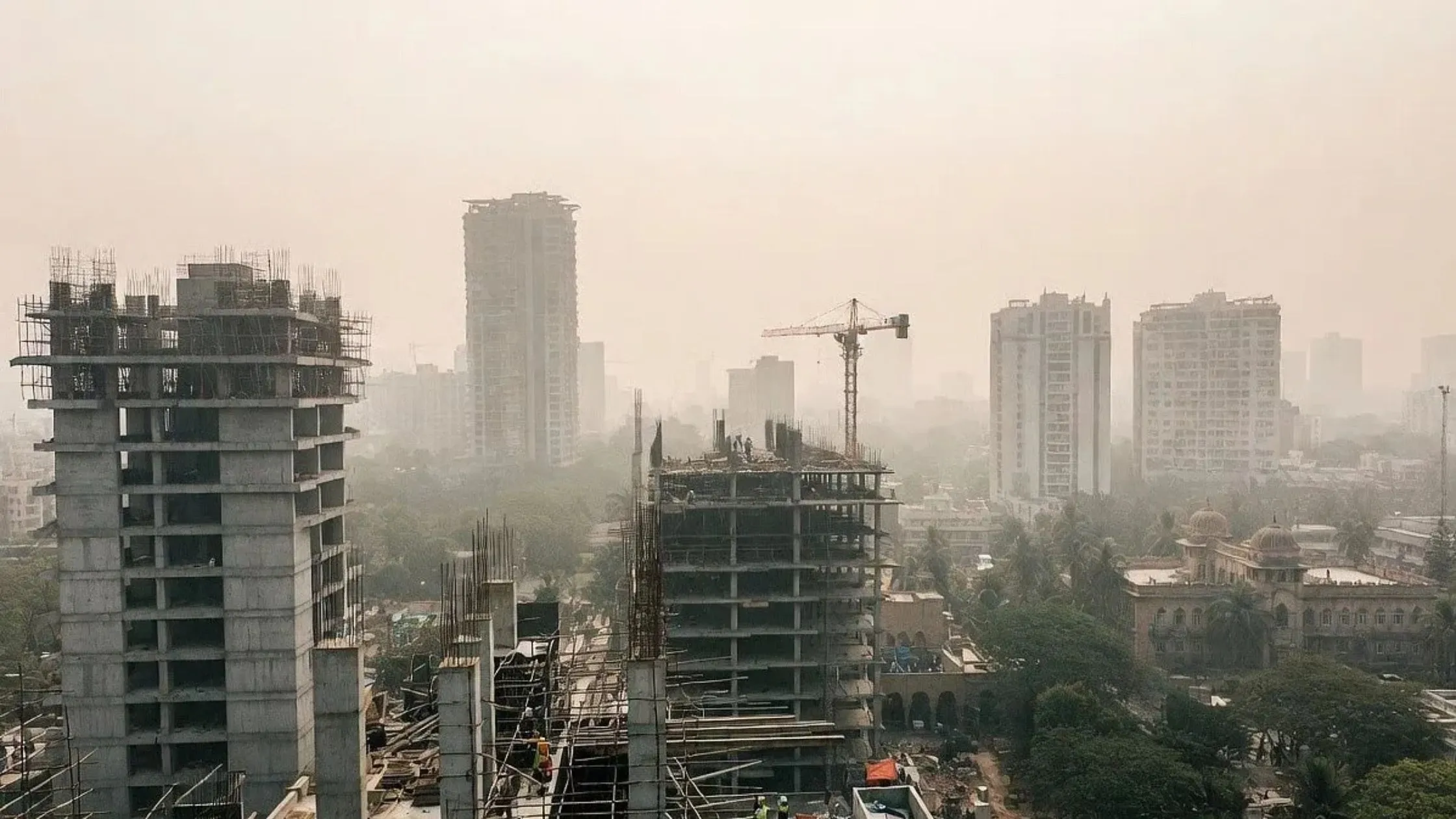
Mumbai’s civic administration is set to deploy advanced digital tools to tighten oversight of air pollution generated at construction sites, marking a significant shift in how India’s largest city plans to regulate dust and emissions amid an ongoing infrastructure boom. The state government has directed the Brihanmumbai Municipal Corporation to implement an integrated system using Internet of Things (IoT) sensors and artificial intelligence to track air quality levels dynamically across active construction zones.
The move follows sustained concern within the state legislature over deteriorating air quality in several Mumbai neighbourhoods, particularly those witnessing simultaneous metro, rail, highway, and private real estate construction. Legislators flagged rising particulate matter levels near dense construction clusters, highlighting gaps in on-ground compliance with dust mitigation norms such as debris covering, controlled demolition practices, and material handling. Under the proposed framework, real-time data from site-level sensors will be aggregated and analysed using AI-based models to identify pollution spikes, compliance failures, and repeat offenders. Civic officials said the system is expected to move enforcement away from manual inspections toward evidence-based action, allowing faster penalties, work stoppages, or corrective measures where thresholds are breached.
Urban environment experts note that construction dust remains one of Mumbai’s most persistent air quality challenges, especially during the dry season. Unlike vehicular pollution, which can be monitored through fixed stations, construction-related emissions are localised and transient, making them harder to regulate without continuous monitoring. A technology-led approach could help bridge this gap by linking pollution data directly to specific sites and contractors. The discussion has also drawn attention to the reliability and interpretation of air quality data. State officials have reiterated that regulatory decisions will be anchored to officially monitored data streams rather than third-party datasets, while also acknowledging the need to integrate information across agencies. The Maharashtra Pollution Control Board and the Central Pollution Control Board are expected to play a role in aligning standards and validation protocols.
Beyond Mumbai, concerns were raised about pollution linked to large earthworks and transport corridors in rapidly developing zones around the metropolitan region, including areas leading to new airports and logistics hubs. Officials acknowledged that dust suppression measures such as water spraying alone are insufficient and need to be supplemented with better planning, enforcement, and public awareness. The technology push aligns with broader national commitments under the National Clean Air Programme, which targets substantial reductions in fine particulate matter across identified urban centres by the middle of the decade. State-level action plans are already in place for multiple cities, focusing on construction practices, transport emissions, and waste handling.
Public health remains a central concern in the debate. While recent health department assessments have not indicated a sharp rise in respiratory illness linked solely to pollution spikes, urban health specialists caution that cumulative exposure—particularly for children, older residents, and outdoor workers—requires proactive mitigation rather than reactive responses. If implemented effectively, the IoT- and AI-based monitoring system could reshape how Mumbai balances rapid infrastructure expansion with environmental responsibility. For a city building at unprecedented scale, the success of this initiative may determine whether growth can proceed without deepening long-term public health and climate risks.
Mumbai Turns To AI For Air Quality Oversight