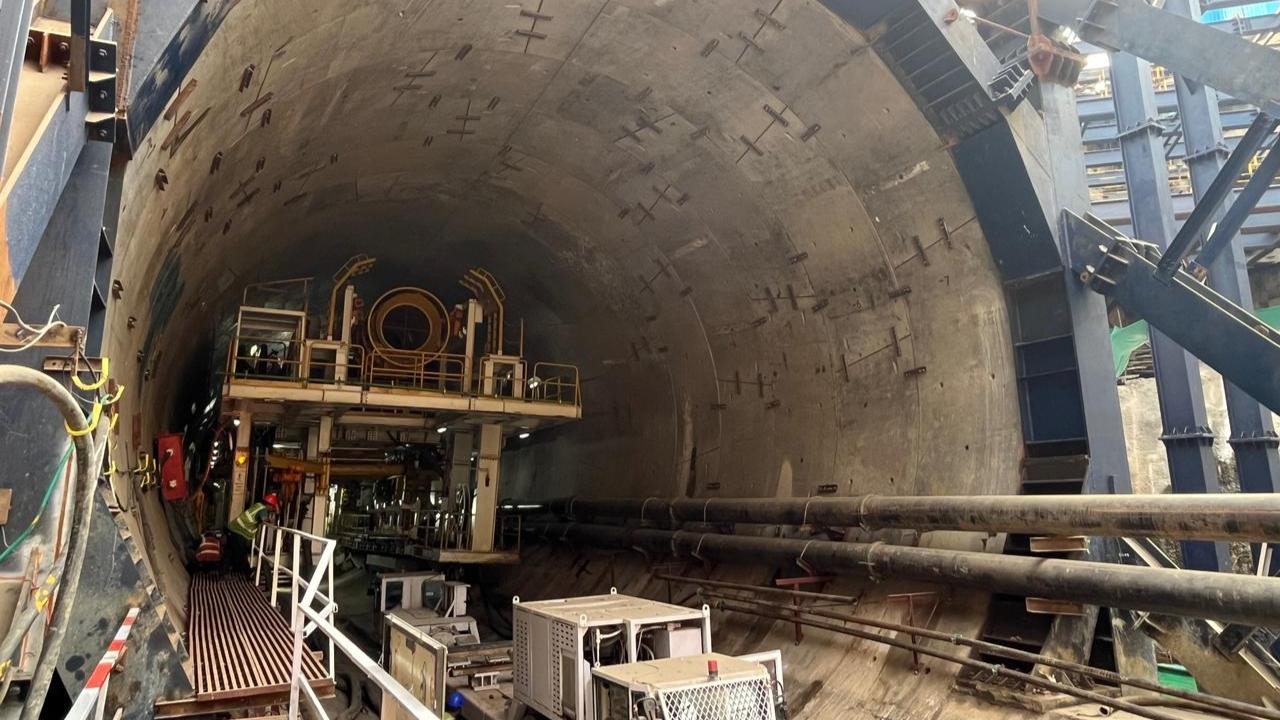
Mumbai’s push to expand underground road infrastructure has entered a critical construction phase, with excavation now underway on a major east–west tunnel corridor beneath South Mumbai. The development marks a significant milestone in the city’s effort to decongest surface roads while building climate-resilient, high-capacity mobility systems.
The Orange Gate Marine Drive tunnel, a key component of the metropolitan region’s long-term transport strategy, has transitioned from preparatory work to full-scale boring operations. A tunnel boring machine has already advanced several dozen metres into the alignment, signalling the start of continuous excavation along one of the most technically demanding urban routes in India. The project involves the construction of twin underground tunnels spanning several kilometres, designed to link the eastern waterfront with the city’s western seafront. This connection is expected to reduce travel time between key business districts while providing an alternative to heavily congested arterial roads.
Engineering complexity remains a defining feature of the project. The tunnel alignment runs deep below the surface—reaching significant depths—and passes beneath existing railway lines and metro infrastructure. Such conditions require high-precision tunnelling methods, advanced monitoring systems, and strict adherence to safety protocols to prevent disruption to overground transport networks. Urban infrastructure experts point out that slurry shield tunnel boring machines, like the one deployed here, are particularly suited for coastal and water-bearing soil conditions. These machines help maintain ground stability while excavating through mixed geology, which is essential in a city like Mumbai where sub-surface conditions vary significantly across short distances.
The Orange Gate Marine Drive tunnel is also being positioned as part of a broader integrated mobility network. Once operational, it is expected to connect seamlessly with projects such as the coastal road and trans-harbour link, creating a multi-layered transport grid that distributes traffic more efficiently across the metropolitan region. From an environmental standpoint, underground corridors offer potential benefits by reducing surface congestion and associated emissions. However, experts caution that such gains depend on how effectively these projects are integrated with public transport and demand management strategies, rather than simply expanding road capacity.
The pace of initial excavation suggests that project authorities are aiming to maintain momentum during this phase, which is often the most time-intensive in tunnelling projects. Early progress can help establish construction benchmarks and reduce risks associated with delays in later stages. For Mumbai, where land constraints limit the expansion of surface infrastructure, underground solutions are becoming increasingly central to urban planning. The success of this tunnel will likely influence future investments in subterranean transport corridors across the city.
As excavation progresses, attention will remain on safety, engineering precision, and timely execution. If delivered as planned, the corridor could reshape connectivity in South Mumbai while contributing to a more resilient and efficient urban transport system.
Mumbai Tunnel Project Advances With TBM Drive Progress